Hoshizaki F2A-FS Freezer — Part B: Charging the System and Finding the Evaporator Leak in Nettleton, MS
Commercial Refrigeration, Hoshizaki Freezer Repair, North Mississippi
Hoshizaki F2A-FS Freezer — Part B: Charging the System and Finding the Evaporator Leak in Nettleton, MS
This is Part B of a real service call on a Hoshizaki F2A-FS commercial freezer in Nettleton, MS. If you missed the first part of the story where I walked through the initial diagnostic, you can read it here: Hoshizaki F2A-FS Freezer — Part A: Diagnostic in Nettleton, MS.
Picking Up Where We Left Off in Nettleton, MS
I am Dan Southwick with S.I. Service Group out of Tupelo, and this Hoshizaki F2A-FS commercial freezer in Nettleton, MS has turned into a solid example of how a low-charge situation can lead you straight to an evaporator problem. In Part A, I found the cabinet temperature sitting at 79°F, confirmed the compressor windings were good, and determined the system was low on refrigerant. The unit uses R290 refrigerant with a factory charge of 4.2 ounces, so there is not much room for error. When that charge is low, you know the refrigerant went somewhere, and the job becomes finding where it escaped.
Step 1: Charging the System with R290 and Bringing the Freezer Back to Life
Before I could track down the leak, I needed the system running. On a small R290 system like this Hoshizaki freezer, accuracy matters. We are only dealing with 4.2 ounces total, so I charged by weight using my scale and followed proper R290 handling procedures. R290 is a hydrocarbon refrigerant, which means it is flammable. It works very efficiently in low-charge commercial freezers, but it has to be respected. No open flames, good ventilation, and controlled recovery and charging are all part of doing this safely and by the book. A few extra minutes of care is worth avoiding a dangerous situation in a busy commercial kitchen.
Once I brought the charge back up, the compressor started up smoothly, and the Hoshizaki F2A-FS began cooling again. Pressures and temperatures started to move in the right direction. That told me the compressor itself was not the problem; the windings had already tested good, and now the system responded the way it should when properly charged. For a restaurant owner in North Mississippi, this is the kind of news you want to hear: the heart of the system is fine, but we still have to deal with why that refrigerant disappeared in the first place.
Step 2: Electronic Leak Check — Hunting for the Refrigerant Loss
With the freezer running, my next job was to find the leak. I used an electronic leak detector rated for hydrocarbon refrigerants and worked slowly around the entire system. That means checking the compressor area, service valves, filter drier, capillary tube connections, and any brazed joints. On a commercial freezer with R290, you do not want to guess. You want to confirm exactly where that refrigerant is escaping, especially when you are dealing with such a small total charge. Even a tiny leak can cause big performance issues and frost patterns that do not make sense to the untrained eye.
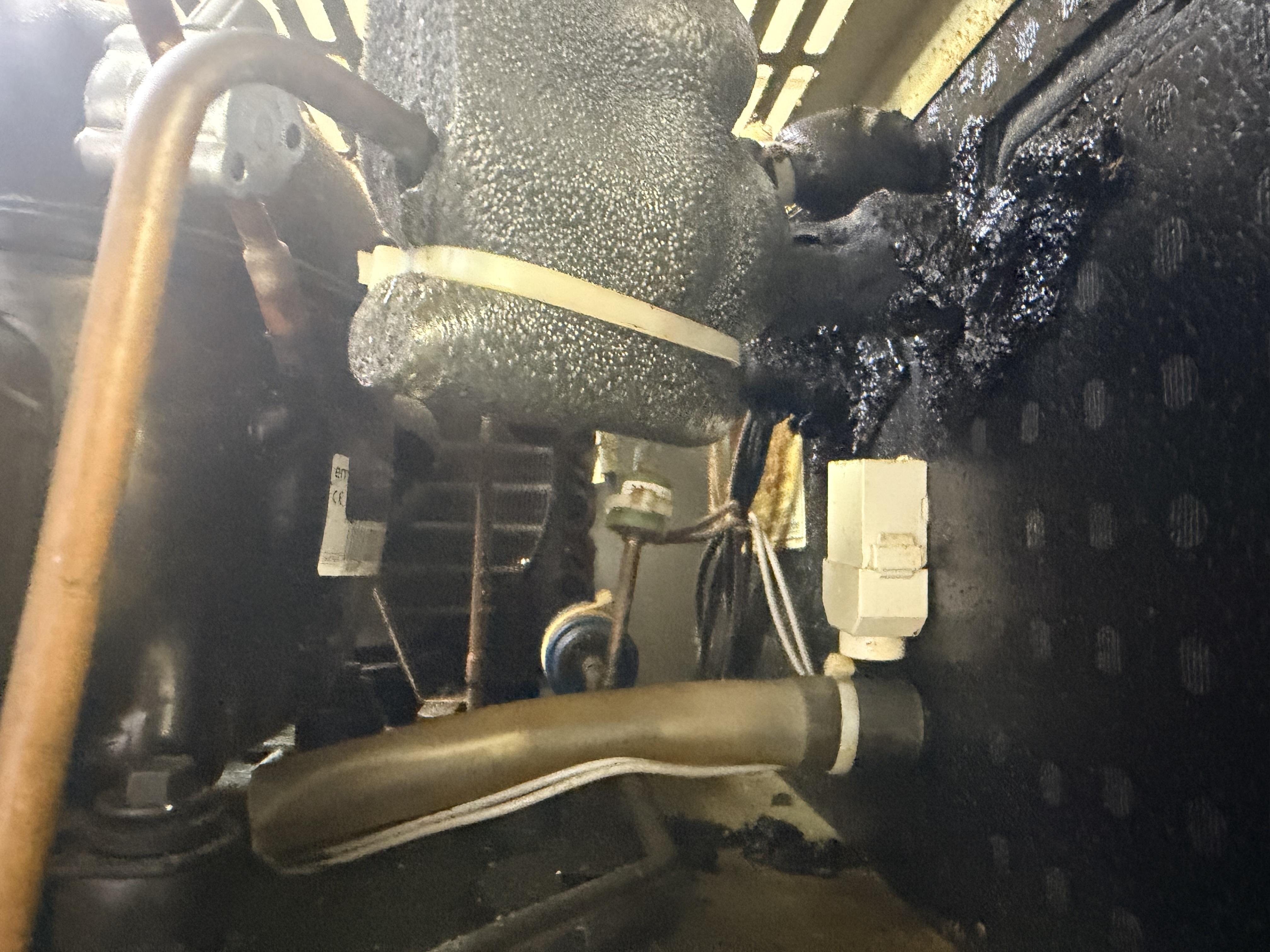
Around the compressor section, I also saw frosting that lined up with low-charge symptoms. That frost is a visual clue that the refrigerant is not boiling off where it is supposed to. It is not proof of the leak location by itself, but it tells me the system has been starving for refrigerant for a while. From there, I kept following the piping and continued scanning every joint and component with the detector until I moved inside the cabinet to the evaporator section.

Step 3: Confirming the Evaporator Coil Leak Inside the Cabinet
Inside the Hoshizaki F2A-FS cabinet, you will see the evaporator coil mounted behind the fan assembly. That is the part that actually gets cold. The fan pulls warm air from the cabinet across that coil, the refrigerant inside absorbs the heat, and the air going back into the cabinet drops in temperature. If you own a restaurant in Nettleton or anywhere in North Mississippi, that evaporator is what keeps your food safely frozen while you are focused on running the kitchen.
When I ran the electronic leak detector across the evaporator coil and the connecting tubing, it alarmed consistently in one area. I repeated the pass from multiple angles to be sure, and the result was the same: the evaporator was leaking. On these coils, leaks can develop from corrosion, vibration, or a weak spot in a bend or joint. Over time, moisture and cleaning chemicals can also take a toll on the aluminum fins and copper tubing. Once that tubing wall gets thin enough, R290 will find its way out. That is exactly what happened here — a textbook Hoshizaki freezer evaporator leak.
What an Evaporator Coil Replacement Involves on a Hoshizaki Freezer
Once I confirmed the evaporator coil was the failure point, the next step was to get the correct replacement on order. For this Hoshizaki F2A-FS, I use OEM or OEM-equivalent parts that match the original design, capacity, and R290 rating. That keeps the system operating the way the manufacturer intended and helps avoid nuisance issues down the road. With evaporators, the fit and connection locations matter. A “close enough” coil may look similar, but it can create airflow problems or mounting headaches that show up later as uneven temperatures or ice buildup.
Replacing an evaporator coil on a commercial freezer like this typically involves recovering the refrigerant, opening the sealed system, removing the old coil and any related piping, installing the new evaporator, and then brazing in the new connections. After that, I pull a deep vacuum, confirm there are no leaks, and recharge with the correct amount of R290 by weight. Finally, I run the freezer through a full operating check, watching cabinet temperature, frost pattern, and compressor behavior. It is not a five-minute fix, but when it is done correctly, you get a reliable, tight system that holds temperature the way your kitchen needs it to.
Why Proper R290 Handling Matters for Your Commercial Freezer
R290, also known as propane refrigerant, is common in newer reach-in freezers and coolers across North Mississippi. It is efficient, environmentally friendly compared to older refrigerants, and works very well in small, self-contained systems. The tradeoff is that it is flammable, so you have to treat it with respect. That means using equipment rated for hydrocarbons, avoiding sparks and open flames, and keeping the charge amount within the manufacturer’s limits. On this Hoshizaki F2A-FS, that 4.2-ounce charge is carefully engineered. Overcharging or undercharging can both create problems, from poor performance to safety concerns.
When we handle R290 systems, we are not just trying to “get it cold again.” We are looking at the long-term reliability and safety of the equipment in a real-world kitchen environment. That is the standard I bring to commercial refrigeration repair in Nettleton, MS and throughout North Mississippi: accurate diagnostics, correct parts, and careful handling of refrigerants, especially hydrocarbons like R290.
Wrapping Up This Visit: Part on Order, Return Trip Scheduled
For this service call, the conclusion of Part B is straightforward: the compressor is healthy, the system responds properly when charged, and the leak has been positively identified at the evaporator coil inside the cabinet. I have the replacement evaporator on order, matched to this Hoshizaki F2A-FS model and its R290 refrigerant requirements. Once the part arrives, I will be back out in Nettleton next week to pull the charge, swap the coil, pressure test, evacuate, and recharge the system so this restaurant can get back to relying on their freezer without worrying about temperature swings or hidden refrigerant loss.
If you run a restaurant or commercial kitchen in North Mississippi and you notice your freezer warming up, running constantly, or showing unusual frost patterns, it is worth having the system checked before food loss or equipment damage gets expensive. In this case, catching the issue early meant we could save the compressor and focus on the real culprit: a leaking evaporator coil. The part is on order, the return visit is scheduled, and we will finish the repair in Part C — follow along for the conclusion of this Hoshizaki freezer evaporator leak story.
FAQ: Hoshizaki Freezer Evaporator Leaks and R290 Refrigerant
- Q: What are the common signs of an evaporator coil leak in a Hoshizaki freezer?
A: Typical signs include rising cabinet temperature, longer run times, uneven frost on the evaporator, and sometimes frost or sweating on the suction line near the compressor. A confirmed diagnosis usually involves checking the refrigerant charge and using a leak detector around the evaporator area inside the cabinet. - Q: Can I just top off the refrigerant instead of replacing a leaking evaporator?
A: Topping off a leaking system is a temporary bandage at best. On a small R290 system with a 4.2-ounce charge, even a small leak will keep coming back. You may get a short-term improvement, but you will still be losing refrigerant, and performance will suffer. The right repair is to find the leak and replace the failing component, especially when the evaporator coil is compromised. - Q: Is R290 refrigerant safe to use in my commercial kitchen?
A: Yes, when it is installed and serviced correctly. R290 is flammable, but the charge amounts in reach-in freezers and coolers are small and carefully controlled. Using proper equipment, following safety procedures, and keeping the system tight and leak-free are the keys to safe operation in a restaurant or commercial kitchen setting. - Q: How long does an evaporator coil replacement usually take on a Hoshizaki F2A-FS?
A: It depends on access and how the unit is installed, but generally plan on several hours. The process includes recovering the refrigerant, replacing the coil, brazing connections, pressure testing, pulling a vacuum, and recharging with the correct amount of R290. I also like to allow time to verify proper operation and stable cabinet temperature before calling the job complete. - Q: Are OEM-equivalent parts okay for my Hoshizaki freezer, or do I need strictly OEM?
A: For critical components like evaporator coils, I use OEM or high-quality OEM-equivalent parts that match the original specifications and are approved for R290 use. The goal is to keep your Hoshizaki freezer operating as designed, with proper capacity, airflow, and reliability, so you are not fighting recurring issues after the repair.