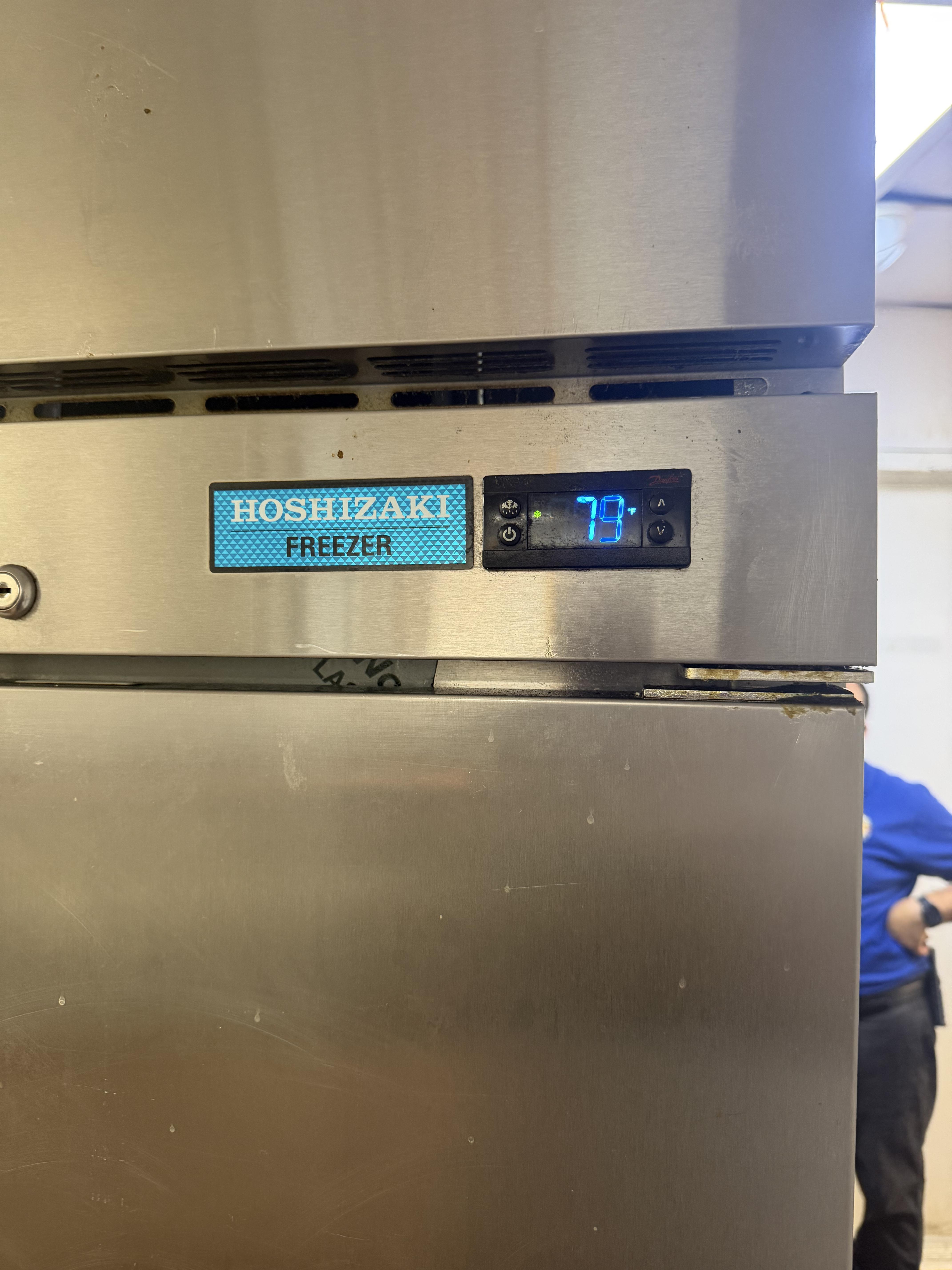
Hoshizaki F2A-FS Freezer Not Holding Temperature — Part A: Diagnostic in Nettleton, MS
Commercial Refrigeration, Hoshizaki Freezer Repair, Nettleton MS
Hoshizaki F2A-FS Freezer Not Holding Temperature — Part A: Diagnostic in Nettleton, MS
I’m Dan Southwick with S.I. Service Group out of Tupelo, MS, and this is a real-world diagnostic walkthrough on a Hoshizaki F2A-FS commercial freezer in a Nettleton, MS restaurant that had climbed all the way up to 79°F inside. In this Part A, I’ll cover exactly how I approached the call, what I tested, and why I made each decision before moving on to charging and leak detection in Part B.

The Service Call: Commercial Freezer Not Holding Temperature in Nettleton, MS
This call came from a restaurant in Nettleton, MS that relies heavily on their upright freezer for daily operations. They reported the unit “not holding temp” and product starting to soften. By the time I arrived, the internal display on the Hoshizaki F2A-FS was sitting at 79°F. For a commercial freezer that should be around 0°F or colder, that’s basically room temperature — not good for food safety or product quality.
When you’re running a restaurant or any commercial kitchen in North Mississippi, a warm freezer is more than an inconvenience. It’s lost product, lost revenue, and a lot of stress on your staff. That’s why a structured, step-by-step diagnostic is important. Guessing at parts is expensive; working the problem methodically keeps costs and downtime under control.
Step 1: Confirming the Exact Model and Refrigerant (R290, 4.2 oz)

Before I ever hook up gauges or start testing components, I confirm exactly what I’m working on. This unit was a Hoshizaki F2A-FS commercial freezer, serial K72376G. The data plate also told me it was charged with R290 refrigerant (propane) with a factory charge of 4.2 ounces.
That information matters a lot. R290 systems are small-charge, high-efficiency units. Four-point-two ounces is not much refrigerant, so even a small leak can have a big effect on performance. It also means you need to be careful, use the right tools, and follow proper safety practices. In our North Mississippi commercial refrigeration work, I see more and more equipment using R290, so identifying the refrigerant right up front is part of my standard checklist.
Step 2: Testing the Compressor Windings — Is the Heart of the System Healthy?
With the model and refrigerant confirmed, my next question was simple: Is the compressor itself okay? When a commercial freezer is not holding temperature, people often jump straight to “bad compressor.” Sometimes that’s true, but a lot of compressors get replaced that are actually still good. That’s an expensive mistake for a restaurant owner in Nettleton or anywhere else.
I pulled access to the compressor compartment and performed a compressor winding test with my meter. I checked resistance across the windings and verified that nothing was shorted to ground. The readings came back where I’d expect them to be for this style of compressor. In plain language: the compressor windings tested GOOD, and the compressor was mechanically sound.
Since the compressor checked out, I could move on from “is the heart dead?” to “why can’t the system move heat like it should?” That usually points you toward airflow issues, restrictions, or refrigerant charge problems.
Step 3: Low Refrigerant — Suspecting a Leak in the R290 System
Next, I evaluated the refrigeration system itself. Fans were running, the box was warm, and the compressor was operating, but the freezer just wasn’t pulling down. On a healthy Hoshizaki F2A-FS, you should see that temperature start dropping once the system kicks in. Here, it just hung high and barely moved. That behavior is a classic sign of a system that isn’t moving enough refrigerant through the circuit.
After checking pressures and performance, I determined the system was low on refrigerant. On an R290 unit with only 4.2 ounces in it, you don’t have to lose much before capacity drops off hard. When a system is low, there’s almost always a reason — and that reason is usually a leak somewhere in the refrigerant circuit. That was the case here: I suspected a leak in the system that had allowed R290 to escape over time.
At this point in the diagnostic, I had a good picture:
- Hoshizaki F2A-FS freezer, serial K72376G, in a working restaurant in Nettleton, MS
- R290 refrigerant system, factory charge 4.2 oz, not cooling — box at 79°F
- Compressor windings tested good — mechanically sound, not the main culprit
- System low on refrigerant, pointing toward a leak that needed to be found and addressed
Why a Careful Diagnostic Matters for North Mississippi Businesses
In our commercial refrigeration service across North Mississippi, including places like Nettleton and Tupelo, I see a lot of the same patterns. Freezers that “just aren’t cold,” units that get topped off with refrigerant without ever finding the leak, and parts replaced based on guesswork. That might get you by for a short time, but it usually comes back around as another breakdown and another bill.
My approach on jobs like this Hoshizaki freezer repair is to treat each step like a piece of a puzzle. Confirm the model, identify the refrigerant, verify the compressor, then look at charge and leaks. When parts are needed, I stick with OEM or OEM-equivalent components so the equipment performs the way the manufacturer designed it to. That gives restaurant owners a better shot at long-term reliability instead of just a short-term patch.
What Comes Next: Charging and Leak Detection (Part B Preview)
Once I confirmed the freezer was low on R290 and the compressor was healthy, the next step was to get the system properly charged and then track down exactly where that refrigerant was going. On a small-charge R290 system, accuracy really matters. You want the right amount of refrigerant in the system and a thorough leak check before you put the unit fully back into service.
In Part B of this case study, I’ll walk through how I handled the charge, brought the Hoshizaki F2A-FS back online, and used a leak detector to pinpoint the problem area so it could be properly addressed and the restaurant could get back to business.
In Part B, we charged the system, got it running, and ran the leak detector — which told us exactly where the R290 was going.
FAQ: Commercial Freezer Not Cooling, R290, and Compressor Testing
1. My commercial freezer is not holding temperature. What should I check first?
Start with the basics: make sure the doors are closing properly, gaskets are in good shape, and nothing is blocking airflow around the evaporator or condenser. Check that the unit has power, fans are running, and the temperature setpoint is reasonable. If the box is still warm, you’ll likely need a technician to check refrigerant charge, system pressures, and components. In many cases, like this Hoshizaki F2A-FS in Nettleton, the issue ends up being a low refrigerant charge or a leak in the system.
2. What is R290 refrigerant, and is it safe in my kitchen?
R290 is a high-purity propane used as a refrigerant in many newer commercial freezers and coolers. It’s efficient and has a low environmental impact compared to some older refrigerants. The systems are designed with small charges — like the 4.2 ounces in this Hoshizaki F2A-FS — and specific safety controls. When installed and serviced properly, R290 systems are safe for commercial kitchens. The key is using proper procedures and equipment whenever the sealed system is opened or charged.
3. How do you test a compressor to see if it’s bad?
A common first step is a compressor winding test with a meter. I check resistance between the compressor terminals and from each terminal to ground. I’m looking for open windings, shorted windings, or a short to ground. I also listen to how the compressor starts and runs. On this Nettleton job, the windings tested good and the compressor ran normally, which told me the problem was somewhere else in the system, not the compressor itself.
4. Can I just add refrigerant if my freezer is low?
Topping off a system without finding the leak is usually a short-term fix. On small-charge R290 systems, it’s especially important to be accurate with the charge and to track down where the refrigerant went. If you only add gas and never address the leak, you’ll likely be calling for service again when the charge drops and the box warms up. A proper repair includes charging to spec and then performing a thorough leak check, just like I did on this Hoshizaki freezer repair case.
5. How important is using OEM or OEM-equivalent parts on a Hoshizaki freezer?
On equipment like the Hoshizaki F2A-FS, sticking with OEM or good OEM-equivalent parts helps keep performance where it should be. Controls, fans, and sealed system components are all designed to work together. When I service commercial refrigeration in North Mississippi, I aim to match the manufacturer’s design as closely as possible so you get reliable temperature control and fewer repeat problems down the road.