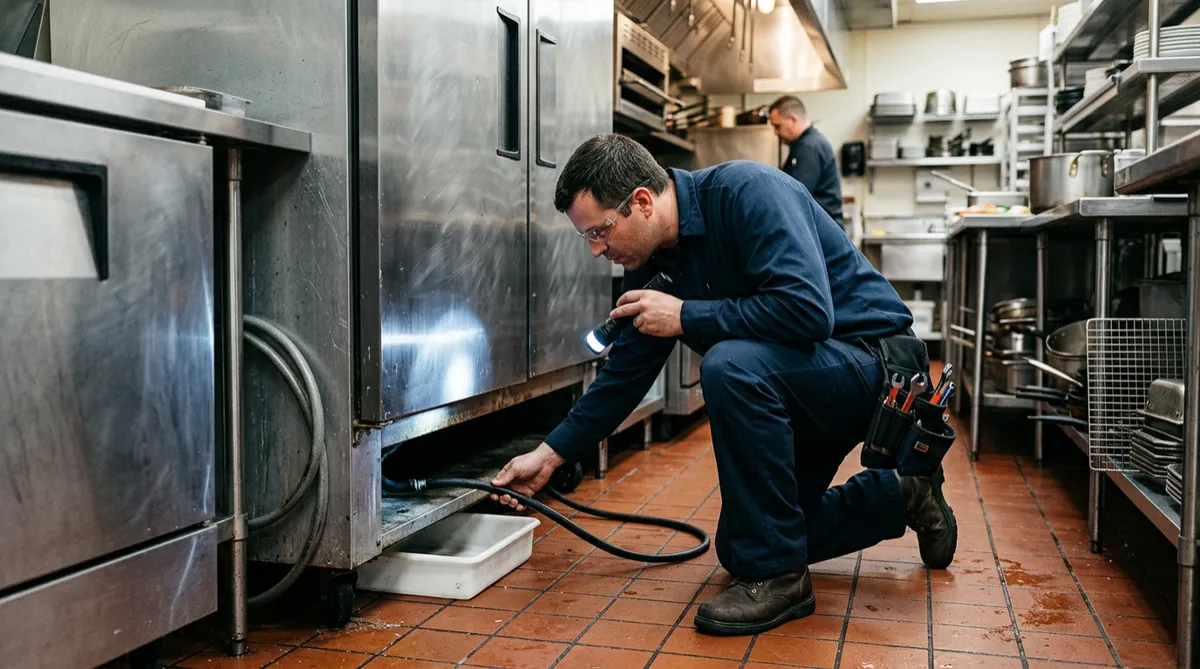
North Mississippi Cooler Temperature Problems: Check the Probe First
North Mississippi Cooler Temperature Problems: Check the Probe First
The display says 37°F, but the milk on the top shelf feels warm. The cooler has run all morning, and someone suspects the compressor. Before we condemn a major part, we check what the controller is being told. A bad probe, misplaced sensor or faulty controller can make a walk-in or reach-in look like it has a larger refrigeration problem.
We see it in restaurants, convenience stores, churches, schools and gas-station coolers around Tupelo, Saltillo, Verona, Plantersville, Baldwyn, New Albany, Pontotoc, Corinth, Ripley, Guntown and Booneville. The display can look fine while the food isn’t.
Why can a cooler display read 37°F while the food is warm?
A digital controller does not measure every carton, pan or shelf. It reads one probe in one spot, then decides when to cool, stop cooling or run a defrost cycle. If that probe is out of calibration, loose, damaged or sitting in the wrong place, the display can report a believable number that does not match the product.
Placement matters. A probe zip-tied to the evaporator coil or sitting in a cold-air stream can mislead the controller. Air temperature swings with each door opening; food changes more slowly. Put a separate, calibrated thermometer in a glass of water or product simulant and let it settle. If the thermometer has a calibration feature, follow its instructions; an ice-water slurry is a useful reference near 32°F. Don’t trust a 36–38°F display without checking.
What do a bad sensor and a failing controller look like?
A probe that drifts can make the box swing up and down, run too long, or shut off before the product is cold. A damaged sensor may make the display jump, show an error code, or go blank. A loose connection can create an intermittent fault. A controller can fail too, but the screen alone does not prove which part is at fault.
We also find settings that were changed by someone trying to quiet an alarm or stop a unit from running. Setpoint, differential and defrost parameters work together. Changing them without checking the equipment can hide a real problem, start unnecessary short-cycling, or leave the box warm through a defrost period. Write down any visible error code and the time it appeared. Don’t start changing programming to see what happens.
Older boxes may use a mechanical thermostat or cold-control instead of a digital controller and separate probe. The control is simpler, but worn contacts, a tired sensing bulb or poor placement can still cause erratic cycling. A new digital display is not automatically a better diagnosis; the circuit and sensor both need to be checked.
What can staff check without opening the refrigeration equipment?
Start with the easy things. Check that the door closes and no carton blocks the evaporator or return-air path. Note whether the display is lit, any error code, and whether the reading changes. Use a separate thermometer in representative product or a product simulant, not air just after the door opens. From a safe position, listen for the evaporator fan and check whether the compressor appears to run. Don’t remove covers, touch wiring or reach near moving parts. A running fan doesn’t prove the unit is cooling; a quiet compressor doesn’t prove it has failed.
If the display is blank, record that too. Check only that the unit’s normal controls and display are on; don’t open a wiring compartment or try to bypass a control. Keep the door shut as much as practical while you arrange service.
When is it time for a refrigeration technician?
Anything involving refrigerant, controller wiring, replacing a probe or controller, or changing defrost parameters belongs with a refrigeration technician. Those checks require the right tools and a diagnosis of the whole control sequence. A technician can compare the controller reading with a calibrated instrument, check probe resistance and placement, inspect the control wiring safely, and confirm that the controller is actually calling for cooling.
This is also how we separate a control problem from a bad compressor. If the controller thinks the box is already cold, it may not call for cooling at all. If the probe lies or the controller output is wrong, the compressor may stay off, cycle at the wrong time, or run almost nonstop. A failed compressor is one possibility, but so are a failed start component, airflow trouble, a control fault or a refrigeration issue. We verify the call for cooling and what the system does with it before calling the compressor bad.
For related symptoms, see our guide to ice buildup in a walk-in cooler. If the cooler is not cooling at all, our walk-in cooler repair page covers the service side.
Why do Mississippi heat and a Friday rush make this costly?
North Mississippi heat and humidity load a cooler hard. Every door opening adds warm, damp air. A busy Friday evening can mean repeated trips in and out while product is still being loaded. If the controller is under-reading or the probe is poorly placed, that extra load can push a borderline box over the edge before anyone notices.
That’s why we don’t treat a display number as a food-safety reading. Cold holding should stay at 41°F or below. A health inspector checks food temperatures, not just the controller screen. If food has been above 41°F, treat it as a food-safety call: follow your food-safety procedures and get the cooler assessed promptly. Don’t serve or keep product based only on a reassuring display.
We work on commercial refrigeration for kitchens and businesses around Tupelo and nearby towns, including Saltillo, Verona, Baldwyn, New Albany and Corinth. A controller fault can be a small repair, but waiting through a lunch service or a Friday rush can turn a misleading reading into lost product and a longer shutdown.
Quick answers about cooler temperature controls
Should I lower the setpoint if the food feels warm?
No. Verify the product temperature with a separate thermometer, note the controller reading and error code, and call for service if the readings disagree. Lowering the setpoint can mask the symptom without correcting a bad probe or control.
Can I replace the probe myself?
Don’t. Probe placement, wiring and controller settings affect how the equipment cycles. Have a refrigeration technician test and replace it if needed.
Is a 37°F display enough to show the food is safe?
No. Check the food or a representative product simulant with a separate thermometer. Cold holding is 41°F or below; if product has been above that, treat it as a food-safety issue.
If a cooler is showing a normal number but the product is warm, call S.I. Service Group in Tupelo for commercial refrigeration service. If the cooler has been above 41°F, tell us that when you call so the food-safety concern is clear.