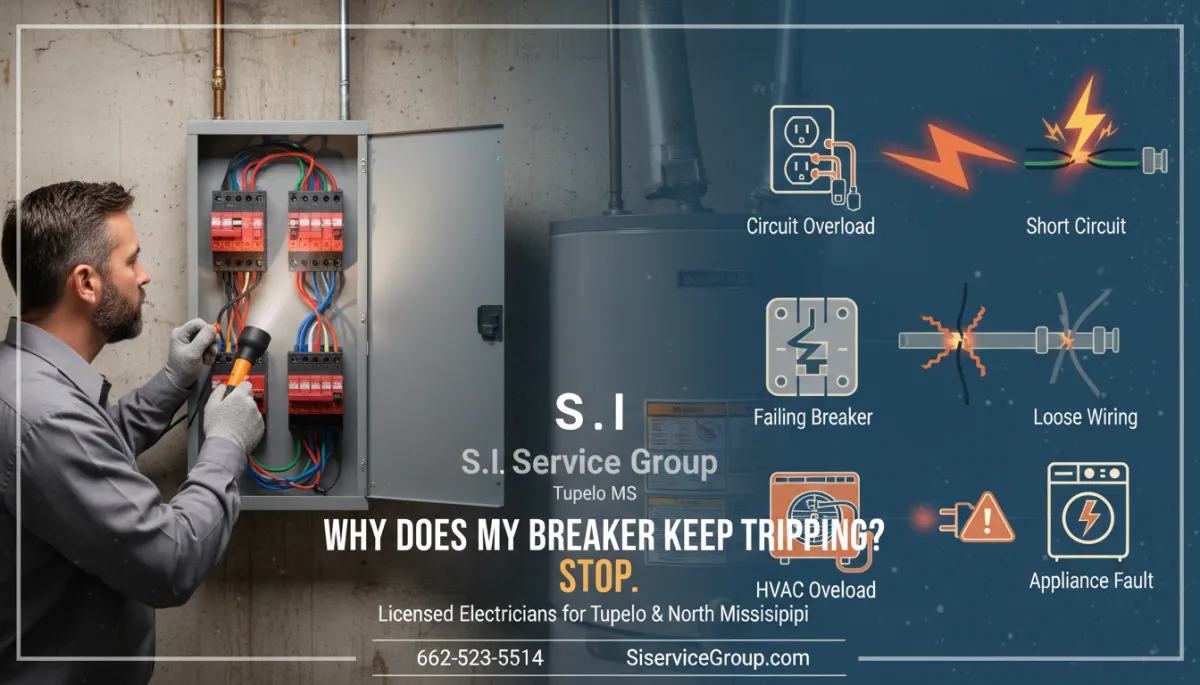
Breaker Keeps Tripping? Call Tupelo Electrician
Electrical Safety, Breaker Keeps Tripping Tupelo MS
Why Your Breaker Keeps Tripping in Tupelo, MS (And When to Call a Licensed Electrician)
If a circuit breaker in your Tupelo or North Mississippi home keeps tripping and you keep resetting it, stop. That breaker is trying to protect you from a serious electrical problem that can lead to fire, shock, or major damage if you ignore it. Here is what is really happening, why it matters, and when you need a licensed electrician in Tupelo to step in.
1. Hook: Your Breaker Keeps Tripping. Stop Resetting and Read This.
Picture this: You are in your Tupelo kitchen, running the microwave, coffee maker, and toaster. Suddenly, everything goes dark on that side of the house. You head to the panel, flip the breaker back on, and keep going. Ten minutes later—click—it trips again. Now you are annoyed, maybe even worried, but you keep resetting it because you need the power back on.
As a licensed, safety-focused electrician serving Tupelo, Amory, Corinth, Saltillo, Oxford, Fulton, Mantachie, and the rest of North Mississippi, I will tell you plainly: repeatedly resetting a tripping breaker is not fixing the problem—it is ignoring a warning. That breaker is doing its job under the electrical code Tupelo follows (2011 NEC with local amendments), and forcing it to stay on can turn a manageable issue into a fire emergency inside your walls. When in doubt, it is always safer to call a licensed electrician and have the circuit tested properly instead of guessing.
2. How a Circuit Breaker Really Works (Plain English)
A circuit breaker is not an inconvenience. It is a precision safety valve designed to shut power off before wires overheat, insulation melts, and fire starts. Every branch circuit in your panel is rated for a specific amount of current—typically 15 or 20 amps for most North Mississippi homes. When more current flows than the circuit is designed to handle, or when electricity starts flowing where it should not (like through a short or ground fault), the breaker opens the circuit and cuts power instantly or within seconds, depending on the situation.
Inside each breaker is a thermal and sometimes magnetic mechanism that measures how much current is flowing. If it sees too much for too long, or a sudden spike, it trips. That is not the breaker being “touchy”—that is it preventing your wiring from turning into a heating element inside your walls. Especially in older North Mississippi homes with aging wiring, that protection is critical. If your breakers or panel are more than a couple of decades old, it may be time to review your options for an upgrade—see our related guide on electrical panel upgrades for older Tupelo homes for a deeper look.

3. Real Causes of a Constantly Tripping Breaker
Circuit Overload (Most Common)
This is the number one reason we get “breaker keeps tripping Tupelo MS” calls. An overload happens when you simply have too many things drawing power on the same circuit—space heaters, hair dryers, microwaves, window units, or multiple kitchen appliances all on one 15- or 20-amp line. The breaker senses more current than it is rated for and trips to protect the wiring from overheating. Overloads are common in older homes across Tupelo, Amory, and Corinth that were wired long before today’s power-hungry devices. In many of these cases, the real fix is to add dedicated circuits or upgrade the panel, which is work that should always be handled by a licensed electrician in Tupelo.
Short Circuit (Dangerous – Wire Touching Wire)
A short circuit is more serious. It happens when a hot (live) wire touches another hot wire or a neutral wire directly, giving electricity a shortcut with very low resistance. That causes a sudden surge in current, and the breaker trips instantly. Shorts can be caused by damaged insulation, a screw or nail through a cable, a failed outlet, or an internal fault in an appliance. In North Mississippi’s older housing stock, we see shorts from brittle insulation and DIY wiring all the time—and they are a major fire risk if not corrected quickly. A short circuit is one of the top reasons to schedule electrical service instead of trying to reset the breaker repeatedly.
Ground Fault (Dangerous – Live Wire Touching Ground)
A ground fault happens when a hot wire touches a ground path—like a grounded metal box, appliance case, or a wet surface. Instead of electricity flowing safely through the neutral, it leaks to ground. This is especially dangerous around water—bathrooms, kitchens, laundry rooms, garages, and outdoor outlets. That is why modern codes require GFCI protection in those areas. A ground fault can shock you, and it can also cause arcing and fire if the connection is poor or intermittent. If you have older outlets in your Tupelo or Saltillo home with no GFCI protection, you are at higher risk and should strongly consider a safety-focused electrical inspection in Mississippi.
Worn or Failing Breaker (Age and Wear)
Breakers are mechanical devices. After 10–15 years of use—especially in panels that have seen multiple storms, power surges, and frequent tripping—they can weaken or fail. A worn breaker might trip too easily, or worse, fail to trip when it should. Many homes in Tupelo, Oxford, and Fulton still rely on panels from the 1980s and 1990s. When we inspect those panels, we often find breakers that are loose, corroded, or simply at the end of their service life, especially after the recent North Mississippi ice storms and power disruptions. In those cases, we may recommend targeted breaker replacement or a full panel upgrade, as outlined in our article on electrical panel upgrades in older Tupelo homes.
Loose Wiring Connections (Arcing Hazard, Fire Risk)
Every connection point in your system—inside the panel, at outlets, switches, and junction boxes—must be tight and secure. Over time, heat, vibration, and expansion and contraction can loosen screws and lugs. Loose connections create resistance, which creates heat and arcing. That combination can cause a breaker to trip, but it can also start a fire if the breaker does not respond quickly enough. In older North Mississippi homes, we see many uncovered junction boxes and loose wire nuts, which increase this risk dramatically. A thorough, code-focused inspection by S.I. Service Group can identify and correct these hazards before they lead to damage.
HVAC System Drawing Too Much Power (Common in Summer)
When the summer heat hits Tupelo, Amory, and Corinth, air conditioners and heat pumps run hard. If your HVAC system is on a marginal circuit, has failing components (like a compressor or fan motor), or was never wired correctly, the breaker protecting that circuit may start tripping frequently. A tripping AC breaker is a red flag—either the unit is drawing more power than it should, the wiring is undersized, or the breaker is failing. Because S.I. Service Group is licensed in both HVAC and electrical, we see this problem constantly in North Mississippi and know how to diagnose whether the issue is the equipment, the circuit, or both.
Appliance with an Internal Fault
Sometimes the wiring and breaker are fine, and the problem is a single appliance. A failing dryer heating element, a leaky water heater, a bad microwave, or a worn-out window unit can all cause a breaker to trip repeatedly. In these cases, unplugging or disconnecting that one appliance makes the breaker behave again. That is a strong clue you are dealing with an appliance fault rather than a whole-house wiring problem—but it still needs professional attention, especially if the unit is hard-wired. An experienced electrician can test the circuit and confirm whether you need appliance repair or electrical repair in Tupelo MS.
A breaker stuck between on and off is a clear sign it has tripped and needs attention.
4. How to Tell Which Type of Problem You Have
While only proper testing by a licensed electrician can give you a definitive answer, there are some patterns you can watch for in your Tupelo or North Mississippi home:
- Likely overload: Breaker trips after several minutes when multiple devices are running (space heater, hair dryer, vacuum, toaster, etc.) on the same circuit. Turning one or two off stops the tripping. This is common in older homes in Saltillo, Oxford, and Fulton where circuits were not designed for today’s loads.
- Likely short circuit: Breaker trips immediately when you plug in a certain device, flip a particular switch, or reset the breaker. You may hear a pop, see a spark, or notice scorch marks at an outlet or switch. This is dangerous and needs immediate professional attention.
- Likely ground fault: Breaker or GFCI trips when using outlets near water—kitchen, bathroom, laundry, garage, or outside—or when an appliance gets damp. You may feel a slight tingle before it trips. This is a serious shock hazard.
- Possible failing breaker: Breaker feels loose, won’t stay reset, or trips with very little load on the circuit. Other circuits with similar loads are fine. Panel may be older or show rust or corrosion. In Tupelo, many panels still running under the 2011 NEC era are simply past their prime.
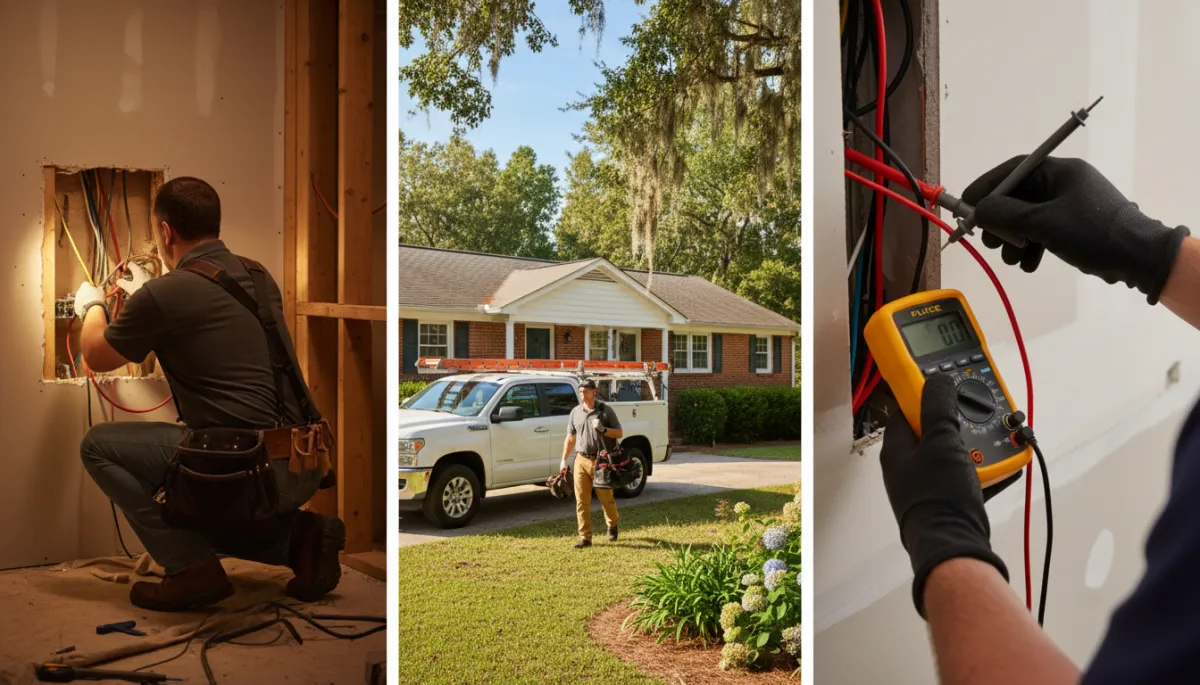
5. The Danger of Repeatedly Resetting a Tripping Breaker
When your circuit breaker keeps tripping in North Mississippi, every reset without fixing the root cause is a roll of the dice. If the problem is a short circuit, ground fault, or loose connection, you are forcing current through a damaged or unsafe path. That can cause:
- Overheating of wires inside your walls—especially dangerous in older homes with outdated wiring or insulation.
- Arcing at loose connections, outlets, and switches—tiny electrical explosions that can ignite wood framing or insulation.
- Failure of the breaker itself—repeated high-stress trips can weaken the breaker so it no longer responds correctly when you really need it.
In an area like Tupelo, where many homes were built before today’s stricter safety standards and have weathered years of storms and power surges, ignoring these warning signs is one of the quickest paths to an electrical fire. The breaker is trying to protect you. Listen to it. When you are unsure, it is always safer to call a licensed electrician than to keep flipping the switch and hoping for the best.
6. What You Can Safely Do vs. What Requires a Licensed Electrician
Safe Steps for Homeowners
- Unplug devices on the tripping circuit. If you know which outlets or rooms go dead when the breaker trips, unplug everything there, then reset the breaker once. If it stays on, plug items back in one at a time to see which one triggers the trip again. If a single appliance causes the trip, stop using it and call for service on that appliance or the circuit.
- Check for obvious damage. Without removing covers, look for scorch marks, melted plastic, or a burning smell at outlets, switches, and the panel. If you see or smell anything suspicious, do not reset the breaker again.
- Use extension cords correctly—temporarily. If one room’s circuit is overloaded, you can temporarily move a device (like a window unit) to a different outlet on another circuit using a properly rated extension cord while you wait for service. This is a short-term workaround, not a fix.
When You Need a Licensed Electrician (No Exceptions)
- The breaker trips immediately when reset, even with everything unplugged.
- You smell burning, see smoke, or notice heat at the panel, outlets, or switches.
- Lights flicker, dim, or buzz when large appliances start or stop on the same circuit.
- Your HVAC breaker trips repeatedly, or the outside disconnect looks corroded or damaged.
- Your panel is older, rusted, or has unlabeled or double-tapped breakers (two wires under one terminal).
In Tupelo, Amory, Corinth, Saltillo, Oxford, Fulton, and Mantachie, S.I. Service Group can diagnose and fix these issues safely and up to code. We work within Tupelo’s adopted 2011 NEC standards and local amendments, so your repairs are not only safe but compliant with local requirements.
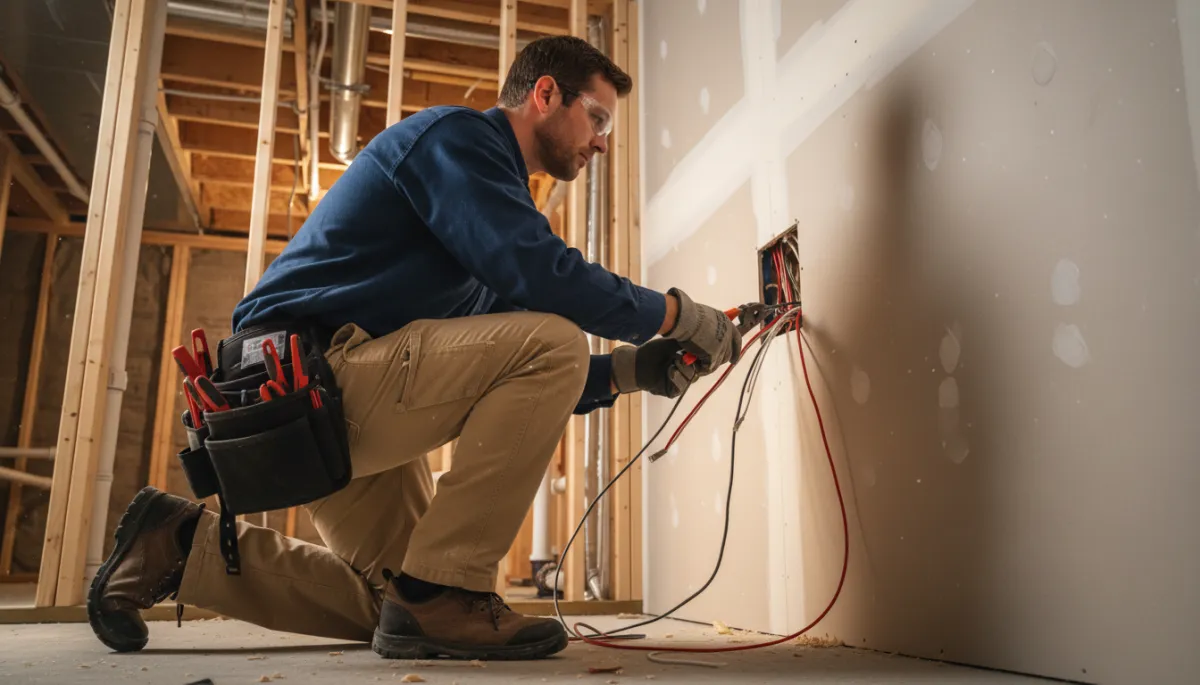
Professional testing finds hidden faults that homeowners cannot see or safely access.
7. When a Tripping Breaker Means You Need a Panel Upgrade
Sometimes the issue is not just one bad breaker or one overloaded circuit—it is that your entire electrical system is undersized for modern life. If you live in an older home in Tupelo, Saltillo, or Oxford, and you are constantly juggling which appliances can run at the same time, your panel may simply not have enough capacity or available spaces for dedicated circuits. Common signs you may need a panel upgrade include:
- Frequent tripping on multiple circuits across the home, not just one problem breaker.
- No room left in the panel for new breakers, or lots of tandem (skinny) breakers already installed.
- Adding major loads—like a new HVAC system, EV charger, hot tub, or workshop equipment.
A properly sized, modern panel with correctly labeled breakers, adequate ampacity, and room for dedicated circuits dramatically reduces nuisance tripping and improves safety. To learn more, see our in-depth guide: Electrical Panel Upgrades in Tupelo, MS – What You Need to Know and our additional article on panel upgrades for older Tupelo homes. If you are already dealing with multiple tripping breakers, those resources and a professional inspection are your next steps.
8. Arc Fault vs. Ground Fault vs. Overloaded Circuit – Knowing the Difference
Modern electrical protection goes beyond simple breakers. You will hear terms like AFCI (arc-fault circuit interrupter) and GFCI (ground-fault circuit interrupter). Understanding the difference helps explain why your breaker is tripping and why upgrades may be recommended under newer code standards—even though Tupelo currently enforces the 2011 NEC with local amendments.
- Overloaded circuit: Too much current on a circuit. Standard breakers trip when the current exceeds the rating for too long. This protects wires from overheating. It is about how much electricity is flowing.
- Ground fault: Electricity is leaking to ground (often through water, a person, or a grounded surface). GFCIs monitor the difference between hot and neutral; if current is “missing,” they trip in fractions of a second to prevent shock. This is about where electricity is going.
- Arc fault: Electricity is jumping (arcing) across a gap due to a damaged conductor, loose connection, or crushed cord. AFCIs detect the signature of these dangerous arcs and trip to prevent fires. This is about how electricity is flowing.
Even though Tupelo has not yet adopted the very latest NEC editions, many homeowners are choosing to upgrade to AFCI and GFCI protection voluntarily for added safety—especially in bedrooms, living areas, and wet locations. For more on how newer NEC changes affect you, see our article: What the 2023 NEC Code Changes Mean for Tupelo Homeowners and our companion piece on 2023 NEC code changes for Tupelo homeowners.
9. Fire Risk of Ignored Electrical Problems in Older North Mississippi Homes
North Mississippi has a large number of older homes—farmhouses, mid-century ranches, and 1970s–1990s subdivisions from Tupelo to Mantachie and Corinth. Many of these houses still have outdated wiring, older panels, and undersized circuits. Add today’s heavy electrical loads, plus storm-related power surges and generator use, and you have a perfect storm for electrical fires if problems are ignored.
Common risk factors we see during inspections across North Mississippi include:
- Overloaded and frequently tripping breakers that homeowners keep resetting instead of repairing.
- Uncovered junction boxes in attics, crawlspaces, and garages with loose wire nuts and exposed splices.
- Overlamped light fixtures (bulbs with wattage higher than the fixture rating) creating excess heat near old, dry wood framing.
- Outdated panels with corroded breakers, double-tapped lugs, and no room for dedicated circuits.
Combine those issues with severe weather—like the January 2026 ice storm that left thousands in Oxford and surrounding areas without power for days—and you have homeowners relying on generators and makeshift wiring just to keep lights and heat on. One wrong move with a backfed generator or overloaded circuit can end in tragedy. Regular electrical inspections and prompt repairs are not a luxury in North Mississippi; they are a critical part of keeping your family and home safe. To understand what a thorough inspection includes, review our detailed guide on electrical inspections in Mississippi.
10. FAQ: Breaker Keeps Tripping in Tupelo, MS
Why does my breaker keep tripping in Tupelo, MS?
In North Mississippi homes, the most common reasons a breaker keeps tripping are circuit overloads (too many devices on one circuit), short circuits (damaged wiring or devices causing a direct fault), ground faults (electricity leaking to ground, often near water), and aging or failing breakers. Seasonal loads—like space heaters in winter or AC units in summer—often push older systems over the edge. The only way to know for sure is to have a licensed electrician in Tupelo test the circuit and the panel with proper equipment.
Is it safe to reset a tripping breaker?
It is generally safe to reset a breaker once after you have unplugged devices on that circuit and checked for obvious damage. If it trips again, especially immediately, do not keep resetting it. That is your signal to call a licensed electrician. Repeated resets without fixing the cause can overheat wiring and increase fire risk, especially in older North Mississippi homes.
What causes breakers to trip repeatedly in North Mississippi homes?
Repeated tripping usually points to an ongoing problem rather than a one-time glitch. Common causes include:
- Undersized or overloaded circuits serving kitchens, bathrooms, or window units.
- Damaged cords, outlets, or switches creating intermittent shorts or ground faults.
- Loose connections in junction boxes or inside the breaker panel causing arcing.
- Aging panels and breakers that no longer perform reliably under load.
If your breaker keeps tripping in Tupelo, MS, treat it as a sign that something needs attention—not as a nuisance to work around. A quick service call now is cheaper than repairing fire or smoke damage later.
When should I call an electrician vs. reset it myself?
You can safely reset a breaker one time after unplugging devices and checking for obvious damage. If any of the following are true, stop and schedule electrical service instead:
- The breaker trips immediately when you reset it, even with everything unplugged.
- You smell burning, see smoke, or feel heat at the panel, outlets, or switches.
- The same breaker has tripped more than twice in a short period.
- Your home has older wiring or an older panel and you are not sure what is on each circuit.
At that point, you are beyond “DIY reset” territory and into “protect your home and family” territory. Let a pro handle it.
How much does it cost to fix a tripping breaker in Mississippi?
Costs depend on the cause. In the Tupelo area, you can expect:
- Service call and diagnosis: roughly $75–$200, depending on time and complexity.
- Standard breaker replacement: about $150–$300 total.
- GFCI/AFCI breaker replacement: often $200–$500, due to higher part cost.
- Wiring or short repair: typically $150–$400, more if walls need opening or multiple circuits are affected.
A full panel upgrade in North Mississippi usually ranges from about $1,300–$2,500+ depending on size, condition, and permit requirements. The only way to get an accurate number is a site visit and written estimate from a licensed electrician who understands local codes and conditions. You can always reach out to S.I. Service Group for a clear, up-front quote.
How do I know if my breaker is overloaded versus a short?
An overloaded circuit usually trips after some time under heavy use—like when multiple appliances run together. A short circuit often trips the breaker instantly when you reset it or plug something in, sometimes with a pop or spark. Either way, if your circuit breaker is tripping in North Mississippi more than once, it is time to have it inspected by a professional who can test the circuit safely with proper equipment.
Can a tripping breaker cause a fire?
The breaker itself is designed to prevent fire by shutting power off. The danger comes when the underlying problem—shorts, ground faults, loose connections, or overloaded circuits—is not fixed and the breaker is forced back on repeatedly. That can allow dangerous heat and arcing to continue in your wiring. In older Tupelo, Amory, and Corinth homes, that is a serious fire risk. The right move is to treat a frequently tripping breaker as a safety alarm and have it checked promptly.
Do I always need a new panel if my breaker keeps tripping?
Not always. Sometimes the fix is as simple as replacing a single bad breaker or moving a heavy load to a different circuit. However, if multiple breakers trip frequently, your panel is old, or you are adding big loads like HVAC upgrades or EV charging, a panel upgrade may be the safest long-term solution. Our article Signs You Need an Electrician for Your Breaker Panel in Tupelo covers the warning signs in more detail.
Can I replace a breaker myself in Mississippi?
Technically, a homeowner can physically purchase and install a breaker—but that does not mean it is safe or code-compliant. Working inside a live panel is dangerous and can be fatal if you slip. There are also local code requirements in Tupelo (based on the 2011 NEC and amendments) about conductor size, labeling, and disconnects. For your safety and insurance coverage, breaker replacement and panel work should always be done by a licensed, bonded, and insured electrician.
Why does my breaker trip more in summer in North Mississippi?
Summer in Tupelo, Amory, and Corinth means air conditioners, fans, dehumidifiers, and refrigerators all working harder. That extra load can push older or undersized circuits over the edge, especially if you add portable AC units or space coolers. If your breaker keeps tripping in Tupelo, MS mainly during hot weather, it is a strong sign that your HVAC circuits or panel capacity need to be evaluated by a professional who understands both HVAC and electrical systems.
11. Need Help Now? Call a Licensed Electrician in Tupelo, MS
If your breaker is tripping right now in Tupelo, Saltillo, Oxford, Amory, Corinth, Fulton, Mantachie, or anywhere in North Mississippi, do not keep guessing and resetting. Get a licensed professional on-site who can find and fix the real problem safely and quickly.
Call S.I. Service Group now at 662-523-5514 or request service online through our contact page. You can also learn more about our full range of electrical services at /electrical-services. We are veteran-owned, local, and committed to keeping North Mississippi homes safe, code-compliant, and comfortable year-round. For more about who we are and what we do, visit the S.I. Service Group home page.
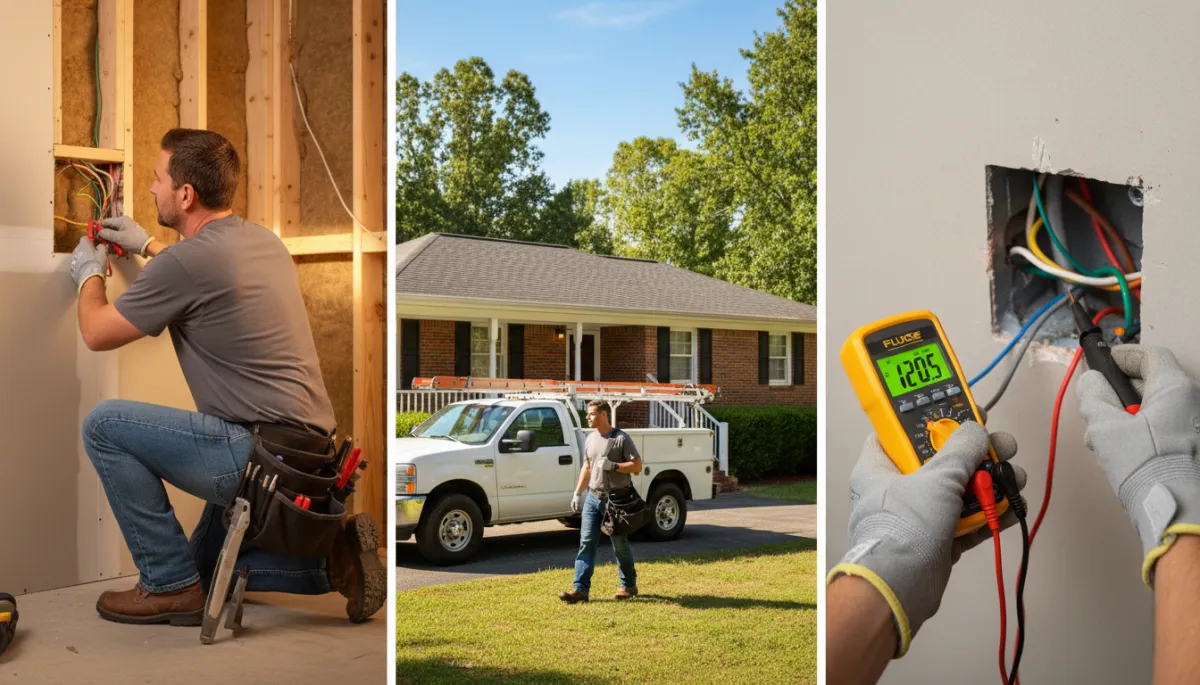
A professional inspection can turn a frustrating breaker issue into a permanent, safe solution.
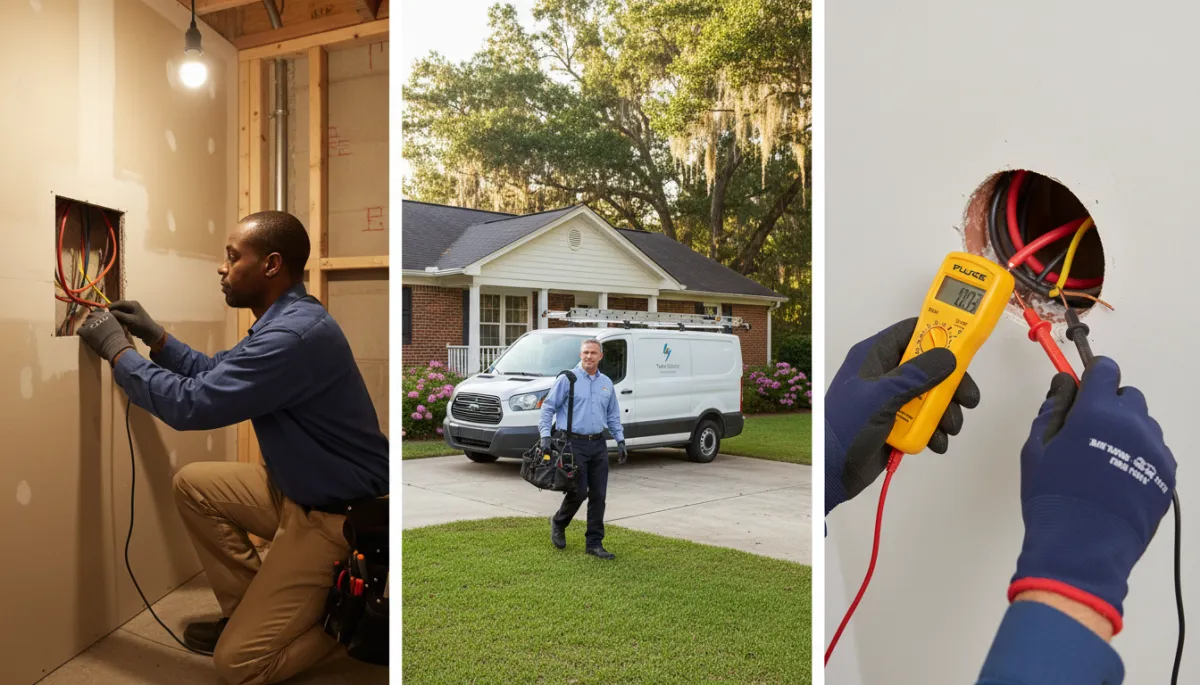
12. About the Author – Dan Southwick, S.I. Service Group
Dan Southwick is the founder and owner of S.I. Service Group, a veteran-owned HVAC, electrical, and commercial refrigeration company serving Tupelo and North Mississippi. With over a decade of hands-on experience in residential and commercial systems, Dan and his team bring an experienced, safety-first, code-focused approach to every job—whether it is a single tripping breaker or a full panel and HVAC upgrade. S.I. Service Group is fully licensed, bonded, and insured, proudly serving homeowners and businesses in Tupelo, Amory, Corinth, Saltillo, Oxford, Fulton, Mantachie, and surrounding North Mississippi communities.