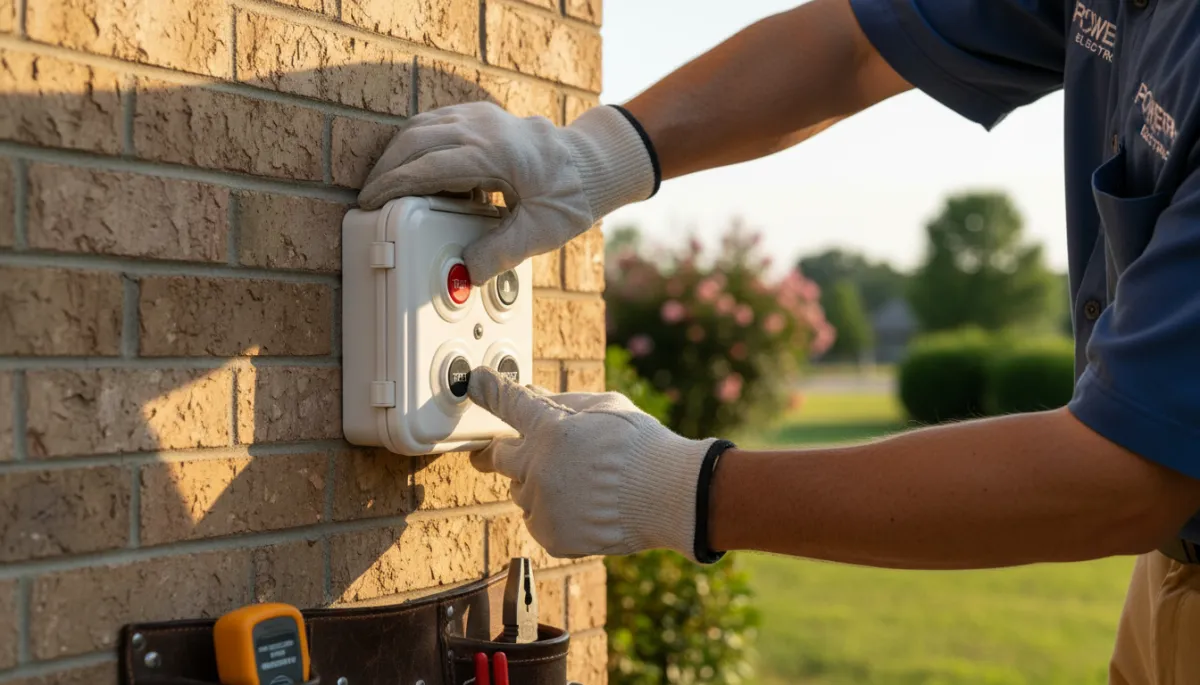
Why Is My Outdoor GFCI Outlet Not Working? A North Mississippi Electrician Explains
Every summer, starting around late June, I begin getting calls about outdoor outlets. Homeowners in Tupelo, Saltillo, Verona — doesn't matter where — they all say about the same thing: "The outlet on my patio just stopped working." Sometimes it happened overnight. Sometimes right in the middle of a cookout when the string lights cut out. And sometimes right after a storm rolled through and dumped two inches of rain before anyone could blink.
Here's the real talk: when your outdoor GFCI outlet goes dead, it's usually doing exactly what it's supposed to do — protecting you from a shock. The trick is understanding why it tripped, whether you can reset it yourself, or whether something deeper is going on. I've been pulling these things off walls across North Mississippi for years, and in this post I'm going to walk you through every real reason your outdoor outlet isn't working, how to troubleshoot it safely, and when to stop and call a licensed electrician.

What Is a GFCI Outlet and Why Do You Have Them Outside?
GFCI stands for Ground Fault Circuit Interrupter. I know that sounds like textbook stuff, but here's what it actually does: it monitors the current flowing in and out of the outlet, and the moment it detects even a tiny imbalance — something like 5 milliamps — it cuts power faster than a standard circuit breaker ever could. That speed matters because a ground fault, which is current taking an unintended path like through a person or through a puddle of water, can kill you in less than a heartbeat.
That's why the National Electrical Code requires GFCI protection anywhere electricity and moisture are likely to coexist: bathrooms, kitchens, garages, and absolutely every outdoor outlet. Here in Mississippi, with our humidity, afternoon thunderstorms, and sprinkler systems running six months out of the year, outdoor GFCI protection isn't just code — it's common sense.
Most outdoor outlets are protected in one of three ways: a GFCI receptacle with TEST and RESET buttons right on the face of the outlet, a GFCI circuit breaker inside the main panel, or protection flowing from another GFCI outlet that's upstream in the same circuit. That last one is where most homeowners get turned around — and we'll get into it shortly.
The #1 Reason Your Outdoor GFCI Outlet Stops Working in Mississippi Summer
If I had to bet on any single cause for an outdoor GFCI failure in July, it's moisture — and Mississippi summers make the problem dramatically worse than just about anywhere else.
We don't get gentle weather down here. A storm can roll through Mooreville or Mantachie in the middle of a July afternoon and dump two inches of rain in under an hour. If a weatherproof cover isn't seated right, or if the rubber gasket has dried out and cracked from years of UV exposure, water gets into the outlet box. Even high humidity alone — the kind that fogs your glasses when you step outside — can cause condensation inside the box on a hot day. When moisture contacts the electrical components, the GFCI detects it as a ground fault and trips. That's exactly what it should do.
I went out to a job in Verona a couple of summers back where a homeowner's wife was trying to run a patio fan for a birthday party. The outlet on the back of the house was completely dead. When I pulled the weatherproof cover off, the inside of the box was damp. The gasket had turned brittle and cracked — it wasn't sealing a thing. We replaced the outlet, installed a new cover with a fresh gasket, and it's worked perfectly ever since.
The fix depends on how much damage has been done. If it was a one-time moisture trip and the outlet is otherwise fine, you can dry it out and try the reset. But if water has been sneaking in repeatedly — storm after storm, season after season — the contacts corrode, the internal components degrade, and eventually the device won't reset no matter how many times you push that button.
That Tricky "Upstream" Problem — Another GFCI Is the Real Culprit
This is the one that trips people up the most. I explain it probably five times a week, and it never stops surprising homeowners.
Here's how GFCI circuits work: one GFCI outlet or breaker can protect multiple regular outlets that are wired downstream of it on the same circuit. So if the upstream GFCI trips, every outlet after it in that circuit goes dead too — even if those downstream outlets look perfectly normal and have no TEST or RESET buttons on them at all.
I had a homeowner in Plantersville call me once. His patio outlet was working fine, but the garage outlet right inside the door was completely dead. He'd already been outside pressing the patio GFCI reset button over and over. Turns out the GFCI protecting the entire circuit was actually inside the garage on a different wall — not on the patio at all. We reset that one, and everything came back on in thirty seconds.
Before you assume the outlet itself is bad, check every GFCI outlet in your home — garage, bathrooms, laundry area, and any outdoor-adjacent space. Press RESET on each one. You might solve the whole problem in two minutes without touching a single tool. Also check your breaker panel for any breaker with a small TEST button on the face — that's a GFCI breaker, and it can trip without the handle going all the way to the off position.
When the GFCI Device Itself Has Failed
GFCI outlets don't last forever. The average lifespan is around 10 to 15 years under normal conditions — and outdoor units age faster than indoor ones because of the heat, UV exposure, and constant humidity cycling they take every single Mississippi summer.
When a GFCI device fails internally, it typically does one of two things: it trips and refuses to reset, or it fails while still passing power — meaning the outlet works, but there's no ground fault protection anymore. The second failure mode is the dangerous one, because everything feels normal until it isn't.
The "won't reset" situation is what I encounter most often on outdoor calls. You press RESET, it clicks, then immediately pops back out. Or it won't click at all. Sometimes there's a faint hum from the device. That tells me either there's a live fault still present in the circuit that needs to be cleared first, or the device has internally failed and it's time for a new one.
The only reliable way to test a GFCI outlet is with a dedicated outlet tester that has GFCI test capability. I use one on every outdoor service call. It checks for correct wiring, confirms the GFCI protection is active, and verifies the reset mechanism is functional. If the device fails the test, it gets replaced. And I'll tell you honestly — I recommend replacing any outdoor GFCI that's more than 10 years old regardless of whether it seems to be working, because the protection circuitry degrades quietly over time.
Other Summer-Specific Reasons Your Outdoor Outlet Won't Work
Beyond moisture and device failure, here are a few more causes I run into regularly during Mississippi summers:
Overloaded circuit. July brings out all the outdoor gear — string lights, patio fans, outdoor refrigerators, power washers, outdoor speakers, inflatable pool pumps — and a lot of homeowners stack all of it on the same circuit. Every outdoor residential circuit has a rated capacity, typically 15 or 20 amps. Push past that and the breaker trips. If your outlet is dead and a breaker in your panel is also tripped, that's usually the answer. Reset the breaker and spread the load across multiple circuits.
Damaged wiring. Outdoor wiring takes real punishment. UV exposure degrades insulation over time. Weed eaters nick surface-run cables. Lawn equipment hits buried lines. I got called out to a home in Amory once where a homeowner had driven a landscape stake straight through the underground feed cable going to his side-yard outlet. The breaker never tripped, but the outlet was completely dead. Damaged wiring is a professional job — don't try to splice buried outdoor cable yourself.
Failed weatherproof cover. The bubble-style in-use cover that stays sealed even with a cord plugged in is required on all outdoor outlets by code. If it's cracked, warped, or missing, water goes straight into the box. These covers are inexpensive and easy to replace — but if water has been getting in repeatedly, have the outlet inspected while you're at it.
How to Safely Reset a Tripped GFCI Outlet
Here's the sequence I walk every homeowner through before I think about rolling a truck:
- Unplug everything from the dead outlet and any nearby outdoor outlets on the same circuit. A live fault in a connected device will prevent the GFCI from resetting.
- Locate the outlet with the TEST/RESET buttons. It may not be the dead outlet itself — check your garage, bathrooms, laundry room, and any other outdoor-adjacent GFCI locations first.
- Press the RESET button firmly until you feel and hear a distinct click. If it springs back out immediately, either a live fault is still present in the circuit, or the device has failed and needs to be replaced.
- Test the outlet with a phone charger or small lamp before plugging anything else back in.
- Plug devices back in one at a time. If the GFCI trips again when you add a specific appliance, that device is the source of the fault — stop using it and get it inspected.
If the RESET button won't stay in, or if the outlet has power but the TEST button won't trip the protection — meaning the GFCI safety function has silently died — stop right there and call a licensed electrician.

When to Call a Licensed Electrician
There's a clear line between safe homeowner troubleshooting and what requires a license. Resetting a GFCI? That's your call to make. Replacing a GFCI outlet? Mississippi law allows homeowners to do electrical work on their own residence, but here's my honest advice: if you're not completely comfortable with wiring, don't. A miswired GFCI looks fine on the surface but may provide zero ground fault protection — and that's more dangerous than a dead outlet.
Call a licensed electrician in North Mississippi when:
- The GFCI trips repeatedly even with nothing plugged in
- You notice scorching, melted plastic, or a burning smell around the outlet box or panel
- Multiple outlets in separate areas of the house go dead at the same time
- The outlet won't reset after working through all the steps above
- You suspect damaged buried or in-wall wiring
- Your outdoor outlet is more than 10–15 years old and has never been professionally tested
- You need a new outdoor outlet added where there currently isn't one
I carry Mississippi Electrical License #20095, covering both residential and commercial work across Northeast Mississippi. I've been doing this long enough to know that the repairs that look simple on the surface can become costly — and dangerous — problems when they're not done right the first time.
Frequently Asked Questions
How do I know if my GFCI outlet is bad or just tripped?
Press the RESET button with nothing plugged in. If it clicks and stays, the outlet was just tripped and is working fine. If the button won't stay in, or if it clicks but the outlet still has no power, either there's a live fault still present in the circuit or the device has failed internally and needs to be replaced.
Why does my outdoor GFCI keep tripping even when nothing is plugged in?
This is almost always a wiring issue — moisture inside the box, a damaged wire somewhere in the circuit run, or a failing device detecting phantom faults. If the outlet keeps tripping with zero load connected to it, stop resetting it and call an electrician. Something in the circuit itself is causing the fault, and you need to find it before it becomes a larger problem.
Can rain trip a GFCI outlet?
Yes — and that's precisely what the device is designed to do. If rain gets into a weatherproof cover with a failing gasket, or blows directly onto an exposed outlet face, the GFCI detects ground current from the moisture and trips to protect you. Once the outlet and box dry out, try the reset. If it trips again after the next rain, the weatherproof cover needs to be replaced and the outlet inspected.
How long do GFCI outlets last?
Most manufacturers rate them for 10 to 15 years. Outdoor outlets in Mississippi — dealing with summer heat, UV exposure, and high humidity — often fail sooner. The tricky part: a GFCI can fail two different ways. It can trip and refuse to reset, or it can silently stop protecting while still passing power. The second mode is the dangerous one. Use a dedicated outlet tester to verify GFCI function on all your outdoor outlets at least once a year.
Is it safe to use an outdoor outlet with a broken or missing weatherproof cover?
No. A damaged or missing cover creates a direct path for rain and humidity into the outlet box — both an electrocution and fire hazard. In-use weatherproof covers are required by the National Electrical Code on all outdoor outlets, and for good reason. Replacement covers are inexpensive and available at any hardware store. Don't use the outlet until the cover is replaced and properly seated.
The Bottom Line
A dead outdoor outlet in July might feel like the worst possible timing — and in Mississippi heat, it kind of is. But in most cases the problem is fixable, and it starts with understanding why GFCI outlets exist and what causes them to trip in the first place.
Start with the basics: look for an upstream GFCI that's tripped, unplug everything and try the reset, and inspect your weatherproof cover for damage. If none of that resolves it — or if the outlet keeps tripping on its own with nothing plugged in — that's when you need a licensed electrician with the right tools to find the actual fault in the circuit.
We work across all of Northeast Mississippi — Tupelo, Saltillo, Verona, Plantersville, Mooreville, Mantachie, Fulton, Amory, New Albany, and everywhere in between. Whether it's a GFCI replacement, a panel question, or outdoor wiring you've been putting off all summer long, we're here and ready to help.
📞 Call or Text: 662-523-5514
S.I. Service Group — Licensed, Bonded & Insured. Mississippi Electrical License #20095. Serving Tupelo, Saltillo, Verona, Plantersville, Mooreville, Mantachie, Fulton, Amory, New Albany, and all of Northeast Mississippi.