Why Is My AC Running Constantly But the House Won't Cool Down? A North Mississippi HVAC Tech Explains
It's mid-July. The heat index outside is pushing 108°F. Your AC has been running since 6 AM, and it's now 3 in the afternoon — and your thermostat still reads 84°F. It hasn't cycled off once.
I get calls exactly like this all summer long from homeowners in Tupelo, Saltillo, Verona, Mooreville, and just about every other town across Lee and Itawamba County. When your AC runs nonstop without pulling the house down to temperature, something is wrong — and in North Mississippi heat, you can't afford to ignore it.
I'm Dan Southwick with S.I. Service Group. I've been running HVAC service calls across North Mississippi for years — crawling under houses, pulling air handler panels, and diagnosing systems in conditions that would make your head spin. Let me walk you through exactly what I look for when a homeowner calls and says their AC is running all day and the house just won't cool down.
Why Mississippi Makes This Harder Than Most Places
Before I get into the specific causes, here's something important to understand: North Mississippi is one of the most demanding environments for residential HVAC systems in the entire country. We're not just dealing with heat — we're dealing with heat and humidity at the same time. When the heat index is 110°F and the dewpoint is in the low 80s, your AC system is fighting two battles simultaneously: pulling the indoor temperature down while also pulling massive amounts of moisture out of the air.
Add in the older housing stock across Plantersville, Mantachie, Amory, and Fulton — single-pane windows, minimal attic insulation, and original ductwork from the 1980s — and you've got a system working at maximum load every single day of summer. That doesn't mean a struggling system is normal. It means the margin for error is zero. Here's what I check on every service call.
1. Your Air Filter Is Clogged
I'm leading with this because it's the most common thing I find on the first call — and the fix costs less than $20.
When your air filter is completely clogged with dust and debris, airflow across your evaporator coil is severely restricted. The system can't pull enough warm air through the coil to transfer heat properly. The result: your AC runs and runs, but never makes a dent in the indoor temperature. Eventually the coil itself freezes over, which makes things even worse.
I pulled up to a house in Mooreville last summer and knew something was off before I even opened the air handler — the supply registers barely had any airflow. The filter was completely matted gray, hadn't been changed in over a year. Swapped it out, let the frozen coil thaw overnight, and the homeowner texted me the next morning that the house hit 72°F by noon.
Check your filter right now. If you can't see light through it, it needs to change. Replace it every 1–3 months — more often if you have pets or anyone in the house with allergies.
Typical cost to fix: $5–$20 for a replacement filter. Do it yourself, today.
2. Your Evaporator Coil Is Dirty or Frozen Solid

The evaporator coil lives inside your air handler and is responsible for absorbing heat from your indoor air. Two things can shut it down fast: restricted airflow from a dirty filter, or low refrigerant levels. Either one can cause the coil to freeze solid — and when that happens, you've got a block of ice where your cooling coil should be. The system blows warm air (or barely any air at all) even while running full blast.
I've popped open air handler panels in Saltillo and Verona and found coils that looked like miniature icebergs. The homeowners thought the system had completely failed. Sometimes the fix is surprisingly simple: shut the system off, run the fan only for 4–6 hours to let the coil thaw, change the filter, and restart. If it refreezes within 24 hours, that tells me we've got a refrigerant issue — which is the next cause on this list.
A coil that's simply dirty — caked with dust, mold spores, and years of particulate buildup — reduces heat transfer efficiency by 20–30%. Your system has to work that much harder and longer to compensate. A professional coil cleaning makes a real, noticeable difference.
Typical cost to fix: Professional coil cleaning: $150–$300. If the coil is frozen due to low refrigerant, expect additional costs for leak detection and recharge.
3. You're Low on Refrigerant — And You Have a Leak
I want to be direct about this: refrigerant doesn't get used up like fuel. If your system is low on refrigerant, you have a leak. Full stop. "Topping it off" every summer without finding and fixing the leak is just throwing money away — and more importantly, it means your system runs in an undercharged state all season long.
Low refrigerant cripples your system's ability to absorb and transfer heat. The suction line — the big, insulated copper line running from the air handler to the condenser — will often frost or ice over near the evaporator connection when you're running low. On a service call last August in New Albany, I arrived to find that exact situation: customer's suction line was iced from the air handler all the way to the outdoor unit. Suction pressure was 40 PSI low, superheat was completely off. Leak was at a Schrader valve core that had been slowly weeping refrigerant all season.
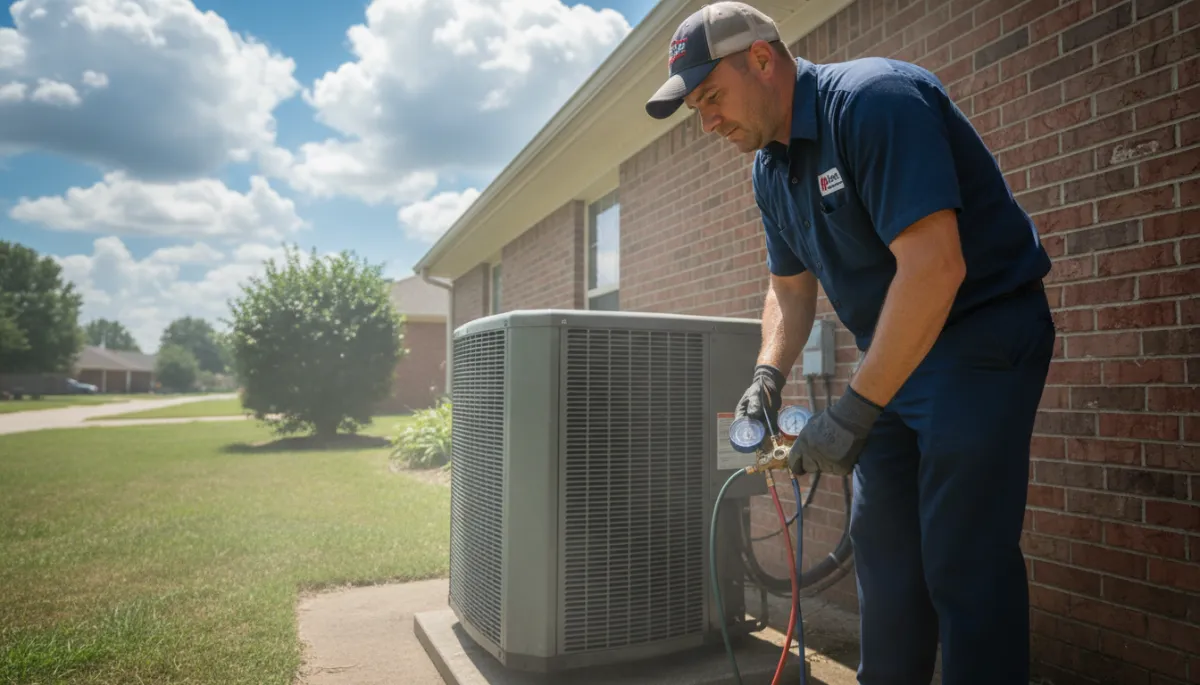
When I suspect refrigerant, I hook up my manifold gauges and pull actual pressure readings. From there I can tell you exactly what you're dealing with, where the leak is likely located, and what the repair involves. Common leak points: Schrader valve cores, evaporator coil connections at the air handler, and service line fittings that have vibrated loose over years of use.
Typical cost to fix: Leak detection, repair, and refrigerant recharge: $250–$650+, depending on refrigerant type (R-410A vs. R-22), the location of the leak, and how much refrigerant has been lost.
4. Your Ductwork Is Leaking Into the Crawl Space

This is the one that never gets enough attention — and it's responsible for more "my AC won't cool the house" calls than most homeowners would ever guess.
I've crawled under homes in Fulton and Amory and found ductwork that was essentially wide open — flex duct pulled completely apart at the boot fitting, blowing 73°F air straight into the crawl space while the living room sat at 86°F. The HVAC system itself was in perfect working order. The ductwork was the entire problem.
When conditioned air leaks out of your duct system before it reaches your rooms, two things happen: First, your house never gets the airflow it needs to cool down. Second, your AC runs constantly trying to compensate, driving up your electric bill while the actual problem goes unaddressed. In some older North Mississippi homes, I've measured duct leakage rates of 30–40%. That means nearly half the air you're paying to cool never makes it to your living space — it's conditioning your crawl space instead.
Common duct failure points: flex duct connections that have pulled apart at supply boots, duct mastic that dried and cracked at metal-to-flex transitions, and return air plenums that were never properly sealed at installation.
Typical cost to fix: Duct sealing with mastic or UL-rated tape: $300–$1,200+ depending on the number of problem areas and system size. The energy savings often pay this back within two or three cooling seasons.
5. The System Is the Wrong Size for Your Home
Sometimes this isn't a component failure at all — it's a fundamental mismatch between your AC's capacity and your home's actual cooling load. An undersized system will run 24 hours a day in a Mississippi July and still never reach setpoint. That's not a repair problem. That's a sizing problem, and the only real fix is a properly-sized replacement.
I ran a Manual J heat gain calculation on a house in Plantersville last summer. The homeowner had a 2.5-ton system and couldn't understand why it never caught up. When I ran the numbers, the actual cooling load came back right around 4 tons. They'd enclosed a screened porch with insulated glass panels — roughly 400 additional square feet of living space — without touching the HVAC system. The original unit never had a chance.
Common scenarios I see across North Mississippi: homeowners who added a sunroom or converted a garage without upgrading the system; older homes where the insulation has settled and degraded over 30+ years, significantly increasing the heat load; and systems that were marginally sized at installation and "got by" until a brutal summer like this one exposed the problem for good.
Typical cost to fix: New system, properly sized and installed: $4,000–$8,500+. We'll do a real load calculation for your home — not a rule-of-thumb guess — and give you straight numbers.
6. Thermostat Problems
I never skip the thermostat during a diagnostic. A malfunctioning thermostat can command the system to run constantly — either because it's reading the temperature incorrectly, or because of wiring issues causing erratic behavior.
The most common culprit I've been seeing lately is Wi-Fi smart thermostats installed without a proper C wire (common wire). Without a C wire, the thermostat draws power parasitically from the system's control wiring — and that causes all kinds of strange behavior, including continuous operation and short-cycling. I've also seen thermostats mounted directly in sunlight or near heat-producing appliances, causing them to read 10–15 degrees warmer than the actual room and running the system into the ground chasing a setpoint it's never actually measuring correctly.
If your thermostat was recently replaced, or you upgraded to a smart thermostat in the last year or two, it's worth having a technician verify the wiring is correct.
Typical cost to fix: Thermostat replacement and proper wiring: $100–$300 installed, depending on the model and wiring complexity.
7. Attic Heat Load and Inadequate Insulation

This one is sneaky because the HVAC system checks out perfectly on every diagnostic — and yet the house still won't cool. The problem is above your ceiling, not in the equipment.
Attic temperatures in North Mississippi in July regularly hit 140–160°F during peak afternoon hours. That heat radiates directly through your ceiling into your living space, all day and into the evening. If your attic insulation is thin, settled, or absent over certain sections of the house, your AC is in a losing battle against radiant heat gain that never lets up.
I walk a lot of attics during HVAC calls across Tupelo, Verona, and Mantachie. Homes built before the mid-1990s frequently have R-11 or R-13 insulation — maybe 3–4 inches of settled fiberglass. Current energy code recommendations for North Mississippi are R-38 to R-49. That gap in insulation value translates directly into longer AC runtimes, higher utility bills, and a house that never quite feels comfortable no matter how hard the system runs.
Improving attic insulation is a building envelope fix, not an HVAC fix — but it directly determines how hard your system has to work every single summer.
Typical cost to fix: Blown-in insulation upgrade: $1,500–$4,000+ depending on attic size and existing conditions. The comfort improvement is often dramatic and immediate.
When to Call vs. When to Handle It Yourself
Do it yourself:
- Change your air filter — check it monthly, replace every 1–3 months
- Check thermostat batteries and verify settings haven't been accidentally changed
- Let a frozen coil thaw overnight (run fan-only mode, not cooling) before calling
- Clear vegetation and debris from around the outdoor condenser unit
- Gently rinse the condenser fins with a garden hose if they're visibly packed with cottonwood or debris
Call a professional:
- Anything involving refrigerant — it requires EPA Section 608 certification and adding refrigerant without fixing the leak first is a waste of money
- Electrical faults at the disconnect, capacitor, or contactor — these involve voltages that can kill
- Evaporator coil cleaning — improper technique damages the aluminum fins permanently
- Ductwork issues in the crawl space or attic
- Any situation where the system has been running constantly for more than 24 hours with no improvement
Don't wait on this. A system running nonstop in Mississippi summer heat puts serious, cumulative stress on the compressor. Compressor replacement on a residential system typically runs $1,200–$2,500. Catching a refrigerant leak or a dirty coil early is $250–$500. I've watched homeowners wait two weeks on a struggling system and end up with a compressor failure that was completely avoidable with one service call.
Frequently Asked Questions
Is it normal for an AC to run constantly in Mississippi summer?
Extended run cycles are expected on extreme heat days — but if your system runs all day and the house never reaches your thermostat setpoint, that's not normal. Even on a 100°F day in Tupelo, a properly functioning and properly sized system should eventually satisfy the thermostat. If it doesn't, something needs to be diagnosed.
Why does my AC run all day in Mississippi and never reach temperature?
The most common causes are a clogged air filter, low refrigerant from an unrepaired leak, a dirty or frozen evaporator coil, duct leaks sending conditioned air into the crawl space, or a system that's undersized for your home's actual cooling load. In North Mississippi's climate, even minor issues that a system could "get away with" in a milder environment will cause real problems in July and August.
Can I add refrigerant to my AC myself?
No. Handling refrigerants legally requires EPA Section 608 certification. More importantly, adding refrigerant without locating and repairing the leak first is a temporary fix at best — you'll be back in the same situation next summer, probably at the worst possible time. Find the leak, fix the leak, then recharge.
What does it mean when my AC is running but the air coming out isn't cold?
Usually one of three things: low refrigerant preventing proper heat absorption in the coil, a frozen or dirty evaporator coil blocking heat transfer entirely, or an electrical issue with the compressor or contactor that's preventing the refrigerant circuit from actually running — even though the fan is moving air. A diagnostic visit will tell you which one you're dealing with.
How much does it cost to fix an AC that runs constantly but won't cool the house?
It depends on the cause. A filter replacement is free. Refrigerant recharge with leak repair: $250–$650. Professional coil cleaning: $150–$300. Duct sealing: $300–$1,200. A properly sized replacement system: $4,000–$8,500+. A diagnostic service call — typically $75–$125 — tells you exactly what you're dealing with before you commit to anything else.
My AC runs constantly and my electric bill is sky high. What should I do?
Call for a diagnostic before something expensive breaks. A system running continuously draws maximum amperage around the clock — that's brutal on the compressor and brutal on your utility bill. Most of the issues behind this problem are fixable for a few hundred dollars if you catch them before the compressor fails. Compressor replacement is $1,200–$2,500. A service call is $75–$125. That math isn't complicated.
How long should my AC run before cycling off in the summer?
On a typical 95°F Mississippi day, run cycles of 15–20 minutes are common and healthy. On a 105°F heat index day, longer cycles are expected — but the system should still cycle off occasionally when it satisfies the thermostat. If it literally never shuts off during an entire day, that's a problem that warrants a diagnostic call.
Bottom Line: Your AC Is Telling You Something
When your system runs all day without cooling your house down, it's not just uncomfortable — it's a warning. Most of the time, it's a diagnosable, fixable problem: a refrigerant leak, a dirty coil, a clogged filter, leaky ductwork, or a thermostat that's fighting against itself. Caught early, these repairs run $200–$600. Left alone until the compressor gives out, you're looking at $2,500 in parts and labor — or a full system replacement you weren't ready for.
I've been handling HVAC service calls across North Mississippi for years — Tupelo, Saltillo, Verona, Plantersville, Mooreville, Mantachie, Fulton, Amory, New Albany, and everywhere in between. We're licensed, insured, and we don't upsell you on things you don't need. When I run a diagnostic, I tell you exactly what I found, exactly what caused it, and exactly what it costs to fix — no surprises, no pressure.
If your AC is running nonstop and your house won't cool down, give us a call or shoot us a text at 662-523-5514. We'll get out there, find the problem, and give you a straight answer. Schedule your service call today — S.I. Service Group, Tupelo's trusted HVAC, electrical, and commercial refrigeration team.