Why Is My AC Running But Not Cooling My House? A Tupelo HVAC Tech Explains
If you're reading this in July, I already know exactly what you're dealing with. It's 97 degrees outside, your AC has been running since sunup, and your house is sitting at 82 — maybe 85 — degrees. The system is clearly on. You can hear it humming. You can feel air coming out of the vents. But you're sweating in your own living room, and nothing's getting better.
I've been doing HVAC work across Northeast Mississippi for years — Tupelo, Saltillo, Verona, Plantersville, Mooreville, out to Amory and New Albany — and this is hands down the most common call I get every single July. My AC is running, but it's not cooling. Nine times out of ten, I already have a short list of suspects before I even pull into the driveway.
Let me walk you through what I actually look at when I get to a call like this — in order, from the most common to the most serious.

1. The First Thing I Check: Your Air Filter
I know. You've heard this before. But I'm going to tell you anyway, because I showed up to a house in Saltillo last August and the homeowner had a filter in there that looked like a wool blanket. Solid gray. Couldn't see through it. No airflow — and no cooling — because of something that costs $8 to replace.
Here's what actually happens when your filter gets that clogged: the blower is trying to pull air through your return vents, but it can't get enough through that blocked filter. The evaporator coil gets cold from the refrigerant doing its job — but there's no warm air passing over it to absorb heat from your house. The coil just keeps getting colder. Eventually it freezes. Meanwhile, your house stays hot because no air is actually moving through the system.
Check your filter right now. If you can't hold it up to a light and see through it clearly, replace it. Use a standard 1-inch filter — nothing too restrictive. High-MERV filters might look impressive on the box, but they can choke a residential system just like a dirty one. If the filter's clean, keep reading.
2. A Frozen Evaporator Coil — More Common Than You'd Think
If your air filter is fine but your AC still isn't cooling, the next thing I check is the evaporator coil — the coil inside your air handler, that big box in your closet or attic. Open the access panel and shine a flashlight in there. If you see ice on the coil or on the copper refrigerant lines going into it, you've got a freeze-up.
A frozen evaporator coil can't absorb heat from your home's air. Ice is a great insulator. When that coil is coated in ice, your refrigerant is just cycling through a frozen block while your house stays hot.

Why does it freeze? Several reasons. That clogged air filter we just talked about is actually the most common cause. Low refrigerant is another big one. A dirty coil itself can freeze up from reduced airflow across the fins. And if your blower motor is starting to fail and not moving enough air, you'll freeze up fast in Mississippi summer conditions.
If it's frozen: turn the system off entirely or switch it to "fan only" mode and let it thaw — usually takes 2 to 4 hours. Do not crank it back on until it's completely thawed and you've figured out why it froze. Running a frozen system can damage your compressor, and that's a repair bill nobody wants. Call a tech before you restart it.
3. Low Refrigerant — Signs Without Gauges
Refrigerant is what makes your air conditioning system actually work. It cycles through the system absorbing heat from inside your house and releasing it outside. If you're low on refrigerant, the system can run all day long and never catch up — because it's just not moving enough heat to make a dent.
I was at a house in Plantersville a few weeks ago. The homeowner had been running her AC solid for two days straight and her house was sitting at 84 degrees. I went out and checked the suction line — that's the big insulated copper pipe going into the outdoor unit. It should be cold and sweating on the outside. Hers was barely cool to the touch. That's a refrigerant flag right there. Sure enough, when I put my gauges on it, the system was significantly undercharged.
Here's what to look for without tools: frost or ice on the copper lines at your outdoor unit. Air from your vents that feels barely cool — not cold. The system runs constantly without the indoor temperature ever dropping. If those sound familiar, there's a good chance you've got a refrigerant issue.
One thing I want to be straight with you about: adding refrigerant is not a permanent fix. Refrigerant doesn't get "used up" like gasoline — if you're low, you have a leak somewhere in the system. I can add refrigerant to get you through the summer, but at some point that leak needs to be found and repaired. Topping off a leaking system every season is just throwing money out the door.
4. Dirty Condenser Coils on the Outdoor Unit
Your outdoor unit — the big box sitting in your yard — is called the condenser. Its job is to dump the heat your indoor coil pulled out of your house into the outside air. In July in Mississippi, the outside air is already 95 degrees or higher. That's a tough job even when everything is working perfectly.
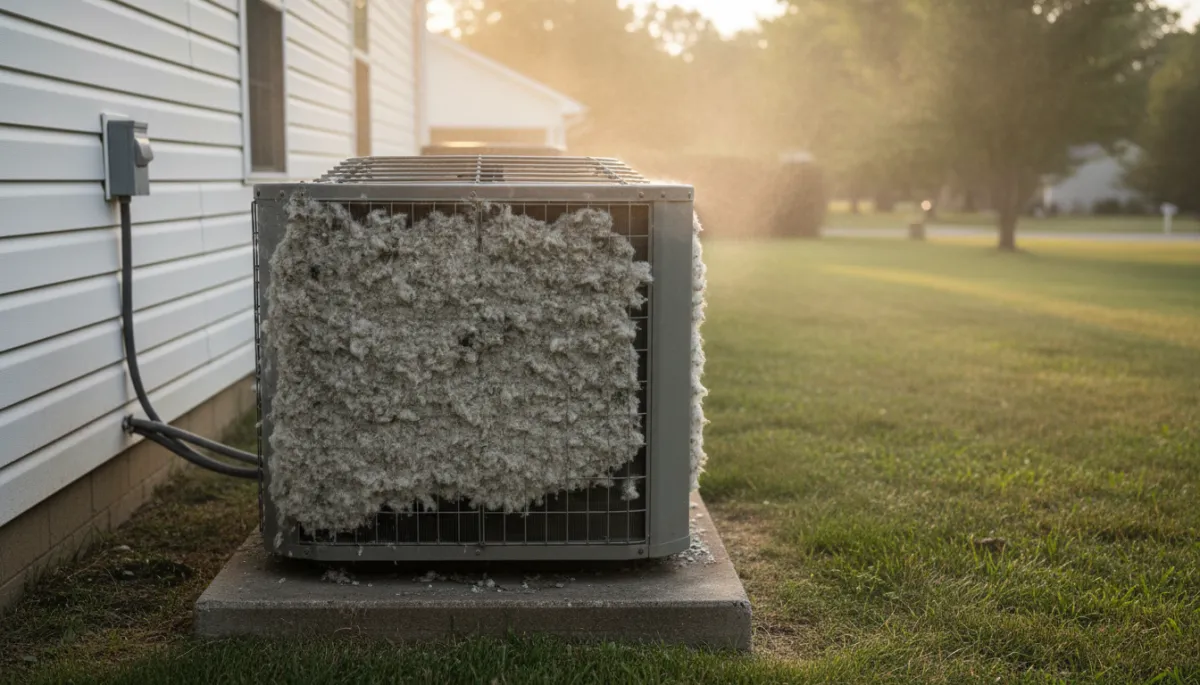
Now pack those fins with a layer of cottonwood, dog hair, dirt, and whatever else has been blowing around your yard — and the condenser can't get rid of that heat efficiently. System pressures climb. The compressor works harder. Efficiency drops. And your house just never cools down the way it should.
Go look at your outdoor unit right now. Can you see through the fins on the sides? If they look clogged or matted with debris, that's part of your problem. You can rinse them gently with a garden hose from the inside out — never blast them with a pressure washer, you'll bend the fins flat and make it worse. Or give us a call and we'll clean it properly as part of an AC tune-up.
I clean condenser coils on probably a third of the summer calls I run. It's one of those maintenance items most homeowners never think about, and it makes a genuine difference in how well your system cools — especially during a Mississippi heat wave.
5. Duct Leaks — Losing Cold Air Before It Gets to You
This one's sneaky. Your system might be running perfectly — good refrigerant charge, clean coils, strong airflow — but if your ductwork is leaking, the cold air is never actually making it to your living spaces.
I see this constantly in older homes around the Tupelo area and especially in manufactured homes across Mooreville and Mantachie. Ductwork runs through the attic or crawl space. Attic temperatures in a Mississippi July can hit 140 degrees or higher. If your ducts have gaps, disconnected sections, or just deteriorated insulation, your AC system is working overtime to cool your attic — not your living room.
Signs of duct leaks to watch for: rooms that are noticeably hotter than others even with all vents open. Energy bills that have been creeping up over the past few years. Weak airflow from certain vents even when the system is clearly running hard. Excessive dust accumulating in rooms even with a clean filter. Any one of those can point to a duct issue.
Duct sealing and repair is one of the most cost-effective improvements you can make to an older home. The savings in energy cost alone often justify the work within a year or two.
6. Thermostat Problems — Simple Fixes That Get Overlooked
Sometimes the problem isn't the system at all — it's the thermostat. I know that sounds obvious, but I've driven 45 minutes out to a call in Amory only to find out the thermostat was set to "on" instead of "auto." The fan was running constantly, circulating warm unconditioned air, and the homeowner was convinced the AC wasn't working. Five seconds to flip that setting and suddenly the house started cooling down.
Make sure your thermostat is set to "cool" and "auto" — not "on." Confirm the set temperature is actually lower than the current room temperature. If you have a smart thermostat, check that it's getting power and hasn't lost its programming from a power surge.
Location matters too. If your thermostat is in a hallway that gets direct afternoon sun through a window, it's reading that spot as hotter than the rest of the house and overcooling until it short-cycles. If it's near a supply vent, it's reading artificially cool air and shutting off before the bedrooms are comfortable. Both situations can make your system behave exactly like it's broken — when the fix is just relocating a sensor.
7. An Aging or Wrong-Sized System That Can't Keep Up
Here's the honest conversation that some homeowners don't want to have: sometimes the system is running fine. It's just too old or too small for the job you're asking it to do.
A 15-year-old unit in Mississippi heat and humidity is working at maybe 60 to 70 percent of its original efficiency. Refrigerant has degraded from years of slow micro-leaks. The compressor works harder to do less. The coils are roughed up from years of use. Even with clean filters and regular maintenance, an aging system is going to struggle to hold a house at 72 degrees when it's 97 outside and the humidity is pushing 80 percent.
Undersizing is another issue I see in homes that were built years ago or that have been renovated without updating the HVAC. If the original contractor sized the system for a 1,400-square-foot house and you've since added a master suite, finished the garage, or opened up the floor plan, that 2-ton unit isn't designed for what you're asking of it.
If your system is over 12 to 15 years old and you're having cooling problems, call us for a proper assessment. Sometimes it's a repair that buys you a few more good years. Sometimes it's time to have the replacement conversation. I'll tell you which it is — straight.

Frequently Asked Questions: AC Running But Not Cooling
Why is my AC running all day but not cooling my house?
The most common reasons are a clogged air filter restricting airflow, low refrigerant from a slow leak, a frozen evaporator coil, dirty condenser coils on the outdoor unit, or duct leaks losing cooled air before it reaches your living spaces. Start with the air filter — it's free to check and cheap to fix — then work through the list. If you can't find the answer, a licensed HVAC repair technician can diagnose it properly with the right tools.
How do I know if my AC is low on refrigerant?
Without gauges, watch for: frost or ice forming on the copper lines at the outdoor unit, air from your vents that feels barely cool instead of cold, the system running constantly without the indoor temperature dropping, or a faint hissing or bubbling sound near the refrigerant lines. You need a licensed technician with EPA certification and manifold gauges to confirm and safely recharge the system — this isn't a DIY job.
Why can't my house cool below 80 degrees even with the AC on?
A properly functioning system should maintain 72–75°F indoors even when it's 95°F outside. If you can't get below 80°F, look at: system age and capacity (is it undersized?), duct leaks sending cooled air into the attic, dirty coils reducing heat transfer efficiency, or a refrigerant charge issue limiting how much heat the system can move. A 15+ year-old system in Mississippi conditions may simply not have the output it once did.
Should I turn my AC off if it's not cooling?
If you can see ice on the evaporator coil or the copper lines, yes — turn the system to "fan only" or off completely and let it thaw for 2 to 4 hours before restarting. Running a frozen system can damage the compressor. If there's no visible ice, you can leave it running, but get a tech out as soon as possible. Running a system with low refrigerant or another mechanical issue accelerates compressor wear and can turn a moderate repair into a full replacement.
How much does AC repair cost in Tupelo, MS?
It depends on what's wrong. A diagnostic visit and capacitor replacement might run $150–$300. A refrigerant recharge can be $200–$500 depending on the refrigerant type and quantity needed. Evaporator or condenser coil replacements are more significant — typically $800–$2,000+ depending on the system. A full system replacement runs $4,000–$8,000+ for a quality installation. At S.I. Service Group, we give you a straight diagnosis and honest pricing before any work begins. No pressure, no surprises.
Bottom Line: Don't Let a Mississippi July Win
An AC that's running but not cooling is telling you something. It might be a $8 air filter. It might be a refrigerant leak. It might be coils, ducts, a thermostat problem, or a system that's simply reached the end of its road. The only way to know for sure is to get a qualified tech in there with the right tools and enough experience to read what they find.
I've been working on HVAC systems across Tupelo, Saltillo, Verona, Plantersville, Mooreville, Mantachie, Fulton, Amory, and New Albany for years. I know these neighborhoods, I know what these systems deal with in a Northeast Mississippi summer, and I give you a straight answer about what's wrong and what it's going to take to fix it — before any work begins.
Don't suffer through another week of 80-degree indoor temperatures. Call S.I. Service Group at 662-523-5514 and let's get your AC doing its job again. We offer HVAC repair and AC tune-up and maintenance services across Northeast Mississippi — and when we get there, you'll get the honest story, not the upsell.