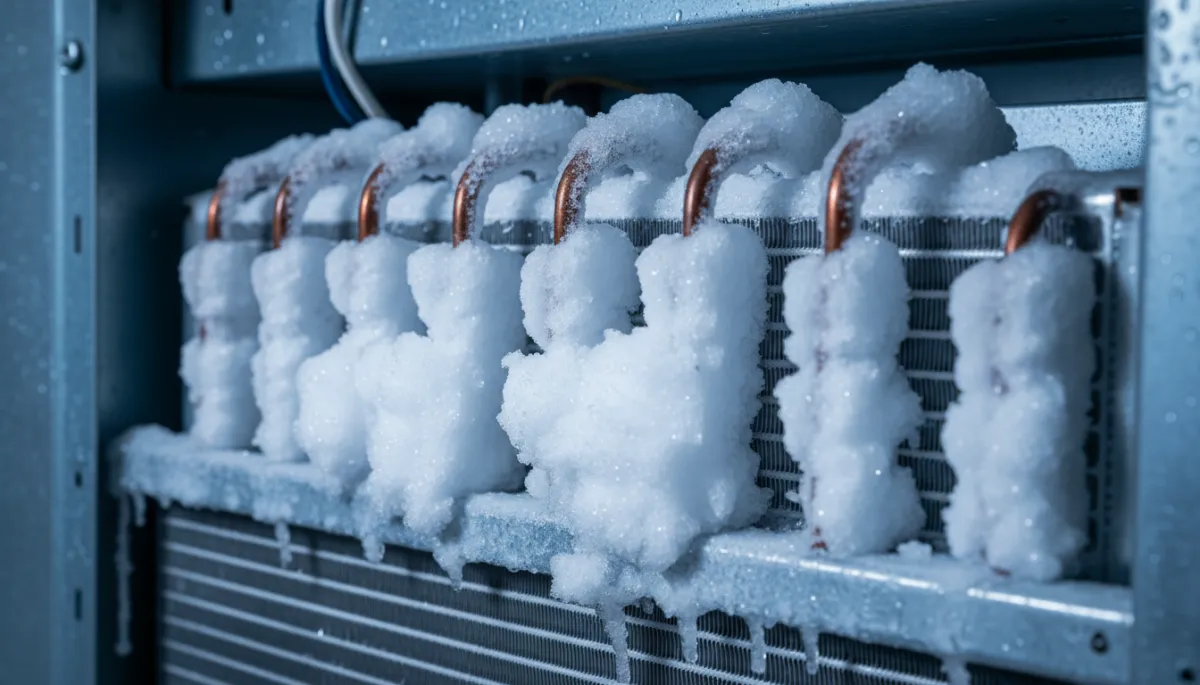
Why Is My AC Freezing Up in July? What Homeowners in Tupelo, MS Need to Know About Iced-Over Coils

It Was 98 Degrees Outside — and His Coils Were Solid Ice
I got the call around 2 in the afternoon last summer. Guy from Saltillo, already frustrated before he even said hello. "Dan, my house is 84 degrees and it won't cool down. I went outside to check and there's ice all over my AC unit." I asked him one question: "Have you changed your filter lately?" Dead silence. You already know how that one went.
If you're reading this, you're probably in the same boat right now — July in North Mississippi, it's somewhere between 95 and 100 degrees, and your AC is either not cooling or you've spotted something that looks completely wrong: ice. Actual ice. On your air conditioning unit. In the middle of summer.
It seems like it shouldn't be possible. But it's one of the most common HVAC service calls I run all summer long, from Tupelo to Mooreville, Verona to New Albany. Let me explain exactly what's going on, what to do right now, and when to call for help.
How Does an AC Coil Freeze Up When It's 98 Degrees Outside?
I get this question every single time. It seems backward — how can something freeze in this heat? Here's the quick version of the science.
Your air conditioner doesn't actually create cool air. It removes heat. The system works by circulating refrigerant through two coils — the evaporator coil inside your home and the condenser coil outside. When warm air from your home blows across the evaporator coil, the refrigerant inside absorbs that heat and carries it outside.
Here's the key: that evaporator coil runs extremely cold — normally around 40°F. When everything is working correctly, warm air moves across it constantly, keeping frost from forming. But when that airflow drops or the refrigerant charge gets off, the coil can drop below 32°F. And at 32 degrees, the humidity in the air starts freezing right on the coil. Once that ice starts building, it insulates the coil from warm air even more, which causes more freezing, more ice — and eventually, a coil that's a solid block of ice and an AC that's doing absolutely nothing useful.
It's a chain reaction. And the July heat outside doesn't matter one bit to what's happening on that coil inside your air handler.
The Six Reasons Your AC Coils Are Freezing Up
1. A Dirty or Clogged Air Filter (The #1 Cause)
I'll say it plainly: the vast majority of frozen coil calls I respond to in Tupelo and the surrounding area come back to a dirty filter. A clogged filter restricts the airflow across the evaporator coil. Less warm air across that coil means the coil gets too cold, ice builds up, and your whole system shuts down in slow motion. It's that straightforward.
In Mississippi during summer, your AC runs almost continuously. That filter is catching dust, pet hair, and humidity constantly. If you're not changing it every 30 to 45 days during peak season, you're pushing your system toward this exact problem. If I had a dollar for every house in Plantersville and Mooreville I've walked into where the homeowner thought they were on a "three-month" filter schedule while running their system around the clock — I'd have a lot of dollars.
Check your filter first. Right now, before you do anything else.
2. Low Refrigerant — a Leak, Not Running Out
Refrigerant doesn't evaporate or get used up like gas in a car. If your system is low on refrigerant, there's a leak somewhere. Low refrigerant means lower pressure in the system, which drops the coil temperature below freezing. Ice forms. The system loses cooling capacity. You're hot.
Low refrigerant is not something you fix with a can of refrigerant from a hardware store. Those consumer recharge kits aren't designed for most modern home systems and can cause additional damage. More importantly, you're adding refrigerant to a leaking system without fixing the actual leak — it'll be low again in weeks or months. A licensed tech needs to find the leak, repair it, and recharge the system properly. I deal with refrigerant leaks across Amory, Fulton, and Mantachie regularly — it's a core repair for us, and it's not something to DIY.
3. Blocked or Closed Supply Vents
Walk through your house right now. Are any vents closed? Blocked by furniture, curtains, or a rug? Homeowners sometimes close vents in unused rooms to "save energy." It actually does the opposite — it restricts airflow through the whole system and can drop that coil temperature right into freeze territory. Open every vent in the house and make sure nothing is blocking them. This one is completely free to fix.
4. A Dirty Evaporator Coil
Even with a filter in place, dust and debris build up on the evaporator coil over time. A layer of grime acts as insulation on the coil — it reduces heat transfer, which causes the coil temperature to drop further than it should. A dirty coil also restricts airflow, similar to a clogged filter. You can't safely clean the evaporator coil yourself without disassembling the air handler — this one needs a professional with the right equipment and coil cleaner solution.
5. Blower Motor or Fan Problems
The blower fan is what moves warm air across the evaporator coil. If the motor is running slow, struggling, or beginning to fail — airflow drops and freezing follows. A failing capacitor (the component that helps the motor start and run properly) is one of the more common and affordable repairs we make all summer long. If you hear your system straining to start, or you notice reduced airflow even with a clean filter, the blower circuit deserves a diagnostic look.
6. Running AC When Outdoor Temps Drop Too Low
This is less relevant in the middle of July in Mississippi — our nighttime lows still sit in the low 70s through most of the summer. But in spring and fall, running your AC when outdoor temps fall below 60°F can cause freezing. If you're dealing with this problem right now in peak summer, this isn't your culprit — but file it away for the shoulder seasons.

What to Do RIGHT NOW if Your Coils Are Frozen
This is the most important thing I'll tell you in this entire post: do not keep running your air conditioner on cooling mode when the coils are frozen.
I know it's tempting. It's July. It's 98 degrees. You want cold air. But running a compressor against a frozen evaporator coil is a fast track to compressor failure — and a new compressor can run $1,500 to $3,000 or more. Don't do it.
Here's the right sequence:
- Switch the thermostat to FAN ONLY mode. This keeps the blower running — moving warm air across the coil to speed up thawing — without running the compressor or cycling refrigerant.
- Turn off cooling mode completely. If your thermostat doesn't have a fan-only option, switch it all the way off. Let the system rest.
- Pull and inspect the filter while you're waiting. If it's gray, matted, and barely recognizable, that's likely your answer. Replace it immediately.
- Give it 1 to 4 hours to thaw. Do not try to chip ice off the coil. Let it melt naturally into the condensate drain pan below the air handler.
- Check the drain pan. All that melt water has to go somewhere. Make sure the condensate drain isn't clogged or you'll end up with water damage on top of your AC problem.
- Restart on cooling and monitor. If it holds and cools properly, a dirty filter was your culprit. If it freezes again within a few hours — call a tech. The problem is mechanical, and the filter swap didn't solve it.
When to Call a Pro vs. Handle It Yourself
I want to be straight with you here, because homeowners deserve an honest answer on this.
What you can handle yourself: Checking and replacing the air filter. Opening closed or blocked vents. Clearing leaves and debris from around the outdoor condenser unit. Letting the system thaw fully and restarting it. Monitoring whether the problem repeats.
What needs a licensed HVAC tech: Low refrigerant — finding the leak, repairing it, and properly recharging the system. Evaporator coil cleaning. Blower motor and capacitor diagnosis and replacement. Any work involving the refrigerant circuit, electrical components inside the air handler, or system diagnostics beyond a visual check.
Our HVAC repair team in Tupelo handles these diagnostics daily across all of Northeast Mississippi. It's not a mystery on our end, even if it feels overwhelming from the homeowner side. A good diagnostic tells you the root cause — not just the symptom — so you're not calling back for the same problem three weeks later.
What Does This Cost in North Mississippi?
I'm going to be real with you because I hate vague answers. Here are honest cost ranges for the most common frozen-coil repairs we handle:
- Diagnostic service call: $75 to $150. Our diagnostic fee gets applied toward your repair when you book with us.
- Air filter replacement: $10 to $30 for the filter itself — free labor if you swap it yourself.
- Refrigerant leak detection and recharge: $250 to $650 or more depending on refrigerant type, how much is needed, and where the leak is located. R-22 systems cost significantly more due to phase-out pricing.
- Evaporator coil cleaning: $150 to $350 depending on access difficulty and buildup severity.
- Capacitor replacement: $75 to $200 parts and labor — one of the more affordable HVAC fixes we do.
- Blower motor replacement: $300 to $600 depending on motor specs and labor time.
- Compressor replacement (if you waited too long): $1,500 to $3,500 installed. This is the number that makes people wish they had called sooner.
We serve Verona, Saltillo, New Albany, Amory, Fulton, Mantachie, and throughout Northeast Mississippi. Flat-rate pricing applies across the whole region — you get an upfront quote before any work begins, every time. No surprises on the invoice.
Why a Frozen Coil Today Becomes a Dead Compressor Tomorrow
The compressor is the heart of your entire HVAC system. It pumps refrigerant through the circuit. When you run a cooling cycle against a frozen evaporator coil, liquid refrigerant can flow back into the compressor — what technicians call liquid slugging. Compressors are engineered to compress gas, not liquid. Liquid slugging destroys them from the inside out.
I've watched this happen to good systems in Plantersville and Mooreville. Homeowners thought the unit was just "struggling in the heat" and kept it running, day after day. By the time they called, the compressor was gone. At that point we're talking a new compressor — $1,500 to $3,500 installed — or a full system replacement if the unit is old enough that the investment doesn't make sense. Neither is a fun conversation to have on a hot August afternoon when the house is already an oven.
Catching a frozen coil early and fixing the root cause can cost a few hundred dollars. Ignoring it can cost several thousand. I've seen it go both ways enough times that I won't sugarcoat it.

Frequently Asked Questions: Frozen AC Coils in Mississippi
Why is there ice on my AC unit in the middle of summer?
Because the evaporator coil inside your air handler is dropping below 32°F — caused by restricted airflow (usually a dirty filter or closed vents) or low refrigerant pressure in the system. The outdoor temperature has no bearing on what's happening inside that coil. Mississippi's humidity actually accelerates ice buildup once the process starts, because there's so much moisture in the air for the coil to freeze onto.
Should I turn off my AC completely if the coils are frozen?
Yes — turn off cooling mode immediately. Switch to FAN ONLY to help thaw the coil faster while keeping air moving through the system. Do not run the compressor against frozen coils. Continuing to run cooling mode with ice on the evaporator coil puts the compressor at serious risk — and compressor failure is an expensive repair that a simple thaw-and-fix could have prevented.
How long does it take for AC coils to thaw?
Typically 1 to 4 hours on FAN ONLY mode, depending on how much ice has built up. Severe cases can take longer. Do not try to chip ice off the coil or use a heat gun to speed things up — let it thaw naturally into the condensate drain pan. Rushing it can damage the aluminum coil fins, turning a refrigerant problem into a coil replacement problem.
Can I recharge my own AC refrigerant?
No — handling refrigerants legally requires EPA Section 608 certification. DIY recharge kits from auto parts stores are not appropriate for home central HVAC systems, and adding refrigerant without finding and fixing the leak just postpones the real repair. The system will be low again within weeks. Call a licensed HVAC tech, have the leak located and repaired, and get the system properly recharged so the fix actually holds.
How often should I change my AC filter in Mississippi?
Every 30 to 45 days during summer when your system runs nearly continuously. In milder weather, every 60 to 90 days is reasonable for most homes. If you have pets, smokers, or family members with allergies, cut those timelines shorter. A dirty, clogged filter is the single most preventable cause of HVAC problems I see across North Mississippi — and the fix costs $10 to $30 at any hardware store in Tupelo or New Albany.
Will a frozen AC coil fix itself?
The ice will melt on its own if you shut the system down — but the underlying cause won't fix itself. If a dirty filter was the problem, replacing it may be all you need. If it's a refrigerant leak, a failing blower motor, or a dirty evaporator coil, the system will freeze right back up as soon as you restart cooling mode. Do not just thaw it and hope for the best — address the root cause or you'll be calling again in a day or two.
The Bottom Line
A frozen coil in July is your AC system sending you a message: something is wrong. That message might be as simple as "change your filter" — or it might be pointing to a refrigerant leak or mechanical failure that needs professional attention. Either way, the worst thing you can do is ignore it and keep running the system while it grinds toward a bigger failure.
Start with the basics: check the filter, open the vents, let it thaw properly. If it keeps happening, that's what we're here for. Our HVAC repair services across North Mississippi cover everything from simple diagnostics to full refrigerant system repairs — same-day when our schedule allows, because nobody should be sitting in 98-degree heat waiting a week for an appointment.
Call S.I. Service Group — We'll Get You Cool Again
If your coils keep freezing, your system isn't cooling the way it should, or you want a licensed set of eyes on your unit before a small problem turns into a big one — give us a call. We serve Tupelo, Saltillo, Verona, Plantersville, Mooreville, Mantachie, Fulton, Amory, New Albany, and the surrounding communities across Northeast Mississippi.
Same-day HVAC service when available. Upfront pricing on every job. No surprises on the invoice.
📞 Call or text us at 662-523-5514 — we'll get you cool again.