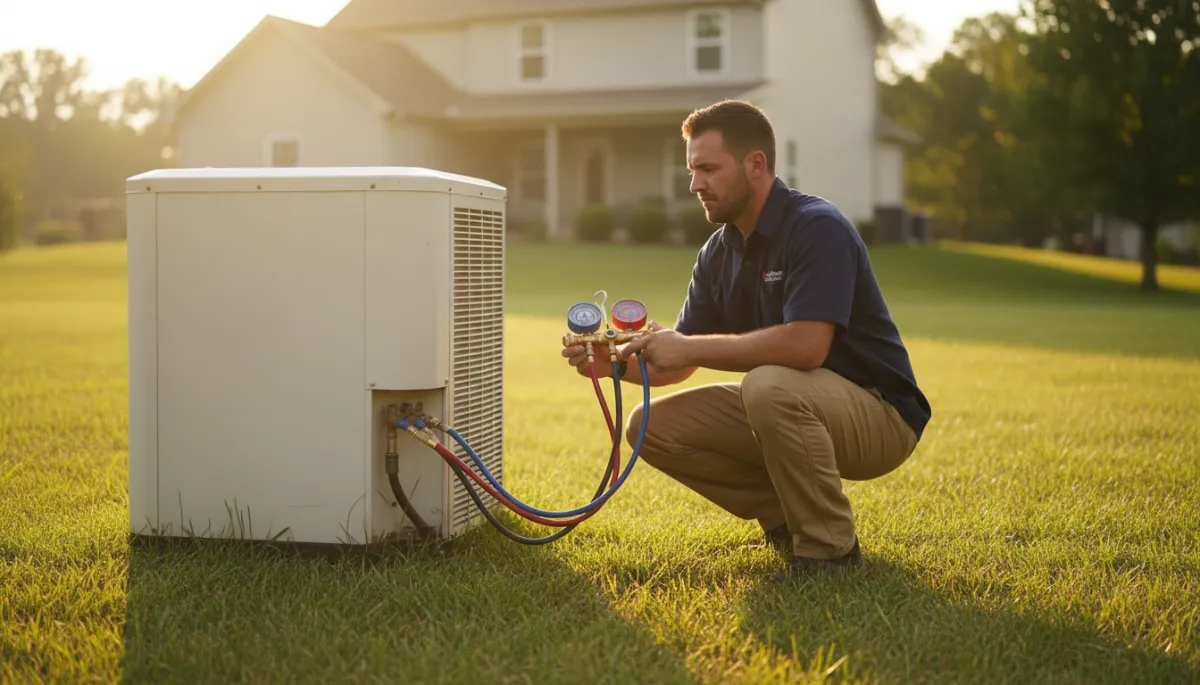
Why Is My AC Blowing Warm Air? A North Mississippi HVAC Tech Breaks It Down
It's August, 103°F feels-like, and you walk inside your house after mowing the yard expecting to hit that wall of cold air — and instead you get a lukewarm breeze out of the vents. Your AC is running. The fan is blowing. But the air coming out isn't cold. Not even close.
I've answered this call a hundred times across Tupelo, Saltillo, Mooreville, and every community in between. The good news is that "AC blowing warm air" has a specific cause every single time — and most of them are fixable without replacing your whole system. The bad news is that a few of them mean you need a tech out there today, not next week.
Let me walk you through every real cause I see in the field, what you can check yourself, and when it's time to call in a professional.
The Quick Answer
If your AC is running but blowing warm air, the most common causes — in order of how often I see them — are: (1) your thermostat is set to "FAN ON" instead of AUTO, (2) the outdoor unit has a tripped breaker, (3) you're low on refrigerant due to a leak, or (4) your system has a failed capacitor. A dirty filter, frozen evaporator coil, or clogged condenser coil are also high on the list. Compressor failure and duct leaks round out the rest.
Start with the easy stuff. Then call me if you're still stuck.

Cause #1: Your Thermostat Is Set to "FAN ON" Instead of "AUTO"
I'm going to start here because it's the most common surprise call I run — and I'm not saying that to make anyone feel bad. This happens constantly. You walk to the thermostat, and the fan is set to "ON" instead of "AUTO." When it's on "ON," the blower runs continuously, even when the system isn't actively cooling. So you're getting room-temperature air pushed through the vents between cooling cycles. It feels warm. It is warm. But your AC is actually fine.
Fix: Switch your thermostat to "AUTO." Done. No charge. Call me next time for something harder.
Cause #2: The Breaker to Your Outdoor Unit Tripped
This one catches people off guard. Most homes have two breakers for the HVAC system — one for the indoor air handler, and one for the outdoor condenser. If the outdoor unit's breaker trips, the indoor air handler keeps running and keeps blowing air — but it's just circulating unconditioned air from inside your home. No cooling happening at all.
Walk to your breaker box and look for a double-pole breaker labeled "AC," "HVAC," or "Condenser." If it's tripped (sitting halfway between on and off, or fully in the off position), flip it fully off, then back on. Then walk outside and listen — you should hear the outdoor unit kick back on within a minute or two.
Important: If the breaker trips again right away, don't keep resetting it. A breaker that won't hold is telling you something is pulling too many amps — a failing capacitor, a bad contactor, or a struggling compressor. That's when you need a licensed tech. I'm licensed for both HVAC and electrical work, so that's a call I'm built for.
Cause #3: Low Refrigerant (You Have a Leak)
This is one of the most common diagnoses I make in the field — especially on systems that are 8 to 15 years old. Refrigerant is what actually moves heat out of your home. It absorbs heat from the air inside, carries it outside, and releases it into the outdoor air. When you're low, the system loses its ability to pull heat efficiently — and what comes out of your vents starts feeling less cold, then warm, then useless.
Here's what a lot of people don't understand: refrigerant doesn't get consumed like gasoline. If your system is low, it leaked somewhere. Adding refrigerant without finding and fixing the leak is like filling a bucket with a hole in it — you'll be calling again in six months with the same problem and another bill.
Signs you may have a refrigerant leak: air that blows cool but never gets cold enough, ice forming on the copper refrigerant lines, a faint hissing or bubbling sound near the equipment, your AC running almost constantly without reaching temperature, and utility bills creeping up for no obvious reason. If you're seeing any of these — whether you're in Verona, Plantersville, or out in New Albany — give us a call. We'll locate the leak, repair it, and recharge the system properly.
Cause #4: Dirty or Clogged Air Filter
A severely clogged filter doesn't just degrade your air quality — it can cause your evaporator coil to freeze, your system to short-cycle, and yes, warm air to blow out of your vents. When airflow gets restricted enough, heat transfer breaks down. The fix is simple and costs you nothing but a quick trip to the hardware store.
Pull your air filter right now. If it's grey or brown and you can't hold it up to a light and see through it, it's overdue for a swap. In a Mississippi summer, with your system running nearly nonstop, I recommend checking your filter every 30 days minimum. Pets, dusty environments, gravel driveways — check every 2 to 3 weeks.

Cause #5: Frozen Evaporator Coil
Your evaporator coil — the one inside your indoor air handler — can literally ice over in the middle of a Mississippi August. When airflow is restricted (dirty filter, blocked return vents) or refrigerant is low, the coil gets too cold and moisture in the air freezes on it. Once it's encased in ice, it can't absorb heat from the air flowing past it. The result: warm air blowing out of your vents, sometimes with noticeably reduced airflow.
How to spot it: look at the copper refrigerant lines coming out of your indoor unit. If you see frost or ice building up on them, that's your sign. The immediate fix is to switch the system to "FAN ONLY" and let it thaw for a few hours — never use a heat gun or anything sharp near the coil. Once it's thawed, replace your filter and see if that was the cause. If the problem comes back, it's likely a refrigerant issue and you need a tech with gauges.
Cause #6: Dirty Condenser Coil (Outdoor Unit)
Your outdoor condenser unit has coils that release the heat pulled out of your home into the outside air. If those coils get coated in cottonwood seeds, grass clippings, pollen, or general grime — and they will if you skip annual maintenance — the system can't shed heat efficiently. It works harder, your efficiency tanks, and eventually the air at your vents stops feeling cold.
I ran a call in Amory last month where the homeowner's AC was running constantly and barely keeping up. Everything checked out — refrigerant charge was fine, capacitors were good, filter was clean. But the outdoor unit was packed with cottonwood. We rinsed the coils, cleared the fins, and the system started cooling like it was brand new. Annual maintenance prevents this. It's cheap compared to what happens when a compressor overheats because of blocked airflow.
Cause #7: Failed Capacitor
Capacitors are small cylindrical components in your outdoor unit that give the compressor and fan motors the electrical kick they need to start. Think of them like a battery for your motor's ignition. When a capacitor fails — and they fail more in summer because of the heat — the motor either doesn't start at all or runs weakly and inefficiently.
If you look outside and the outdoor unit is running (you can hear it) but the fan blade isn't spinning, a bad capacitor is often the culprit. You might also hear a humming or clicking sound coming from the unit as the compressor tries and fails to start. Capacitor replacement is one of the more straightforward AC repairs — typically in the $150 to $300 range for parts and labor. Don't let anyone quote you a full system replacement when a capacitor is the actual problem.
Cause #8: Compressor Failure
I'm not going to sugarcoat this one. A failed compressor is the worst-case scenario for AC repair. The compressor is the heart of the system — it pumps refrigerant through the cycle. If it's dead, you have no cooling, period.
Signs of a failing or failed compressor: the outdoor unit hums or clicks but doesn't run, the system pulls high amps and trips the breaker, you notice loud grinding or rattling from the outdoor unit, or the system simply won't cool regardless of everything else checking out. If you're in Mantachie or Fulton with a system that's 12+ years old showing these symptoms, let's have an honest conversation about repair versus replacement. I'll give you both numbers and let you decide — I'm not here to push you toward a new system when a repair makes sense, and I'm not going to let you sink money into a failing unit either.
Cause #9: Duct Leaks
Your ductwork carries conditioned air from the air handler to every room in your home. In older homes — and there are a lot of them in North Mississippi — duct connections can come loose, and ducts can develop holes, especially in unconditioned attics that hit 130°F in the summer. When that conditioned air leaks into the attic before it reaches your vents, you get weaker airflow and warmer air at the registers.
A telltale sign: one part of your home stays comfortable while other rooms feel warm, even with the system running hard. If you've ruled out everything else and certain rooms just won't cool down, a duct inspection could reveal a disconnected section blowing cold air straight into your ceiling. Duct sealing and repair can dramatically improve your efficiency without touching the HVAC equipment at all.
What You Can Check Yourself vs. What Requires a Licensed Tech
Do this yourself first:
- Check your thermostat — make sure it's set to COOL and FAN is set to AUTO
- Check your breaker panel for a tripped breaker labeled AC, HVAC, or Condenser
- Check and replace your air filter
- Clear away debris, grass clippings, or shrubs around the outdoor unit
- Look for ice on refrigerant lines — if present, switch to FAN ONLY and let it thaw
Call a licensed HVAC tech for:
- Anything involving refrigerant — federal law requires EPA 608 certification to handle refrigerants
- Capacitor or contactor replacement
- Any electrical diagnosis inside the outdoor unit
- Compressor testing and diagnosis
- Duct inspection and sealing
- Any situation where the breaker keeps tripping after reset
Frequently Asked Questions
Why is my AC running but not cooling the house?
If your air handler is running but no cool air is coming through the vents, the most likely causes are a tripped breaker to the outdoor condenser unit, a frozen evaporator coil, low refrigerant, or a failed capacitor preventing the compressor from starting. Begin with the breaker panel and thermostat setting. If those are fine, you need a tech with gauges to properly diagnose the system.
How do I know if my AC is low on refrigerant?
The signs are: air that blows but never gets cold enough to satisfy the thermostat, visible ice on the refrigerant lines near the indoor or outdoor unit, a hissing or bubbling noise from the equipment, longer-than-normal run times, and higher-than-expected utility bills. Refrigerant levels cannot be accurately assessed without professional gauges, and handling refrigerant requires EPA 608 certification. Call us and we'll test the charge and find any leaks.
Can I recharge my AC myself?
No — not legally and not safely for residential systems. The "AC Pro" cans at auto parts stores are designed for car AC systems only. Using them on your home HVAC can damage components and void your system warranty. More importantly, low refrigerant always means a leak — adding refrigerant without locating and repairing the leak is temporary at best and wasteful at worst. A licensed tech will find the leak, fix it, and charge the system correctly.
Why does my AC blow cold air for a while and then warm air?
That pattern is a classic frozen evaporator coil. The system cools normally at first, but the coil gradually ices over — restricting airflow and blocking heat transfer. Once it's frozen, warm air blows through. It thaws during off-cycles, the system cools briefly again, then refreezes. The underlying cause is either restricted airflow (start with your filter) or low refrigerant. If replacing the filter doesn't stop the pattern, call an HVAC tech.
How much does AC repair cost in Mississippi?
Here's what I see in the field: service call and diagnostic runs $75–$125; capacitor replacement $150–$300; refrigerant recharge with leak repair $300–$800+ depending on refrigerant type and leak location; contactor replacement $150–$250; coil cleaning $100–$200; compressor replacement $1,200–$2,500+ (often leads to a full system conversation on older units); new system installation $4,000–$10,000+ depending on size and efficiency rating. I'm upfront about pricing before work starts — no surprises on the invoice.
The Bottom Line: Don't Sweat It Out — Get It Fixed
In North Mississippi, your AC isn't a luxury — it's survival equipment in August. Whether you're in a brick rancher in New Albany, a new build out in Saltillo, a farmhouse near Mantachie, or running a business in downtown Tupelo, warm air from a running AC system is a problem that needs an answer fast.
Most of the causes I've covered here are fixable quickly and affordably. Some of them you can handle in the next ten minutes. The ones that require a licensed tech — refrigerant leaks, electrical faults, compressor diagnosis — we're ready to come out and get it right the first time.
Check out our HVAC repair services page to see everything we handle, or schedule a service call online anytime. We cover Tupelo, Saltillo, Verona, Plantersville, Mooreville, Mantachie, Fulton, Amory, New Albany, and all of Northeast Mississippi.

Ready to Get Cool Again? Call Us.
If your AC is blowing warm air and you want a real answer from a licensed North Mississippi tech, call or text us at 662-523-5514. We'll diagnose the problem honestly, give you a straight price, and get your system cooling again — usually same day or next day.
Don't wait for a full breakdown in the worst heat of the year. The sooner we catch it, the simpler — and cheaper — the fix.