Why Does My Circuit Breaker Keep Tripping in Summer? A North Mississippi Electrician Explains
It was a Tuesday afternoon in late July — heat index sitting right at 108° outside Saltillo — when a homeowner called me in a panic. She'd been home with the kids all day, central AC running since sunup, and right around 3 PM the living room breaker tripped for the third time that week. I could hear the frustration in her voice. She was standing in the utility room resetting the same breaker she'd been babying since June, not knowing whether she had a minor annoyance or a house fire waiting to happen.
That call isn't unusual. Every summer, from Tupelo to Verona, from New Albany to Amory, I get a steady wave of these. Breakers that held fine all winter start acting up the moment the heat index cracks 100. And most homeowners don't know if they're dealing with a $150 fix or a $2,500 panel replacement.
I'm Dan Southwick — owner of S.I. Service Group and a licensed electrician serving Northeast Mississippi. Let me break this down the way I explain it on a service call: what's actually happening, why summer makes it worse, and what we look for when we show up at your door.
How a Circuit Breaker Is Supposed to Work
Your circuit breaker has one job: protect your wiring. Every wire in your home is rated to carry a specific amount of electrical current — measured in amps. When too much current flows through a wire, it heats up. Left unchecked, that heat melts the wire insulation and can start a fire inside your walls where you can't see it or smell it until it's already a problem.
The breaker acts like a pressure valve. When the current in a circuit exceeds its rated limit — usually 15 or 20 amps for a standard household circuit, 30 to 50 amps for a central AC circuit — the breaker trips. The circuit goes dead and the wiring is protected. That's not a malfunction. That's exactly what it's designed to do. The question is why it's doing it too often, and whether the thing triggering it is something simple or something serious.
The Most Common Reasons Circuit Breakers Trip in Summer
Overloaded Circuit
This is the number one cause I see, and it shows up constantly in older homes across Plantersville, Mooreville, and Mantachie where the electrical layout hasn't changed since the house was built decades ago.
Think about what's running on a scorching July afternoon: central AC pulling full load, a window unit in the back bedroom, box fans circulating air on every floor, the refrigerator cycling on, the dishwasher finishing a load, a TV, a couple of phone chargers, maybe a gaming system or two. When too many of those loads share the same circuit, the total amperage climbs past what the breaker is rated for — and it trips.
The fix might be as simple as moving some loads to different outlets on different circuits. But if your home regularly can't handle the summer demand, the real answer is usually adding dedicated circuits. Most modern homes should have dedicated 20-amp circuits for areas like the kitchen, home office, and laundry — not sharing those runs with half the house.
A Worn or Weak Breaker
Breakers are mechanical devices with metal contacts inside. Every time they trip and reset, those contacts wear a little. An older breaker that's been tripping repeatedly for years can start failing at loads well below its rated amperage — what electricians call a nuisance trip. The wiring is fine. The load is fine. The breaker is just done.
I see this regularly in homes built in the late 1980s and 1990s. The breaker says 20 amps on the handle, but it's tripping at 14 or 15.
Here's where this gets more serious: if your home has a Challenger, Federal Pacific (Stab-Lok), or Zinsco panel, we're talking about a different level of concern entirely. These brands have well-documented failure histories — they don't always trip when they should, or they trip when they shouldn't, and in some cases a breaker can appear fully reset while internally still failed. If your home has one of these panels, the conversation goes well beyond just swapping a breaker. Those panels need a thorough evaluation by a licensed electrician, and in most cases I recommend replacement.
Undersized Wiring for Today's Loads
Old wiring is its own chapter. Homes built before the early 1970s sometimes have 14-gauge wire on circuits where 20-amp breakers were later installed — a mismatch that puts the wire at risk every time the circuit is loaded up. In other cases, the home was simply wired for much lighter electrical demands than what a modern family runs today.
I've been in older homes in Verona and out in the Mantachie area where the wiring genuinely can't keep pace with what's plugged in. The breaker tripping there isn't a failure — it's doing the right thing. But the long-term answer isn't a new breaker; it's updated wiring on those circuits, and in some cases a service upgrade to the whole panel.
Short Circuit or Ground Fault
Not all tripping is about overload. A short circuit — where a hot wire contacts a neutral or ground conductor — or a ground fault, where electricity takes an unintended path to ground, can both trip a breaker instantly and hard. These faults can happen inside an appliance, inside an outlet, or within the wiring itself behind the walls.
The timing is the diagnostic clue. A short circuit usually trips the breaker the moment you plug something in or flip a switch. An overload trips more gradually as heat builds up during extended use. If your breaker goes the second you turn something on, that's a very different diagnostic path than one that holds all morning and then trips when the AC cycles on at 2 PM.
Your AC Unit Is Hard-Starting
This one surprises a lot of homeowners, but I see it regularly on calls in the Fulton and Amory areas. Central AC compressors draw a significant surge of current every time they start up — often four to six times the normal running amperage for a fraction of a second. On a new, healthy compressor that startup surge is brief enough that the breaker doesn't see it long enough to respond. On an aging compressor that's struggling, that surge becomes longer and harder, pulling more amps than the circuit can handle before the breaker has to respond.
A hard-starting compressor can sometimes be helped with a start capacitor or a hard-start kit — primarily an HVAC fix rather than an electrical one. But if the compressor itself is failing, it's going to keep hammering that breaker until the underlying problem gets addressed. At S.I. Service Group we work both sides — HVAC and electrical — so we can usually sort out which one is actually driving the problem on a single visit.

Warning Signs It's More Than a Nuisance Trip
Resetting a breaker once during a brutal summer afternoon isn't a crisis by itself. But these are the signs I tell homeowners to treat as urgent — don't ignore them and don't keep resetting and hoping:
- Burning smell near the panel, an outlet, or a switch. That's electrical insulation breaking down under heat. Stop what you're doing and call a licensed electrician the same day.
- The breaker or the panel cover feels warm or hot to the touch. A properly functioning breaker shouldn't be noticeably hot. Warmth means something is wrong — undersized breaker, failing contacts, or a loose connection generating resistance heat.
- Scorch marks or blackening around the breaker face, an outlet, or a switch plate. This means arcing has already happened inside the device. That's a fire risk, full stop.
- The breaker won't stay reset. If it trips again immediately after you reset it, there's a live fault on that circuit. Don't keep forcing it — you'll either put yourself at risk or mask a problem that needs proper diagnosis.
- Lights flickering or dimming when the AC kicks on. This points to a voltage drop problem — undersized service, a failing breaker, or a loose connection somewhere in the system — and it deserves a look from a licensed electrician before it becomes something worse.
What a Service Call Actually Looks Like
When I pull up to a home in Mooreville or drive over to Saltillo on an electrical call like this, here's what actually happens — because I think it helps to know what you're paying for before someone shows up at your door.
First, we talk through the history. When does it trip? After how long does it hold? What's running on that circuit when it goes? That conversation narrows the likely cause before I ever open the panel. A breaker that trips the instant you plug in the microwave is a completely different problem than one that holds all morning and then trips when the AC cycles on at noon.
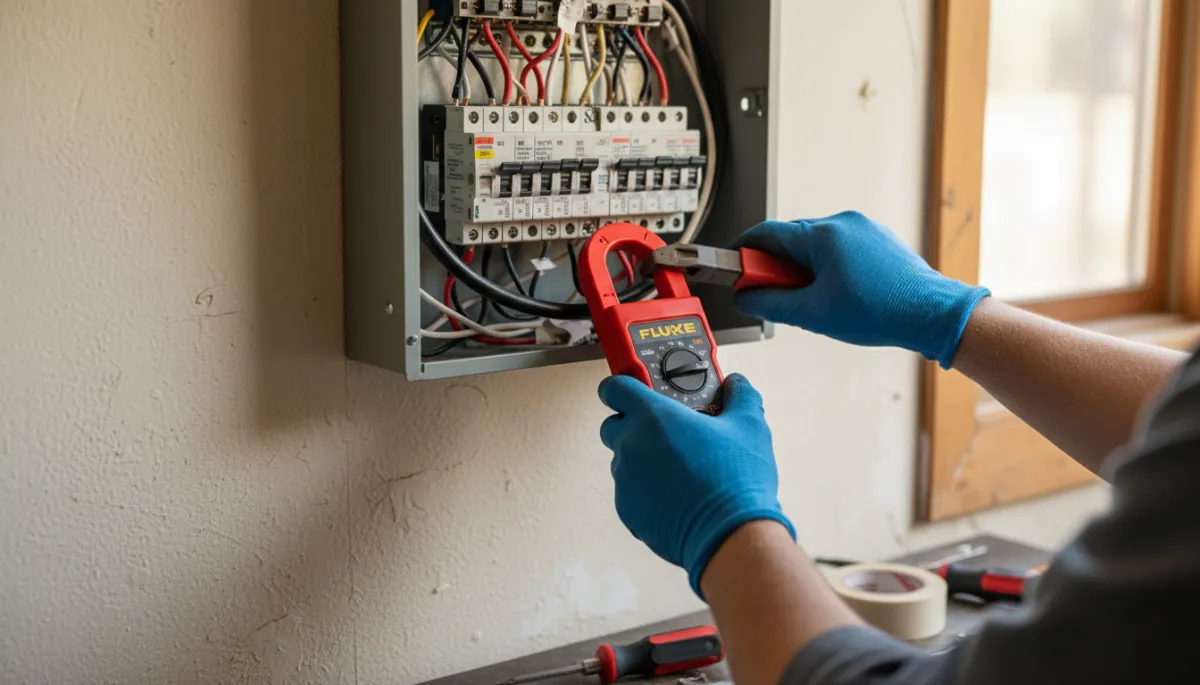
Then I'll put a clamp meter on the circuit and measure the actual current draw under real load. That tells me immediately whether the circuit is genuinely overloaded or whether the breaker is failing below its rated amperage. There's no guessing involved — the numbers tell the story.
I check the breaker itself — brand, approximate age, whether it shows any signs of heat damage or physical wear on the contacts. I check all the connections at the panel, because a loose connection generating heat is one of the most common causes of both nuisance tripping and actual electrical fires. Then I look at the panel as a whole: age, brand, available capacity, whether there's room to add circuits if that's what's needed.
Most straightforward service calls like this run one to two hours. A breaker swap takes less time than that. A panel that needs a full safety evaluation, a circuit that needs to be re-run, or a service upgrade — those are bigger conversations, but we'll tell you exactly what we found and what it takes to fix it before any work begins. You can learn more about what we cover on our electrical services page, or see what's involved in a full panel upgrade here.

Frequently Asked Questions
Can I replace the breaker myself?
Mississippi doesn't outright prohibit homeowners from doing electrical work on their own residence — but I'd strongly advise against opening a panel unless you genuinely know what you're doing. The panel is always energized up to the main breaker, and the service entrance wires coming in from the utility are live all the time with no way to shut them off without the utility company pulling your meter. One wrong contact with those conductors can kill you. Beyond the safety concern, if you swap a breaker and it's not actually the problem, you've spent money and time and you're right back where you started. Get the diagnostic first — then decide what makes sense.
What size breaker does a central AC unit need?
It depends on the unit's nameplate data — specifically the Minimum Circuit Ampacity (MCA) and Maximum Overcurrent Protection (MOP) ratings printed directly on the data tag of the unit itself. Most residential central AC systems run on 240V circuits with breakers in the 30 to 50 amp range, depending on tonnage and efficiency rating. Never assume. Always match the breaker and wire size to what the manufacturer specifies for that exact unit. I've found oversized breakers on undersized circuits in homes around New Albany and Amory — a combination that lets wire overheat without the breaker tripping, which is the opposite of the protection you need.
How do I know if my panel is undersized?
Signs your electrical service may be undersized include: breakers that trip frequently under normal summer loads, lights that visibly dim when the AC or another large appliance starts, no open slots left to add new circuits, and a 100-amp main service when your home runs an electric range, electric water heater, central AC, and modern electronics. Many older homes across Northeast Mississippi were built with 100-amp service that was adequate for 1975 but genuinely struggles with today's demand. A 200-amp service upgrade is often the right call, and it's something we evaluate and install regularly across the region.
Is a tripping breaker dangerous?
A breaker tripping is protection — that's the design working correctly. The real danger comes from ignoring the underlying cause, repeatedly resetting a breaker that won't stay reset (a live fault is still there), or having a panel brand — Federal Pacific, Challenger, Zinsco — where the breakers are documented to fail in ways that skip the trip entirely and let a fault run until wiring overheats. If your panel is one of those brands and you're experiencing any electrical issues at all, get it evaluated by a licensed electrician. That's not something to monitor and wait on.
How much does it cost to fix a tripping breaker in Northeast Mississippi?
A diagnostic service call with a licensed electrician typically runs in the $100–$175 range across most of Northeast Mississippi. A single breaker replacement is usually $150–$300 depending on type, brand, and whether special-order breakers are required for your panel. If the issue is a circuit addition, a wiring run, or a full panel replacement, costs vary more widely — but we give you a straight written quote before any work begins. No surprises, no pressure. We believe in telling you what we found, what it takes to fix it, and what it costs before we touch anything.
The Bottom Line
A breaker that trips once on the hottest day of July isn't the end of the world. A breaker that keeps tripping, a panel that runs warm to the touch, a circuit that smells like something's burning — those are signals worth taking seriously, and the right move is to have a licensed electrician look at it before a manageable problem becomes an emergency.
We serve homeowners and businesses across Tupelo, Saltillo, Verona, Plantersville, Mooreville, Mantachie, Fulton, Amory, New Albany, and the surrounding communities of Northeast Mississippi. If you're dealing with a tripping breaker, a panel that needs evaluation, or any electrical concern this summer, give us a call or text at 662-523-5514. We'll come out, tell you straight what we find, and give you a clear picture of what it takes to fix it — no runaround, no pressure.