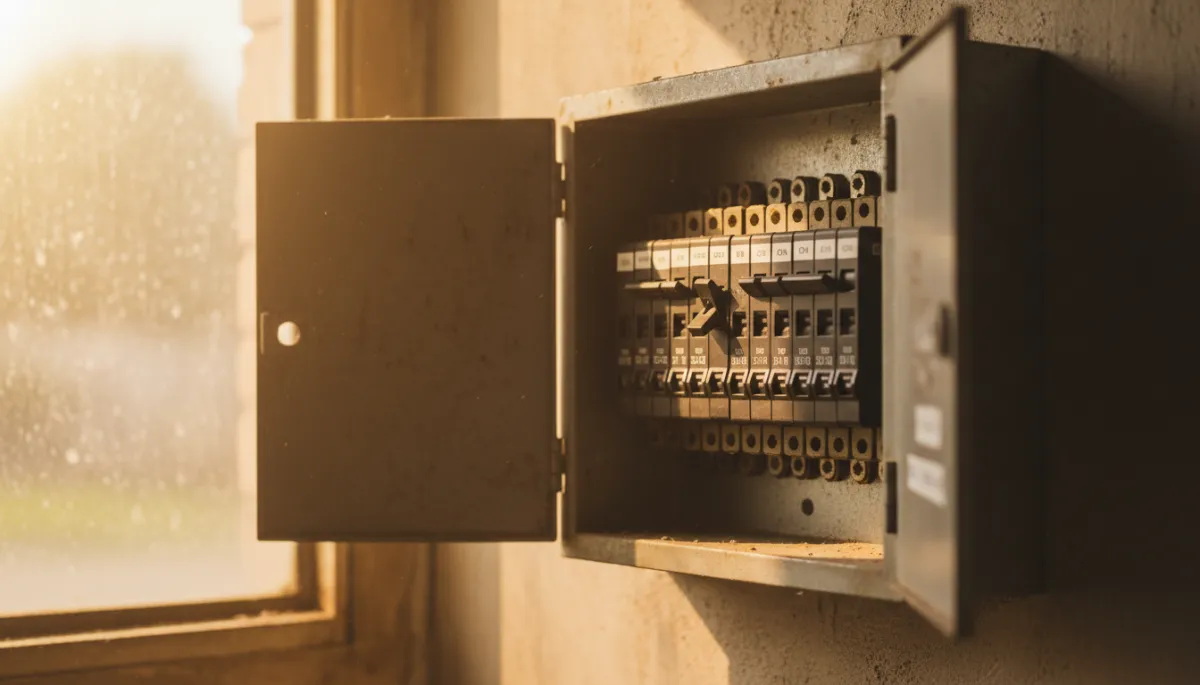
Why Does My Breaker Keep Tripping When the AC Runs? What Homeowners in Tupelo, MS Need to Know
It was a Tuesday afternoon in July — one of those days in Tupelo where the heat index is pushing 105°F and everybody's AC is running wide open. I got a call from a homeowner over in Saltillo whose power had cut off for the third time that week. Every time it happened, he'd go to the panel, reset the breaker for the AC, and everything would be fine — for about 20 minutes. Then it'd trip again.
He thought his air conditioner was broken. He was ready to call an HVAC company and spend a thousand dollars on a new unit. But I told him to hold off. Because nine times out of ten, when an AC breaker keeps tripping in the middle of a Mississippi summer, the problem isn't with the air conditioner — it's with the electrical system.
I've been doing electrical and HVAC work across Northeast Mississippi for years. I've seen this exact scenario play out in Mooreville, Verona, Plantersville, and a dozen other towns. So if your breaker keeps tripping every time the AC kicks on, this post is for you. Let's break down exactly what's happening — and what you should do about it.
First, What Does a Breaker Actually Do?
Before we talk about why it trips, it helps to understand what a circuit breaker is actually designed to do.
A breaker is a safety device. Its entire job is to shut off the flow of electricity when too much current is running through a wire. When your wires carry more amperage than they're rated for, they heat up. Heat up enough, and you've got a house fire. The breaker trips to prevent that from happening.
So when your AC keeps tripping the breaker, your panel is actually doing exactly what it's supposed to do — protecting you. That's the good news. The bad news is that something is wrong, and resetting the breaker over and over isn't a fix. It's just delaying the conversation you need to have with a licensed electrician.
The Most Common Reasons Your AC Trips the Breaker
1. The Breaker Is Old and Worn Out
Breakers don't last forever. Most residential breakers are rated for a certain number of trips, and after enough heat cycles over 15–25 years, they get weak. I've pulled breakers out of panels in Amory and New Albany that look perfectly fine on the outside but test well below their rated amperage. A worn breaker might trip at 15 amps even though it's supposed to hold to 30.
If your home is more than 15–20 years old and you've never had electrical work done, a tired breaker is one of the first things I check. The fix is straightforward — replace the breaker. But the root cause has to be diagnosed correctly first, because a new breaker doesn't help if the real problem is something else on this list.
2. The AC Is Drawing Too Much Current
Your air conditioner pulls the most power right when it starts up — what's called the startup or "locked rotor" amperage. In a healthy unit, that spike is brief and the draw settles down to normal operating current within a second or two.
But when something is wrong with the AC — a failing compressor, a bad capacitor, low refrigerant — the unit struggles to start and keeps pulling high current for too long. That sustained high draw is what trips the breaker. In that case, the breaker is doing its job. You've got an AC problem that needs HVAC repair — not an electrical fix.
3. The Circuit Is Overloaded
Most central AC systems in North Mississippi need a dedicated 240-volt circuit sized correctly for the unit — typically a 30-amp or 40-amp double-pole breaker, depending on the tonnage and equipment specs. If your AC was installed on a circuit that's too small for the unit, it's going to trip that breaker every time the load peaks.
I've seen this come up when homeowners replace an older, smaller AC unit with a newer, bigger one without updating the electrical. The new unit draws more power than the old circuit was designed for. That's a wiring and panel issue, and it needs to be corrected before you damage something or create a fire hazard.
4. You've Got a Double-Tapped Breaker
A double-tapped breaker is exactly what it sounds like — two wires connected to a single breaker that was only designed for one. This is a code violation in most jurisdictions, and it's more common than you'd think in older homes around Mantachie, Fulton, and throughout Lee and Itawamba counties.
When you double-tap a breaker, the shared circuit is overloaded. If the AC happens to be sharing a breaker with another load — say, a water heater or dryer circuit that got tacked on improperly — it doesn't take much for the combined draw to exceed what that breaker is rated for.
5. The Wiring Is Undersized
Wire gauge matters. A 30-amp circuit needs wire that can safely carry 30 amps continuously. If the wire running from your panel to your AC disconnect is undersized — say, 10-gauge wire on a circuit that really needs 8-gauge — it heats up under load. The breaker detects the excess current and trips to prevent a meltdown inside your walls.
This kind of situation needs a full electrical inspection to catch. You won't see it by looking at the panel. It requires tracing the circuit from end to end — the kind of diagnostic work a licensed electrician does on every service call.
6. Your Panel Is at Capacity
Some homes — especially older ones built in the 1970s and 80s — were originally wired with 100-amp service and panels that are now completely maxed out. Every slot is full, and the total load the house is pulling is right up against what the panel can safely handle.
When a heavy load like an air conditioner kicks on during a peak afternoon, the system has no headroom. Breakers start tripping not because any one circuit is overloaded, but because the panel as a whole is being pushed past its limits. The answer here is an electrical panel upgrade to 200-amp service — something I do regularly for homeowners throughout Northeast Mississippi who are adding new equipment or dealing with persistent electrical problems.
7. Summer Heat Is Making the Breaker Brittle
Here's one most people never think about: panels get hot. In July in Mississippi, if your electrical panel is in an unconditioned space — a utility room without AC, a garage, or a tight closet with poor airflow — the panel itself can reach temperatures that cause a marginal breaker to trip under loads it would normally handle fine on a cooler day.
I've had service calls in Verona and Plantersville where the breaker held fine at 9 a.m. but tripped by 2 p.m. every day. Ambient temperature was the entire cause. Sometimes improving ventilation around the panel helps. Sometimes the breaker needs replacing. Sometimes both.

Is It the Breaker or the AC? How to Tell
This is the question I get most often on service calls. Homeowners want to know: do I call my HVAC contractor or my electrician?
Here's my rule of thumb: if the AC runs for a while and then trips — especially during peak load in the afternoon heat — the AC is probably the culprit. It's working hard, the compressor is struggling, and the current draw climbs until the breaker gives up. That's an HVAC repair situation.
If the breaker trips immediately when the AC tries to start — or if you reset it and it trips again within a minute or two — that's more likely an electrical issue. The circuit may be undersized, the breaker may be worn out, or there's a wiring problem somewhere. Either way, that means calling a licensed electrician.
And if you're not sure which it is — call me. I do both electrical and HVAC work, so I can diagnose the whole picture at once instead of bouncing you between contractors who each point at the other guy.
What You Should Never Do When a Breaker Keeps Tripping
I can't tell you how many times I've arrived at a job where the homeowner has been resetting the breaker 10 times a day for two weeks straight. I understand the impulse — it's 97 degrees outside and you've got kids in the house. But repeatedly resetting a tripping breaker is one of the most dangerous things you can do, and here's why:
- Breakers weaken with every trip. Each time it trips and gets reset, the internal mechanism degrades a little more. Eventually it may stop tripping altogether — meaning it'll let current flow even when it shouldn't. That's when wires melt and fires start.
- The underlying problem doesn't go away. Resetting the breaker doesn't fix what's causing it to trip. The wires are still overheating, the compressor is still struggling, the panel is still at capacity.
- Never replace a breaker with a higher-rated one to "fix" the tripping. I've seen this. Swapping in a 40-amp breaker where a 30-amp lived doesn't solve anything — it just removes the protection. Now instead of a tripping breaker, you've got wires that can overheat without shutting off the circuit. That's how structure fires happen.
- Don't open the panel yourself. I know there are YouTube tutorials for everything. But residential panels carry lethal voltage even with the main breaker switched off, because the lines coming in from the utility are always live. This is not a DIY situation — ever.
When It's Time to Call a Licensed Electrician
Pick up the phone and call a licensed electrician when:
- Your AC breaker has tripped more than once or twice in the same season
- The breaker trips immediately when the AC tries to start
- You see scorch marks around any breaker or smell burning near the panel
- Multiple breakers are tripping — not just the AC circuit
- Your home is older than 20 years and the panel has never been inspected
- You're upgrading to a larger AC unit and need to know if your wiring and panel can handle it
An electrical inspection isn't just about fixing what's already broken — it's about catching what's about to break before it becomes a fire or a $4,000 emergency. I offer whole-home electrical evaluations for homeowners throughout Tupelo, Mooreville, Saltillo, New Albany, Amory, Fulton, and all of Northeast Mississippi.
Frequently Asked Questions
Can I replace the breaker myself?
Technically possible, but I'd strongly advise against it. Even with the main breaker off, the conductors entering your panel from the utility are always live at 240 volts — enough to be lethal. Beyond the safety risk, an incorrectly installed breaker can cause fires or damage your equipment. Breaker replacement is a quick, affordable job for a licensed electrician. Don't risk your life over a $75 part.
How much does it cost to replace a breaker in Mississippi?
A standard single or double-pole breaker replacement typically runs $150–$300 depending on breaker type, panel brand, and access. If your panel uses a discontinued breaker — older Federal Pacific or Zinsco panels are notorious for this — costs can be higher, and we'd often recommend a full panel upgrade in those cases anyway since those panels have known safety issues.
What size breaker does a central AC need?
Most residential central AC systems in North Mississippi require a double-pole breaker — typically 30, 40, or 50 amps depending on the unit's size and rated specs. The correct breaker size is printed on the data plate of your outdoor condenser unit under "MCA" (minimum circuit ampacity) and "MOP" (maximum overcurrent protection). The breaker must match those ratings — not the previous owner's best guess. If you're unsure, I can check it when I'm out there.
Will a tripping breaker damage my AC unit?
It can, yes. Compressors don't love repeated hard starts and sudden shutdowns, especially when they're already under stress from whatever is causing the high current draw. Repeated power interruptions during startup can shorten compressor life significantly. If your AC has been tripping the breaker regularly for weeks, it's worth having both the electrical system and the HVAC equipment evaluated before something more expensive fails on the hottest day of the year.
Is it safe to keep resetting the breaker until I can get someone out?
If it tripped once and has held fine for days — maybe. But if it's tripping repeatedly in the same day, stop resetting it. Keep the breaker off, set up fans or a portable window unit if you have one, and call for service. Short-term discomfort beats a house fire every time. For homeowners in Tupelo and surrounding areas, we do our best to get out the same day for urgent electrical issues during summer — call us at 662-523-5514.
How much does a panel upgrade cost in North Mississippi?
A 200-amp panel upgrade in Northeast Mississippi typically runs between $1,800 and $3,500 depending on the home's age, scope of work, and whether permits and inspections are required (they usually are, and we handle all of that). It's a real investment, but it's a one-time fix that increases your home's safety, resale value, and capacity for everything you want to run — EV chargers, generator hookups, additional circuits — for the next 30 years.
The Bottom Line
A breaker that trips when your AC runs isn't just an inconvenience — it's a signal. Something in your electrical system is out of spec, something in your AC is struggling, or both. The good news is that most of these problems are fixable, and catching them now is a whole lot cheaper than dealing with them after a fire or a blown compressor in the middle of a Mississippi heat wave.
I've been doing this work in Tupelo, Saltillo, Verona, Plantersville, Mooreville, Mantachie, Fulton, Amory, New Albany, and all of Northeast Mississippi for years. I know these homes, I know these panels, and I know how brutal our summers can be on older electrical systems. If something's not right, let's find it and fix it — the right way, the first time.
Don't let a tripping breaker ruin your summer.
Ready to Stop Resetting That Breaker?
Call or text S.I. Service Group at 662-523-5514. We're a licensed electrical and HVAC contractor serving Tupelo, Saltillo, Verona, Plantersville, Mooreville, Mantachie, Fulton, Amory, New Albany, and all of Northeast Mississippi. Same-day service available for urgent electrical issues. No runaround — just real answers and real fixes from a contractor you can trust.