Why Do My Lights Flicker When the AC Turns On? A North Mississippi Electrician Explains
I got a call from a homeowner over in Saltillo last July — dead middle of a 97-degree stretch. She told me every time her AC kicked on, every light in the house would dim for about a second and then come back up. Said she'd been living with it for two summers and figured it was just how old houses worked. I told her that wasn't normal, and I headed out that afternoon. What we found was a severely loose neutral connection at her meter base that was getting worse every single time the compressor cycled. Left alone, that's a house fire — not just a nuisance.
That kind of call comes in a lot during August. The heat is relentless, the AC is running almost nonstop, and the extra electrical stress starts revealing problems that were hiding all winter long. If you're seeing your lights dim or flicker every time the air conditioner kicks on — or even when it's been running a while — I want to walk you through exactly what's going on, how serious it might be, and what to do about it.
What's Actually Happening When Your Lights Flicker
To understand why your lights flicker, you first have to understand how your air conditioner uses electricity. Your AC — especially the outdoor compressor unit — is one of the biggest electrical loads in your home. A typical central air conditioner draws anywhere from 15 to 60 amps depending on the size and efficiency rating, and when that compressor first kicks on, it pulls a surge of current that can be three to six times its normal operating load for a fraction of a second. That's what we call inrush current, and it's enough to cause a noticeable voltage drop on the circuit — or sometimes throughout the whole house — which is why your lights dip momentarily.
A brief, slight dim when the AC first starts? That can be normal, within limits. Lights that flicker dramatically, flicker repeatedly, or stay dim for more than a second or two? That's your electrical system sending you a message, and the message is worth listening to.
The Most Common Causes of Flickering Lights When the AC Kicks On
1. AC Compressor Startup Surge (Inrush Current)
Every time your compressor starts, it draws a massive inrush of current — sometimes six times the normal running amperage for a split second. Older single-speed compressors are the biggest offenders, and they're still very common in North Mississippi homes. If your electrical system is undersized, aging, or already running close to capacity on a hot afternoon, that surge causes a measurable voltage dip across the panel. The fix may be as simple as a hard-start capacitor or soft-starter installed directly on the compressor — a relatively inexpensive component that smooths out that startup surge and also extends the life of the compressor. We address these regularly as part of our HVAC service calls across the area.
2. Undersized or Shared Circuit Wiring
Your central AC unit is supposed to be on its own dedicated circuit — one breaker, one wire run, one load. If that circuit isn't sized correctly for the unit it's serving, or if someone has tapped other loads onto that circuit at some point, every time the AC fires up you're going to feel it everywhere else in the house. I was in a home in Mantachie earlier this year where the previous HVAC company had run a new 3-ton unit off a 20-amp circuit with 12-gauge wire. That unit needed a 30-amp circuit at minimum. They'd been getting away with it for a full year because the breaker wasn't tripping — it was just punishing every other circuit in the panel every single time the compressor started.
3. Loose Connections at the Panel or Disconnect
This one is the most dangerous cause on this list, and I don't say that lightly. A loose connection — at the breaker, at the wire lug inside the panel, or at the disconnect switch mounted next to your outdoor unit — creates resistance. Resistance creates heat. Heat creates arcing. Arcing creates fires. Loose connections are especially common in older homes across areas like Amory, New Albany, and Fulton where the wiring and panel hardware hasn't been touched in 30 or 40 years. These connections get worse over time as they expand and contract with heat cycles and as corrosion sets in. If your lights flicker AND you notice any warm spots on your panel cover, a burning smell, or any discoloration around outlets or switches — that is an emergency. Don't wait on that one.
4. Low Utility Voltage (A Power Company Problem)
Sometimes the problem isn't inside your house at all. Your utility company delivers power to your meter at a standard voltage — typically 240 volts, split into two 120-volt legs. If that incoming voltage is sagging — which happens during peak demand on hot August afternoons across the Tombigbee Electric and TVEPA service areas — your AC struggles to start and your lights will flicker. I can verify this with voltage measurements at the panel. If the voltage is low and there's nothing wrong on your side of the meter, the fix is a call to the utility, not a repair bill for you. That's worth knowing before anyone starts pulling wire.
5. Failing or Undersized Electrical Panel
Older panels are a major factor in flickering-light complaints, especially in the Lee County area where a lot of our housing stock dates back to the 1960s through 1980s. If you have a Federal Pacific Electric (FPE) Stab-Lok panel or a Zinsco panel, I need you to pay close attention: both of those panel brands have well-documented failure modes where breakers don't trip correctly under overload conditions. FPE Stab-Lok breakers are known to fail to trip when they should — and that means the only thing standing between an overloaded wire and a fire isn't working the way it's supposed to. Beyond specific brand issues, a 100-amp service panel trying to power a modern 3-ton or 4-ton AC system alongside a full home's electrical load is simply undersized. A 200-amp panel upgrade isn't a luxury — it's a safety investment that pays for itself in peace of mind.
6. Corroded or Loose Neutral Connection
The neutral wire is the return path for current throughout your electrical system. If the main neutral connection at your meter base or service panel is loose or corroded, it creates an imbalance that causes voltage to fluctuate across your circuits — sometimes dramatically. Symptoms include lights that vary in brightness without any obvious trigger, flickering in some rooms worse than others, and electronics that behave erratically. We tracked down this exact problem at a home in Plantersville last fall — a homeowner had been dealing with mysterious electrical weirdness for months, getting progressively worse. The main neutral lug at the meter base had corroded severely. It doesn't happen on every job, but when it does, it's one of the most dangerous conditions we find.
When Is Flickering Dangerous vs. Just Annoying?
When someone calls me with a flickering-lights complaint, I help them triage it over the phone. Here's a quick guide:
Probably okay — get it checked soon:
A brief, subtle dim of one to two seconds that happens only when the AC first starts, lights immediately return to full brightness, no other symptoms present.
Get it checked this week:
Flickering happens across multiple circuits or throughout the house. The flicker lasts more than a second or two. It's getting noticeably worse over time. You have a Federal Pacific, Zinsco, or unbranded panel. You have 100-amp service with a newer, larger AC system installed in the last ten years.
Call immediately — don't wait:
There is a burning smell near your panel, outlets, or switches. The panel cover feels warm or hot. You see scorched or discolored outlets, covers, or wiring. The flickering is accompanied by crackling or buzzing sounds. Your breaker is tripping repeatedly. Lights are getting dramatically brighter or dimmer without any obvious cause.
That last group is a fire and safety emergency. I mean that literally — don't just reset a breaker and go back to bed. Call us or your utility company right away.
What We Check First When We Get the Call
When I pull up to a flickering-lights-and-AC complaint, here's my field diagnostic sequence:
Step 1 — Voltage at the panel. I take readings on both legs of incoming service. I'm checking for low voltage from the utility and for voltage imbalance between the two legs, which can point immediately to a neutral issue.
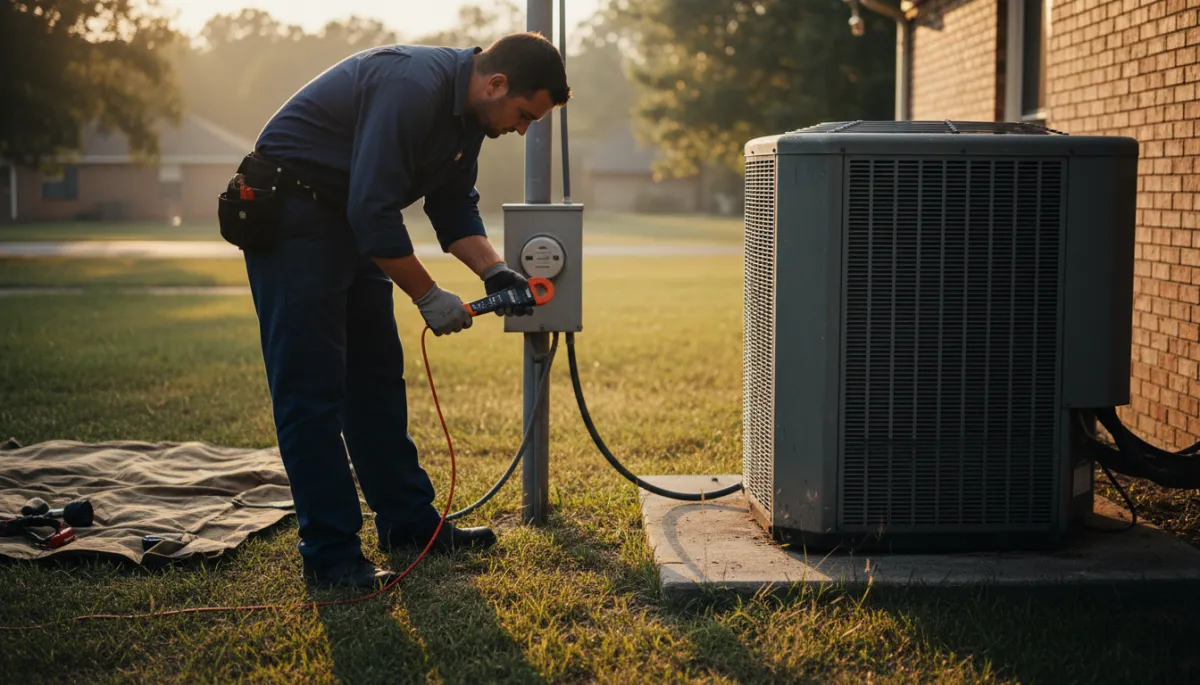
Step 2 — AC startup amp draw. I use a clamp meter to measure the amperage at the moment the compressor kicks on and compare it against the nameplate rating and the breaker size. If the inrush is way above normal, a hard-starting compressor or a failing capacitor may be the culprit — both fixable without replacing the whole unit.
Step 3 — Panel inspection. I open the panel and look at connections, check for heat damage, discoloration, corrosion, and verify that the AC circuit is the correct gauge and a true dedicated circuit with nothing else sharing it.
Step 4 — Outdoor disconnect. Loose connections at the disconnect box next to the condenser are extremely common, especially after years of weather exposure and heat cycling in North Mississippi.
Step 5 — Meter base and service entry. If everything inside checks out, we look at the meter base and service entrance conductors for corrosion or loose connections — which sometimes requires coordinating with the utility depending on where exactly the problem is located.

How to Fix It — Matching the Problem to the Solution
Here's how the repair path maps out once we identify the root cause:
Compressor inrush current → Install a hard-start capacitor or soft-starter on the AC unit. Relatively inexpensive, and it often resolves the flickering immediately while also reducing wear on the compressor itself.
Undersized or shared circuit → Pull a dedicated circuit at the correct wire gauge and breaker size for the AC unit. A dedicated 30-amp, 10-gauge circuit for a standard residential system typically runs $200–$500 depending on distance from the panel and any routing challenges along the way.
Loose connections → Tighten, reterminate, or replace the affected connections and hardware. If there's any evidence of heat damage, we replace the affected breaker or wiring section — there's no halfway fix on heat-damaged wiring.
Low utility voltage → Contact your power company. We document the voltage measurements as supporting evidence for your service complaint with the utility — that way they can't tell you there's no problem without actual data.
Failing or undersized panel → Panel upgrade. A full 200-amp service upgrade and panel replacement in the Tupelo and Lee County area typically runs $1,500–$2,500 depending on the scope of the job and what we find when we open it up. It's the right fix when the panel is the root cause, and it's the kind of investment that protects everything in your home going forward.
Corroded or loose neutral → Repair or replacement of the neutral connection. Meter base repairs sometimes require utility coordination, but we handle this work regularly and we know how to navigate it efficiently.
Frequently Asked Questions About Flickering Lights and AC Systems
Is it normal for lights to flicker when the AC kicks on?
A brief, subtle dim when the compressor first starts is relatively common, especially with older single-stage AC units. It becomes a problem — and stops being "normal" — when the flicker is dramatic, lasts more than a second or two, affects multiple circuits, or is getting worse over time. If you're noticing it more than you used to, that's your electrical system telling you something has changed.
Can flickering lights cause a fire?
Flickering lights themselves don't cause fires — but several of the things that cause flickering lights absolutely can. Loose connections, loose neutrals, and overloaded wiring all create heat and arcing conditions that are a direct fire risk. So yes, the flickering can be a symptom of something that could cause a fire if left unchecked. That's exactly why it's worth having someone look at it.
How much does it cost to add a dedicated circuit for an AC unit?
For a residential central AC unit, a dedicated circuit install typically runs $200–$500 in the North Mississippi area, depending on how far we have to run wire from the panel and what's in the way. That's usually the least expensive fix when the cause is a shared or undersized circuit — and it's one of the most effective.
My lights only flicker in one room — what does that mean?
If flickering is isolated to one room and it correlates with the AC cycling, it usually means that room shares a circuit with the AC unit, or is on the same panel leg and is particularly sensitive to the voltage dip at startup. Occasionally it points to a loose connection at a specific junction box or breaker feeding that circuit. Either way, it's worth a look — isolated flickering can still point to a real problem.
Should I be worried about my old electrical panel?
That depends on what you have. If you have a Federal Pacific Electric Stab-Lok panel or a Zinsco panel, I'd encourage you to take that seriously — both have documented safety concerns that go well beyond flickering lights. If you have an older Square D, Eaton, or Cutler-Hammer panel that's simply undersized for your current load, an upgrade is a smart investment. If you're not sure what brand your panel is, give us a call and we can take a look and give you a straight answer.
Can the HVAC company fix this, or do I need an electrician?
It depends on the root cause. If a hard-start kit on the compressor solves the problem, your HVAC tech can handle that. But anything involving the panel, wiring, circuits, connections, or the meter base — that's licensed electrician work. At S.I. Service Group, we do both, so when we come out we can look at the full picture and tell you exactly what's causing it without anyone pointing fingers at the other trade.

The Bottom Line
Most flickering-light complaints in August come down to one of six problems: compressor inrush current, undersized circuits, loose connections, utility voltage issues, an outdated or failing panel, or a compromised neutral. Some of those are minor. Some of them are genuinely dangerous. And there's no way to know which one you're dealing with without someone actually checking.
I've been doing this work across Tupelo, Saltillo, Verona, Plantersville, Mooreville, Mantachie, Fulton, Amory, New Albany, and the surrounding communities for years, and the one thing I've learned is that electrical problems don't fix themselves. They get worse — usually quietly, and then suddenly. If your lights are flickering every time the AC kicks on, it's worth a service call to find out why before it becomes something bigger.
Our electrical services cover everything from panel diagnostics and upgrades to dedicated circuit installation and connection repairs. We'll tell you exactly what we find and give you straight answers about what it takes to fix it — no upselling, no runaround.
Ready to Stop the Flicker? Call S.I. Service Group.
If your lights are flickering when the AC turns on — or you have any electrical concern in your home or business — we're ready to help. S.I. Service Group serves Tupelo, Saltillo, Verona, Plantersville, Mooreville, Mantachie, Fulton, Amory, New Albany, and communities throughout Northeast Mississippi.
📞 Call us today: 662-523-5514
Licensed. Bonded. Insured. And we answer the phone. Schedule your service call online or call anytime — we'll get out there and figure it out.