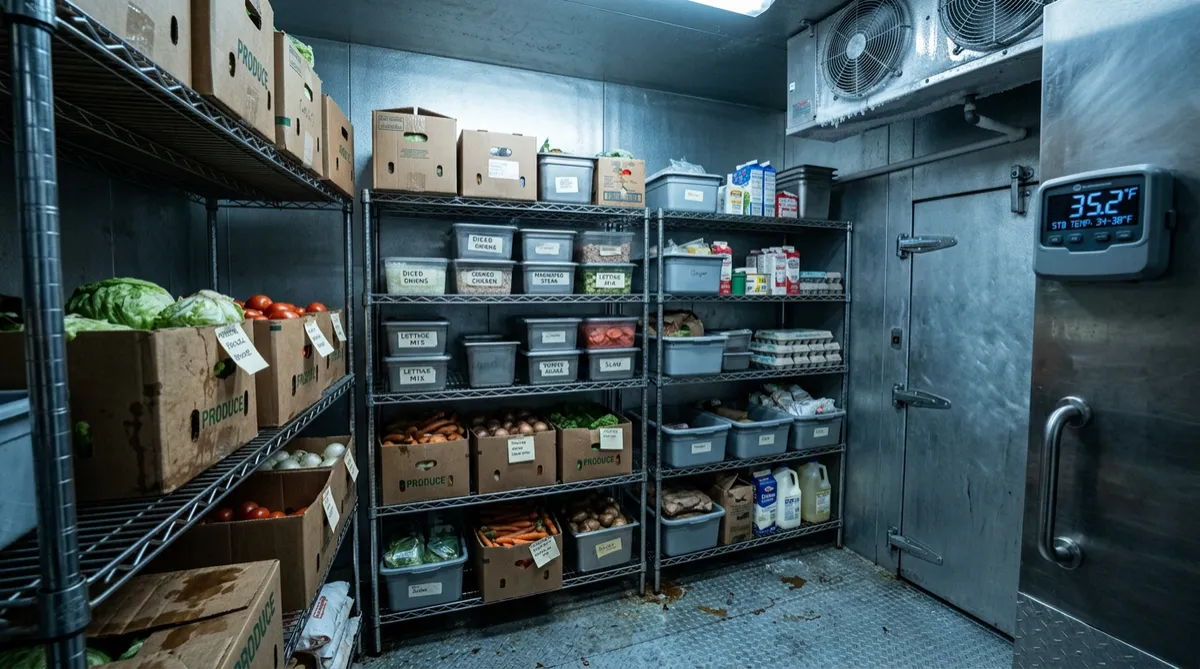
Walk-In Cooler Power Outage: What North Mississippi Restaurants and Stores Should Do in the First Few Hours
Walk-In Cooler Power Outage: What North Mississippi Restaurants and Stores Should Do in the First Few Hours

If you run a kitchen, a convenience store or a church fellowship hall anywhere in Northeast Mississippi, you've either made this call or you will. A thunderstorm rolls through Lee County, an ice storm takes down lines in Alcorn or Tishomingo, a transformer pops outside a diner in Pontotoc, and the first thing you think about is the walk-in. Thousands of dollars of product, sitting in a box that's slowly getting warm.
I'm Dan Southwick, owner of S.I. Service Group in Tupelo. Walk-ins, reach-ins and anything else with a compressor on it is a big part of what we do, and storms keep us busy. The first few hours of an outage matter more than people think. What you do, and what you leave alone, decides whether you lose a little or a lot, and whether the cooler comes back clean or with a damaged compressor.
Rule One: Keep the Walk-In Door Shut
A closed, well-stocked walk-in holds its temperature better than you'd expect, because all that cold product helps hold it. Every time somebody opens the door, the cold air spills out and warm air rushes in. Pick one person to be in charge of the cooler and put a sign on the door. The urge to check it every ten minutes is strong, and it's the worst thing you can do.
It helps a lot to have a thermometer you can read without opening the door, like one with a probe inside and the display on the outside. If you don't have one, a cheap one is worth having before the next storm.
Know Your Temperatures and Write Things Down
Refrigerated food needs to stay at 41°F or below. Most walk-in coolers are set somewhere between 35 and 38 degrees, and freezers run around 0°F. The general food code guidance is that cold food that has sat above 41°F for more than four hours should be thrown out. Your local health inspector has the final say, and the Mississippi State Department of Health is who they answer to. If you're on the fence about a batch of product, call and ask before you decide. It's easier than explaining it afterward.
While the power is out, keep a simple log:
- The time the power went off
- The cooler and freezer temperatures every hour or so
- The time the power came back
- Photos of the thermometer readings
That paper trail helps with the health department and with your insurance company if you end up with a claim for spoiled product.
Freezers Hold On Longer Than Coolers
A packed walk-in freezer will stay frozen a good while longer than a half-empty one. Frozen food that still has ice crystals in it, or that is still at 41°F or below, can generally stay. Anything that has completely thawed and warmed up is not worth gambling on. When in doubt, go back to the health inspector.
When the Power Comes Back, Don't Rush
This is where I see a lot of preventable damage. Here's the order I'd go in.
- Wait for steady power. When a utility is bringing lines back, the power often comes on, drops, and comes on again a few times. That's hard on a compressor. If the condensing unit has its own disconnect and you know exactly where it is, you can switch it off during the outage and back on once the power has been steady for a few minutes. If you're not sure, leave it alone and call us.
- Give the compressor about five minutes. The pressures inside the system need time to equalize. Newer controllers have a built-in delay, but plenty of older units don't. Starting a compressor right back up against high pressure can trip it out or hurt it.
- Listen and look. Are the fans inside the box running? Is the condenser fan outside or on the roof turning? Is the compressor starting up, or just humming and clicking off?
- Check the settings. After a power loss, some electronic controllers go back to factory defaults and lose the set temperature or the defrost schedule. Make sure the numbers are what they should be.
- If a breaker or disconnect tripped, reset it once. Once. If it trips again, stop. Resetting it over and over is a good way to burn up a compressor motor.
- Hold off on restocking. Don't load warm product back into the box until it's down to temperature. You'll overwhelm the system and slow everything down.
How Long Should Recovery Take?
It depends on the size of the box, how full it is and how hot it is outside. A condensing unit sitting on a roof or a gravel lot in July heat in Mississippi is going to work a lot harder than one in February. As a rough idea, a healthy walk-in should be dropping steadily within the first hour or so and be back in range within a few hours.
If the temperature isn't coming down after a couple of hours, or the compressor is running nonstop and nothing is changing, it's time to call. Another thing to watch for is ice on the evaporator coil. After a long warm stretch with the door opened a lot, frost can build up and block airflow, and the coil may need to be defrosted before the box can cool the way it should.
Hidden Damage: Surges and Lost Phases
Storm outages usually come with voltage spikes and dips, and the damage doesn't always show up right away. Compressors, fan motors and control boards all take a beating. If you have three-phase equipment, like a bigger walk-in or a grocery rack, losing one leg of the power can be hard on a compressor. A phase monitor helps protect against that, so ask whoever services your equipment whether yours has one.
After an outage, watch for:
- A unit that starts and stops over and over
- A compressor that hums but won't start
- A dead or blank display
- Warm air coming from where it should be cold
- Breakers that won't stay on
A compressor that seems fine after a storm can still fail a few weeks later. If the power was out and the unit didn't act right when it came back, have someone look at it before it picks a Friday night in a holiday weekend to quit.
Get Ready Before the Next Storm
- Keep a thermometer you can read from outside the box and a clipboard with a log sheet.
- Keep our number where everyone on staff can find it.
- Know where the disconnect for your condensing unit is, and who is allowed to touch it.
- Have a plan for ice or borrowed cold storage, like a nearby grocery or a friend with a reefer truck.
- Keep the condenser coil clean. A dirty coil makes the system work harder every time it starts and every time it has to recover.
- Check the door gaskets. A leaky door loses cold fast.
- Talk to your insurance agent about spoilage coverage before you need it.
If you're thinking about a generator for the cooler, bring that up with us before you buy one. Compressors pull a lot more power on startup than they do running, and that catches people off guard.
Commercial Refrigeration Repair Across North Mississippi
S.I. Service Group is a veteran-owned, licensed and insured contractor (Mississippi contractor license #20095) based in Tupelo. We repair walk-in coolers, walk-in freezers, reach-ins, prep tables and display cases for restaurants, stores, schools and churches in Lee, Itawamba, Monroe, Prentiss, Tishomingo, Alcorn, Lafayette, Union, Marshall and Pontotoc counties, including Tupelo, Saltillo, Fulton, Amory, Corinth, Booneville, New Albany, Oxford and Holly Springs.
If the power went out and your cooler isn't acting right, call 662-523-5514. Our office hours are Monday through Friday, 8 AM to 8 PM and Saturday, 8 AM to 4 PM. Tell us what the unit is doing and what the temperature is reading, and we'll get a technician headed your way as quickly as we can.