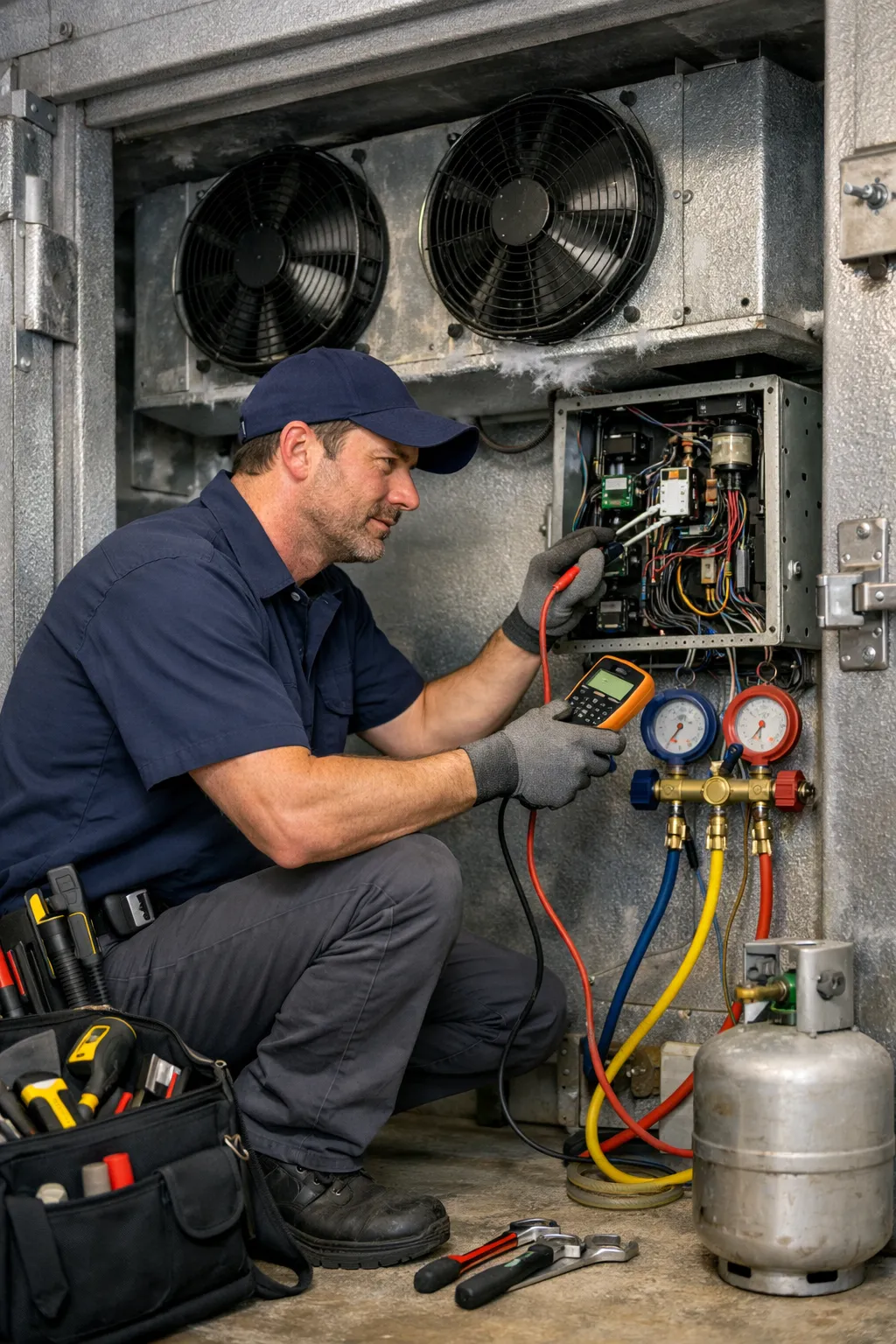
Walk-In Cooler Not Cooling: Compressor Diagnosis
Refrigeration, Commercial Appliance Repair, walk-in cooler not cooling Tupelo MS, commercial refrigeration repair North Mississippi, True refrigerator repair North Mississippi, commercial cooler compressor failure
Standing Walk-In Cooler Not Cooling in Tupelo, MS: Real-World Compressor Failure Diagnosis
When a walk-in-style glass door merchandiser is running but not cooling, every hour of lost refrigeration puts product and profits at risk. This real job case study from S.I. Service Group in Tupelo, MS walks through exactly how owner and licensed HVAC/Electrical contractor Dan Southwick diagnosed a failed compressor on a standing commercial cooler — step by step, in plain language.
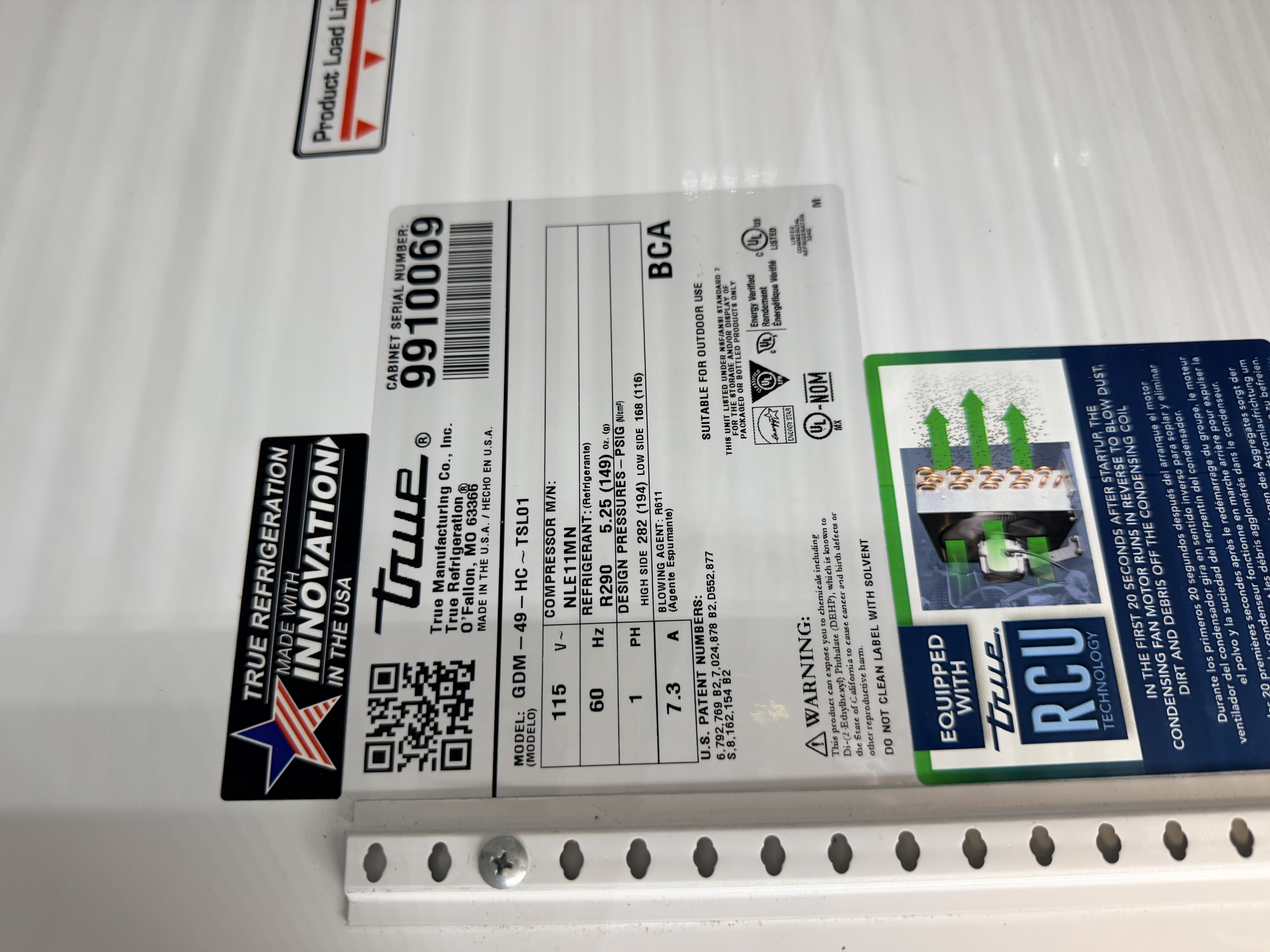
The unit in this case was a True Refrigeration GDM-49-HC-TSL01 — a tall, two-door glass door merchandiser like you see in convenience stores and restaurants, manufactured by True Manufacturing Co., Inc., O'Fallon, MO, a premium U.S. commercial refrigeration brand. This model is 115V, 60Hz, single phase, 7.3 amps full load, uses an NLE11MN compressor, and is charged with 5.25 oz (149g) of R290 (propane) refrigerant. It is also Energy Star certified, designed for efficient, reliable operation when everything is working correctly.
The Problem: Cooler Running, But Not Cooling
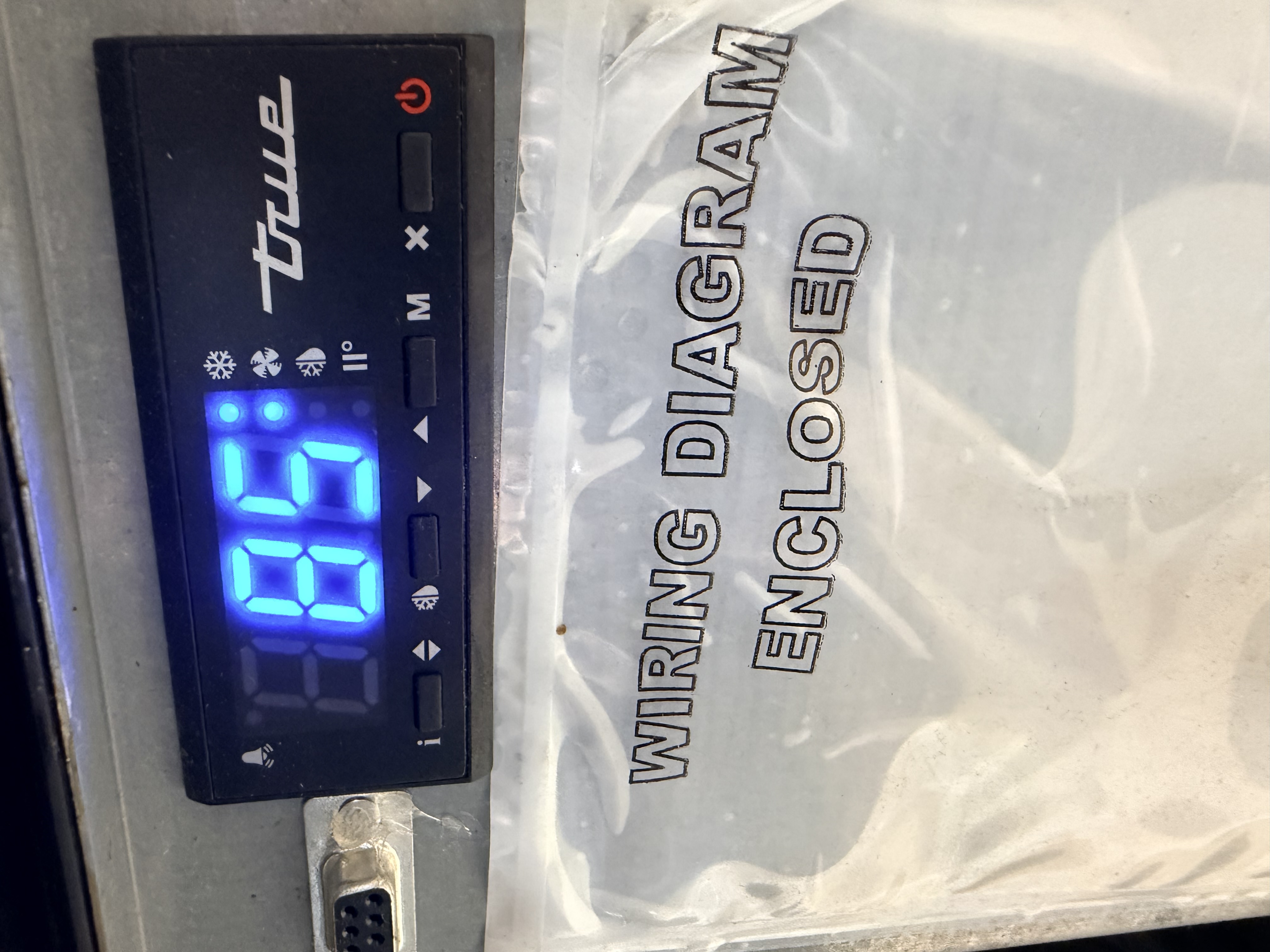
A North Mississippi business called S.I. Service Group because their standing True GDM-49 glass door cooler was running but not cooling. The fan inside the box — the evaporator fan — was blowing air just like it should, the lights were on, and the digital display was lit, but the cooler simply was not reaching temperature. Bottled drinks were warming up, and the owner knew they were one step away from throwing out inventory and disrupting service.
This is a classic scenario we see with a walk-in cooler not cooling in Tupelo, MS and across North Mississippi: the box “sounds” like it is working because you hear the fan, but the real heavy lifter — the compressor — is in trouble. Dan’s job was to confirm exactly what had failed, and why, before recommending a solution that made sense for the customer and their business.
💡 Quick safety note on this unit: The True GDM-49-HC-TSL01 uses R290 (propane), a natural, environmentally friendly refrigerant with very low global warming potential. It is also flammable, which is why refrigerant work on these units must legally be done by an EPA Section 608 certified technician. Cleaning the cabinet and checking door gaskets is fine for owners — but do not attempt DIY refrigerant or compressor work on an R290 system.
Step 1: Check Voltage at the Unit – Rule Out a Power Problem First
The first thing Dan did was check voltage at the unit. That means verifying that the True merchandiser’s condensing unit was actually getting the correct electrical power from the building. With his background in both HVAC and electrical systems — including extensive work on 480V systems and Allen-Bradley PLCs — Dan knows you never skip the basics.
💡 Why this matters: If the power coming in is low, missing a phase, or not present at all, the compressor may not run, or it can be damaged. Confirming correct voltage tells us the problem is not in the building wiring, cord, or breaker, but in the equipment itself.
In this case, the correct voltage was present at the unit terminals. Power was not the issue. That pointed the diagnosis toward a mechanical or internal electrical failure in the cooler’s components — most likely the compressor circuit.
Step 2: Amp Draw Test – Is the Compressor Even Trying to Run?
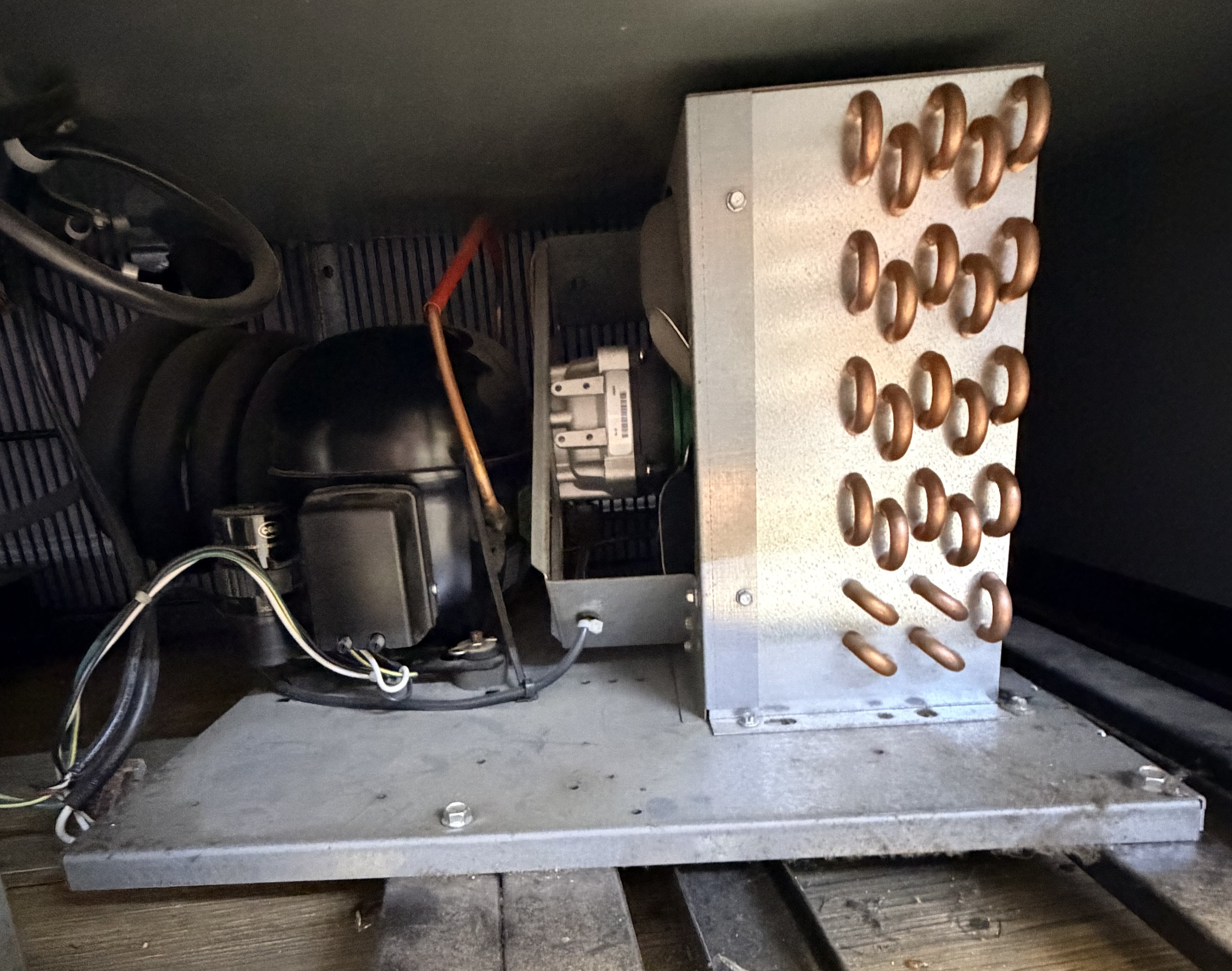
Next, Dan performed an amp draw test on the NLE11MN compressor. This involves clamping a meter around the compressor’s power wire to see how many amps it is pulling while the system calls for cooling. Think of this as checking the “heartbeat” of the compressor under load.
💡 Why this matters: A normal compressor will draw some amount of current when it runs. Zero amps usually means the compressor is not running at all — either because it is not being energized, a control component has failed, or something inside has failed open.
On this standing cooler, the reading was zero amp draw. The evaporator fan was running and the cabinet looked “alive,” but the compressor was not pulling any current. That confirmed what the business owner was already feeling: the “muscle” of the system was not doing its job.
Step 3: Test the Start Capacitor – Always Rule Out the Cheap Fix First
Before condemning any compressor, especially on a unit like this True GDM-49, Dan moved to the start capacitor. A weak or failed capacitor can keep a good compressor from starting, and capacitors are a relatively inexpensive part ($15–$25) compared to a compressor that can run $200–$400+.
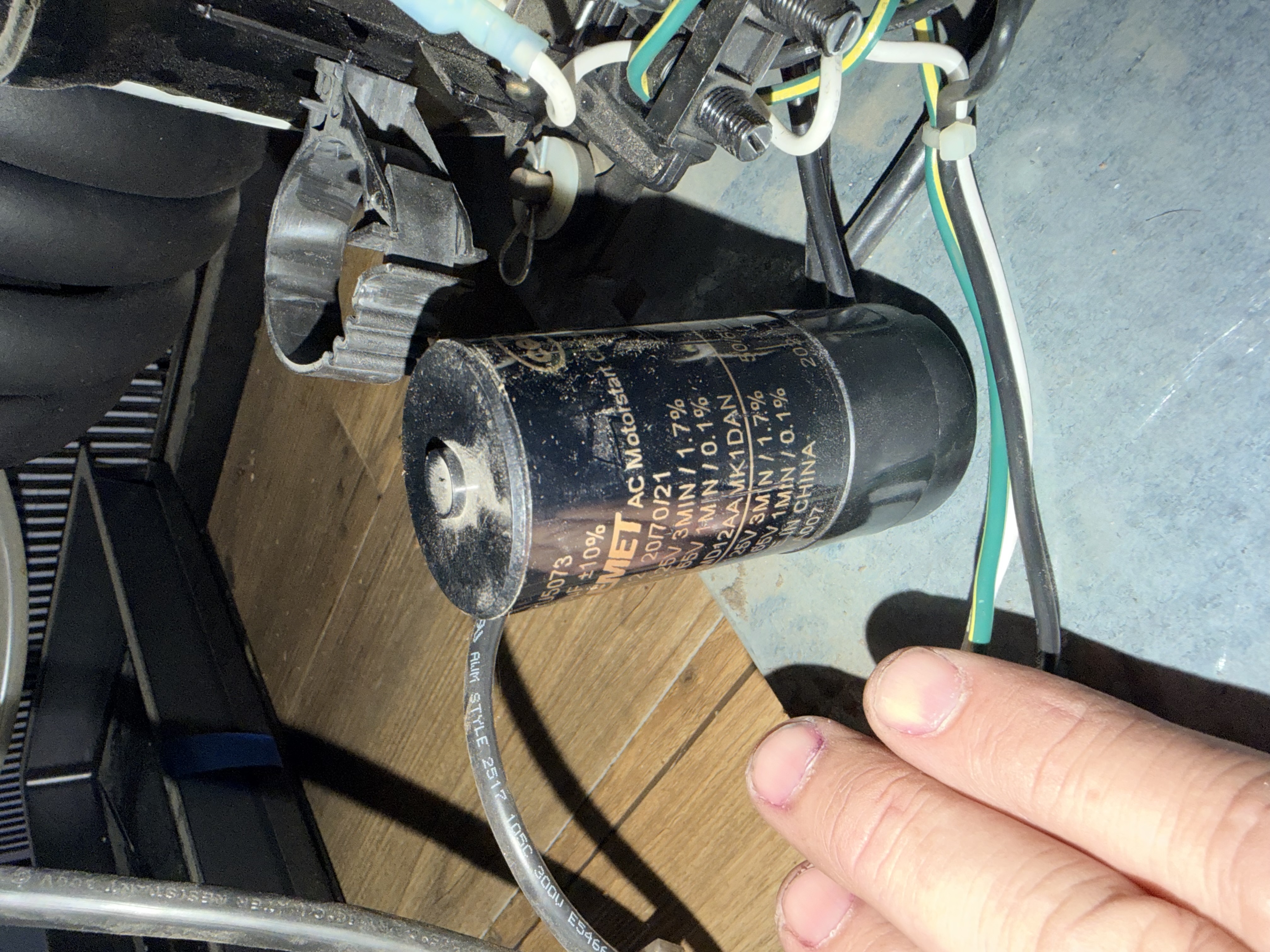
Dan pulled and tested the start capacitor with the proper meter to verify its microfarad (µF) rating against the manufacturer’s specifications. This is a critical step in any True refrigerator repair in North Mississippi — you always rule out the “cheap fix” first before recommending a major repair.
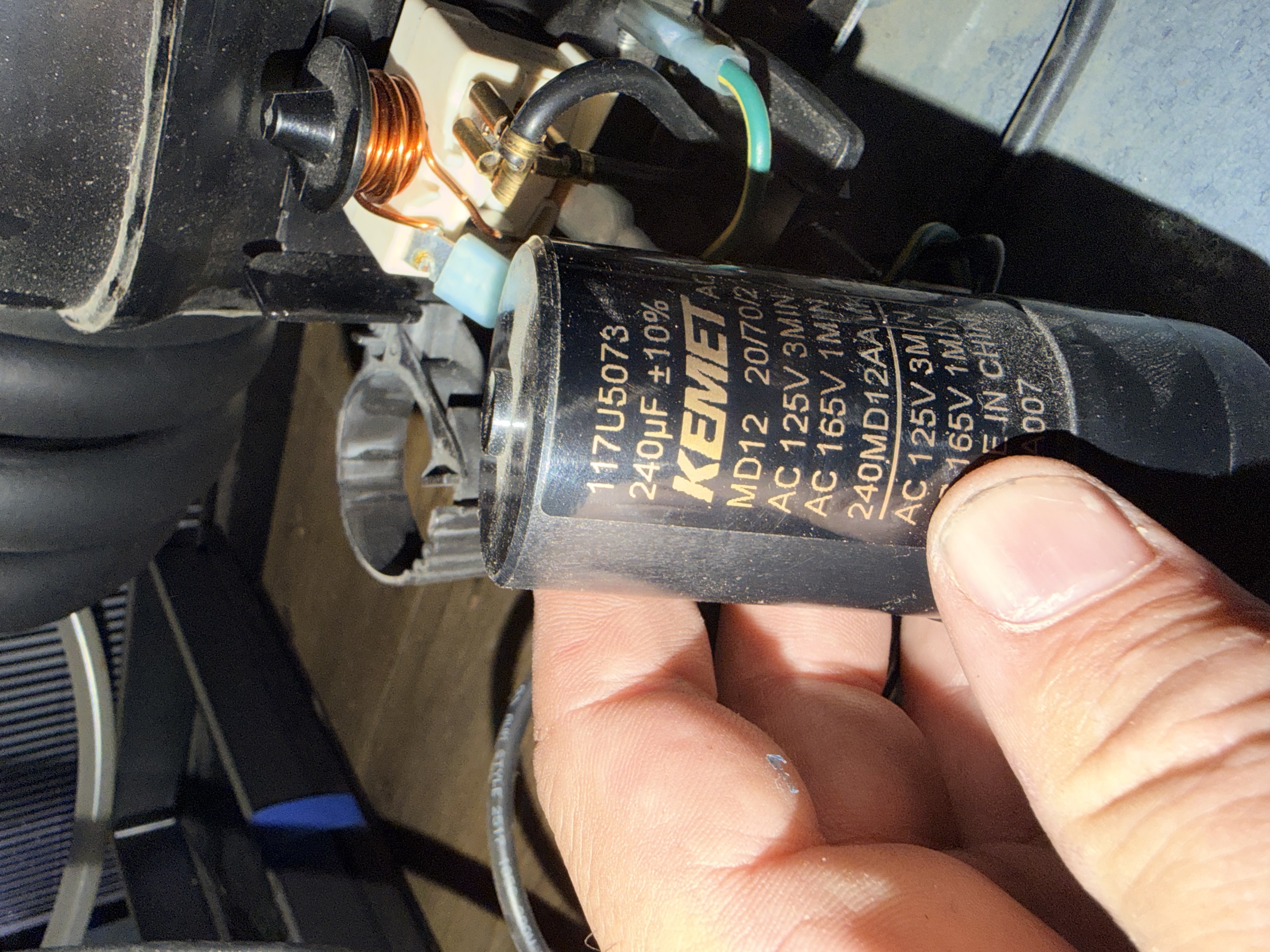
💡 Why this matters: Replacing a compressor when the real problem is a $20 capacitor is a costly mistake. Testing the capacitor protects the customer’s wallet and confirms that we are not overlooking a simple, inexpensive repair.
In this case, the start capacitor tested GOOD. That ruled out the easy fix and confirmed that the problem was deeper in the compressor itself or its internal windings.
Step 4: Disconnect and Isolate the Compressor for Testing
Before going deeper, Dan disconnected the connector from the compressor terminals. This isolates the compressor from the rest of the circuit so any readings he takes are truly from the compressor itself, not affected by other components like contactors, capacitors, or wiring.
💡 Why this matters: Proper isolation prevents false readings and protects both the technician and the equipment. It is a standard, safe practice in professional compressor diagnosis in North Mississippi and anywhere else.
Step 5: 3-Leg Ohm Test – Checking the Compressor’s “Nerves”
With the compressor isolated, Dan performed a 3-leg ohm test on the compressor terminals — often labeled C (Common), S (Start), and R (Run). Using an ohmmeter, he checked:
C to S (Common to Start)
C to R (Common to Run)
R to S (Run to Start)
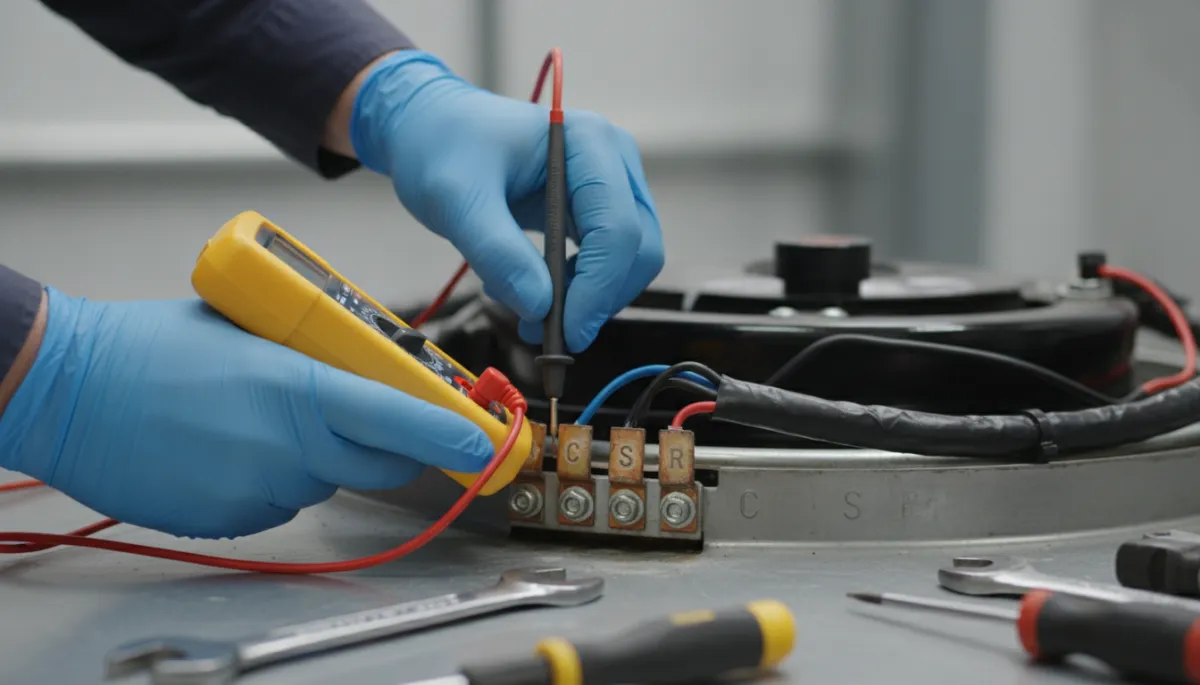
Resistance testing reveals internal compressor failures you cannot see from the outside.
In simple terms, this test measures the resistance of the internal motor windings — the “nerves” that let the compressor motor start and run. On a healthy compressor, each reading falls into a predictable range, often just a few ohms. For this unit, one of the legs should have been around 8 ohms.
Step 6 & 7: The Critical Findings – One Leg OPEN and Coil to Ground
During the 3-leg ohm test, Dan found that one leg read OPEN — meaning the meter showed infinite resistance instead of the expected ~8 ohms. This is like checking a wire and finding it completely broken somewhere inside where you cannot see it.
💡 What “open winding” means: Inside the compressor is a motor made of copper windings. An open winding means that winding is broken or burned open, so electricity cannot flow through. The motor cannot run, no matter how good the power or controls are.
Dan also checked whether the compressor coil had gone to ground. This test measures if the internal windings are shorted to the metal shell of the compressor or the equipment frame. Unfortunately, that is exactly what he found — the coil had went to ground.
💡 What “went to ground” means: The electrical path inside the compressor has broken down and is now touching metal parts that should never be energized. This is a serious internal short and a clear sign the compressor is not repairable.
At this point, the picture was clear: this was a standing cooler compressor failure with both an open winding and a grounded coil — a complete internal failure of the NLE11MN compressor on this True GDM-49.
Step 8: Final Diagnosis – Failed Compressor, Not Repairable
Putting all the test results together, Dan’s professional diagnosis was straightforward: failed compressor — open winding plus grounded coil. This is an internal motor failure; there is no safe or reliable way to repair the inside of a sealed compressor in the field, especially on an R290 Energy Star commercial cooler. Replacement is the only proper solution for long-term, dependable cooling.
A new compressor was ordered for this walk-in-style merchandiser. On the return visit, S.I. Service Group will recover the R290 refrigerant, replace the failed compressor, install new filter-driers, pull a deep vacuum, and recharge the system to the factory 5.25 oz (149g) R290 charge — restoring reliable cooling and protecting the customer’s inventory.
What Business Owners Should Watch For in Their Walk-In Cooler or Glass Door Merchandiser
As a restaurant owner, store manager, or property manager, you do not need to become a technician — but you can spot early warning signs and call for help before a total failure:
Fan running but no cooling: If you feel air blowing inside the cooler but temperatures keep climbing, the compressor may not be running or is failing.
Unit runs constantly: A system that never cycles off may be struggling to maintain temperature, often due to compressor or refrigerant issues.
Unusual noises or silence: Loud humming, clicking, or total silence from the condensing unit while the fan inside runs can all be red flags.
Product temperature drift: If product is consistently warmer than usual, do not ignore it — that is often your first clue something is wrong.
Fast, accurate diagnosis keeps North Mississippi businesses open and products protected.
Need Help with a Walk-In Cooler Not Cooling in Tupelo, MS?
This was a real job on a real standing True GDM-49 glass door cooler here in North Mississippi — not a textbook example. Because Dan Southwick is both a licensed HVAC and Electrical contractor, with dual A.A.S. degrees and deep industrial experience, S.I. Service Group brings a higher level of troubleshooting skill to every commercial refrigeration repair in Tupelo, MS and the surrounding area.
If your walk-in cooler is not cooling, your fan is running but temperatures are climbing, or you suspect a standing cooler compressor failure on a True or any other brand, do not wait until product is lost and service is disrupted. Get a precise, professional commercial cooler compressor diagnosis from a local expert who understands both the refrigeration side and the electrical side of your equipment — including newer R290 True refrigerator repair in North Mississippi.
For prompt, expert commercial refrigeration repair in North Mississippi — including Tupelo, Saltillo, and surrounding communities — contact S.I. Service Group today and keep your walk-in cooler, glass door merchandiser, and your business running the way they should.
SEO Title Tag: Walk-In Cooler Not Cooling in Tupelo MS – True GDM-49 Compressor Failure Case Study | S.I. Service Group
Meta Description: Real case study from S.I. Service Group in Tupelo, MS diagnosing a True GDM-49 standing walk-in-style cooler that was running but not cooling. Learn how Dan Southwick confirmed a failed NLE11MN compressor with capacitor testing and a 3-leg ohm test on this R290 unit, protecting a North Mississippi business from costly product loss.
Meta Keywords: walk-in cooler not cooling Tupelo MS, True refrigerator repair North Mississippi, commercial refrigeration repair North Mississippi, standing cooler compressor failure, commercial cooler compressor diagnosis, compressor diagnosis North Mississippi, True GDM-49-HC-TSL01, R290 cooler repair Tupelo, S.I. Service Group, Dan Southwick