Why Does My Breaker Trip When Cooking Thanksgiving? Tupelo Electrician
Residential Electrical Safety, Holiday Cooking
Why Does My Breaker Trip When Cooking Thanksgiving? Tupelo Electrician
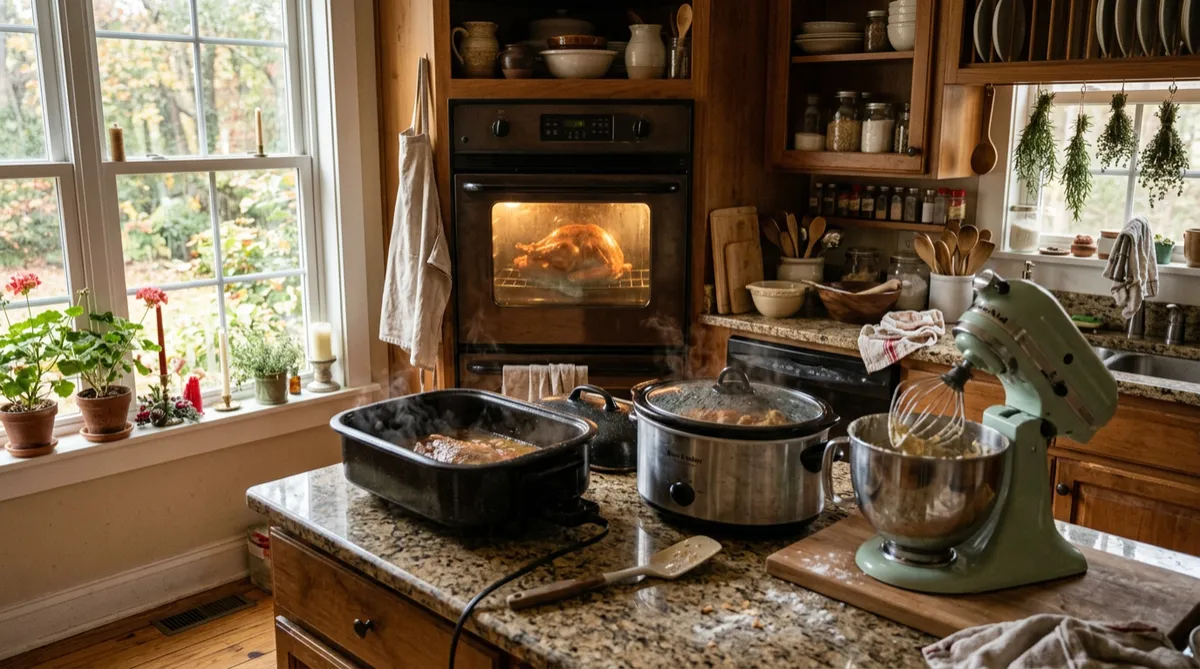
I’m Dan Southwick with S.I. Service Group in Tupelo. Every Thanksgiving, kitchens get busier than they are the rest of the year: the oven is heating, a roaster is plugged in, the air fryer is working, and the slow cooker has been going since morning. If your breaker keeps tripping when cooking, the most common reason is that too many watts are drawing power from one 15- or 20-amp circuit. The breaker is meant to interrupt an overloaded circuit before wiring overheats. It’s frustrating when dinner is underway, but don’t keep resetting it or try to defeat it. Let’s look at what may be happening and how to cook more safely.

Why does the breaker trip when the Thanksgiving meal is cooking?
A breaker trips when current through its circuit gets higher than the circuit can safely carry, or when it detects a fault. Kitchen appliances that heat food draw substantial power. Several operating at once can exceed the safe load on a shared branch circuit, even if each appliance works normally by itself. The breaker may be doing exactly what it was designed to do.
Here’s a quick way to think about the numbers: watts divided by 120 volts gives an approximate current in amps. Many household circuits are rated 15 or 20 amps. For a load expected to run continuously, a common planning guideline is to stay near 80 percent of the circuit rating: about 12 amps, or 1,440 watts, on a 15-amp circuit; about 16 amps, or 1,920 watts, on a 20-amp circuit. Actual appliance labels, circuit conditions, and electrical requirements matter, so this is a planning guide—not a reason to open a panel or test wiring yourself.
| Appliance | Typical watts | Approx. amps at 120 V |
|---|---|---|
| Air fryer | 1,400–1,800 W | 11.7–15 A |
| Electric roaster | 1,200–1,450 W | 10–12.1 A |
| Microwave | 1,000–1,500 W | 8.3–12.5 A |
| Toaster oven | 1,200–1,800 W | 10–15 A |
| Coffee maker | 900–1,200 W | 7.5–10 A |
| Slow cooker | 200–350 W | 1.7–2.9 A |
These are typical ranges, not the rating for every model. Check the appliance label or manual. A roaster and air fryer together can use more than the usual planning load for a 20-amp circuit. Add a microwave or coffee maker and the margin shrinks quickly. The oven is usually on its own 240-volt circuit, but nearby countertop receptacles may share a circuit with each other or with other kitchen outlets.

How a breaker responds to overloads and faults
Most household breakers protect wiring in two basic ways. A thermal element responds to sustained excess current: it heats up and eventually trips. A magnetic mechanism reacts very quickly to a large surge, such as a short circuit. The precise design varies, but the purpose is the same: stop current when a condition could damage wiring or create a fire hazard.
That’s why a breaker may trip after an appliance has been running for a while rather than the instant you plug it in. Several heating elements cycle on, and the circuit accumulates load as appliances overlap. A breaker can also trip immediately because of a short or another fault, which needs a qualified diagnosis. Repeated trips are a warning, not an invitation to keep trying the handle.
Why outlets on the same kitchen circuit still overload
A kitchen can have outlets on different walls that are still served by the same circuit. Plugging the roaster into the far counter and the air fryer beside the pantry does not necessarily split their electrical load. The circuit’s path is determined by how the home was wired, not by how far apart the receptacles look.
Current electrical code calls for two or more 20-amp small-appliance branch circuits for kitchen, pantry, breakfast-room, and similar receptacle loads in many dwelling situations, with specific rules about what they serve. But code requirements and installation quality vary by the home’s age, renovations, and circumstances. A house can have multiple kitchen circuits and still have a heavily loaded one. In an older home, some kitchen outlets may remain on 15-amp wiring, or the layout may not match what a homeowner expects. An electrician can identify which outlets share a circuit and whether the wiring is appropriate.
GFCI trips, AFCI trips, and breaker trips aren’t all the same
A standard circuit breaker primarily protects the circuit wiring from overcurrent. A GFCI device monitors current leaving and returning through a circuit and trips when it detects an imbalance that may indicate current leaking through an unintended path. Kitchen receptacles in required locations generally need GFCI protection under current electrical code. A GFCI trip can happen without an overload, for example if an appliance or cord has a ground fault or moisture is involved.
An AFCI device is designed to detect certain patterns associated with arcing faults, which can occur at damaged cords or loose connections. An AFCI trip is not simply the same as an overloaded breaker, and repeatedly resetting it without finding the cause is not a fix. Some devices can respond to particular loads or electrical conditions, but don’t assume a trip is a nuisance. If GFCI or AFCI protection keeps tripping, have the appliance and circuit checked. Our electrical services include troubleshooting and repairs for residential electrical concerns.

Power strips and extension cords can make a risky setup worse
A power strip does not add capacity to a kitchen circuit. It only gives you more places to plug in. A strip loaded with an air fryer, slow cooker, or roaster can concentrate high-demand appliances at one receptacle and add connection points that may overheat. Never daisy-chain strips, and don’t use an ordinary household extension cord as a substitute for a properly located outlet. Follow the appliance manufacturer’s instructions; many heating appliances are intended to plug directly into a suitable wall receptacle.
If a cord or plug feels hot, the outlet is discolored, or you smell burning, stop using that outlet and appliance. If it is safe to do so, unplug the appliance without touching a damaged or hot connection; if there is smoke, active sparking, or fire, leave the area and call emergency services. Do not use the outlet again until it has been inspected. A warm or damaged connection can be a sign of a loose connection or other hazardous condition, not just a busy kitchen.
How to spread out the Thanksgiving cooking load
Before the holiday rush, make a simple cooking load map. List each countertop appliance, the outlet you expect to use, and the breaker or circuit it is on if that information is already clearly known. Don’t remove a panel cover or experiment with exposed wiring to find out. If you aren’t sure which outlets share a circuit, ask an electrician to map them safely during a service visit.
Then reduce overlap where you can. Let the slow cooker do its work earlier, and avoid running the air fryer, roaster, toaster oven, and microwave at the same time if they may share a circuit. Use counter zones that you know are on separate circuits rather than choosing outlets just because they are in different places. A separate circuit is not guaranteed by distance, so when a breaker trips repeatedly, don’t keep moving plugs around and hoping. Check appliance labels, keep vents clear, and use each appliance only as its manufacturer directs.
Picture a family out near Saltillo: several cooking appliances are running, and a kitchen outlet suddenly stops working. With guests arriving and the meal underway, it would be tempting to get another appliance plugged in or repeatedly reset a breaker. But the safe response is to stop loading that circuit and determine whether the issue is an overload or a fault—not to wedge in another adapter. We see different versions of that holiday scramble in Tupelo, Verona, Plantersville, Mooreville, Mantachie, Fulton, Amory, and New Albany. Every home has its own circuit layout, so a safe cooking plan depends on the wiring that is actually there.
When should I call an electrician about a tripping breaker?
Call a licensed electrician if the same breaker trips again after you have reduced the load, if it will not reset, or if you hear buzzing or crackling from a receptacle or panel. Also get help when lights dim noticeably as the oven or another large appliance starts, when you notice a warm panel, or when an outlet or plug is hot, discolored, loose, or smells burnt. If you see smoke or active arcing, move away and call emergency services.
For a single trip during a clear overload, the general safe response is to switch off or unplug the appliances on that circuit and allow them to cool before a single reset, following the breaker or appliance instructions. If it trips again, stop. Never tape a breaker in position, hold it on, or replace it with a larger breaker. A larger rating can leave the existing wiring unprotected. Keep panel covers on; leave anything inside the panel to a licensed electrician.
If your home is in the area, you can read about our Tupelo electrician services or the residential work we provide for nearby communities, including Fulton and Mantachie. We’ll inspect the condition of the circuit and discuss the next step based on what we find.

What does an electrical fix for kitchen overload look like?
The right repair depends on the cause. If the problem is simply that several high-wattage appliances are being used on one circuit, we may recommend a practical load plan or a properly installed additional 20-amp circuit for the right kitchen receptacle locations. A dedicated circuit may be appropriate for an appliance when required by its instructions or the home’s design. Any new wiring and receptacles must be sized, protected, and installed to meet current electrical code.
If we find a worn receptacle, loose connection, damaged appliance cord, or failed protective device, the repair may focus there instead. GFCI or AFCI protection should be replaced or corrected only after the cause and the proper type of device are confirmed. If the home has limited capacity, an outdated or overloaded panel, or other service concerns, we can evaluate whether a panel upgrade makes sense. Not every breaker trip calls for a panel upgrade, and we don’t recommend one without checking the actual equipment, wiring, and household needs.
Our crew leaves the panel cover in place until the work can be performed safely and explains what we found in plain language. The aim is to correct the underlying problem—not merely silence the breaker for the afternoon. For information about service in this area, see our residential electrical services.
Frequently Asked Questions
Why does my breaker trip when I use the air fryer?
An air fryer commonly draws around 1,400 to 1,800 watts, which can use much of a 15-amp circuit’s practical capacity by itself. If the circuit also supplies a roaster, microwave, coffee maker, or other load, the combined draw may trip the breaker. Check the appliance label and use a suitable outlet as directed; if trips continue, call an electrician.
Is it safe to reset a breaker that keeps tripping?
Do not repeatedly reset a breaker that trips again. Turn off or unplug the loads if it is safe, and get the circuit checked. Never tape or hold a breaker on, install a larger breaker, or remove the panel cover. A persistent trip may signal an overload or a fault that needs diagnosis.
How many appliances can I plug into one kitchen circuit?
There is no universal appliance count. The combined wattage, circuit rating, appliance instructions, and what else the circuit serves all matter. Two heating appliances can exceed a circuit’s practical capacity even when they are in separate wall outlets. Check ratings and have the circuit layout identified if you’re unsure.
Why does my GFCI outlet keep tripping in the kitchen?
A GFCI trip can indicate current leaking along an unintended path, moisture, a damaged cord, or a problem with an appliance. It is different from an ordinary overload trip. Stop using the affected device or outlet and arrange an inspection if the GFCI trips repeatedly. Don’t bypass its protection.
Can I use an extension cord for a roaster?
Use the roaster according to its manufacturer’s instructions; many heating appliances should plug directly into a suitable wall outlet. An extension cord does not create more circuit capacity, and an undersized or damaged cord can overheat. Don’t daisy-chain cords or power strips. Ask an electrician about adding a properly located receptacle if needed.
How much does it cost to add a kitchen circuit?
The cost depends on the home, panel, wiring route, access, and the work needed to meet current electrical code. We give honest quotes after seeing the panel and understanding the installation. We can’t give a reliable figure without evaluating the job.
Do I need a panel upgrade?
Not necessarily. Some cooking overloads can be resolved by changing how loads are used or by adding a suitable circuit; other homes may have panel or service limitations that need attention. An electrician should inspect the equipment and wiring before recommending a panel upgrade.
The Bottom Line: Give your kitchen circuits room to work
Thanksgiving cooking puts a lot of demand on a kitchen all at once. Know the wattage of your appliances, avoid running several heating appliances on the same circuit at the same time, and don’t mistake a breaker trip for a problem to overpower. A warm or discolored outlet, burning smell, buzzing, repeated trips, or lights that dim when a large appliance starts all deserve attention. Keep the panel cover on and let a licensed electrician handle inspection and repairs inside the panel.
Need help with a kitchen circuit in Tupelo or North Mississippi?
If your breaker keeps tripping when you cook, S.I. Service Group can help you understand what is happening and what repair, if any, makes sense. We serve Tupelo and surrounding North Mississippi towns, including Saltillo, Verona, Plantersville, Mooreville, Mantachie, Fulton, Amory, and New Albany. Learn more about our electrical services or call 662-523-5514 to discuss service for your home.