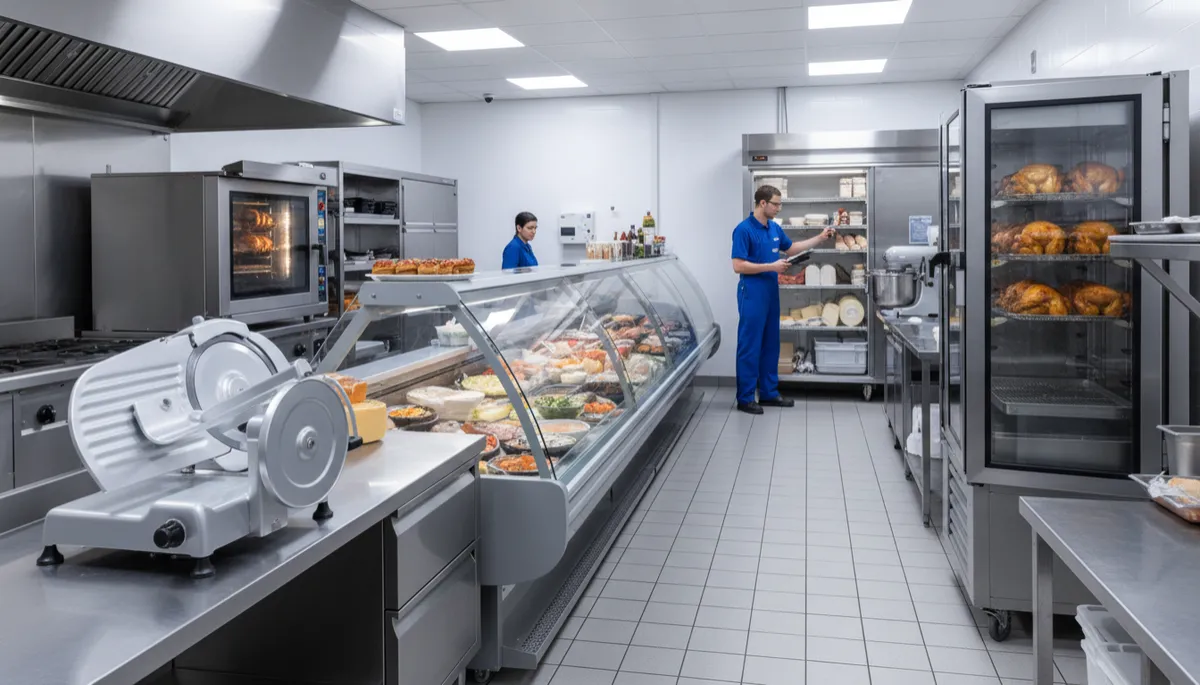
Preventive Maintenance for Deli Equipment
Commercial Kitchen, Preventive Maintenance, Deli Operations, North Mississippi
How High-Volume Deli Operations Keep Equipment Running — Lessons From the Field
After years keeping Walmart and Sam’s Club deli and bakery equipment running 18+ hours a day, I’ve seen what actually keeps commercial kitchens out of trouble — and what quietly sets them up for a 5 p.m. breakdown. This is the preventive maintenance playbook we now bring to Tupelo and deli equipment maintenance across North Mississippi.
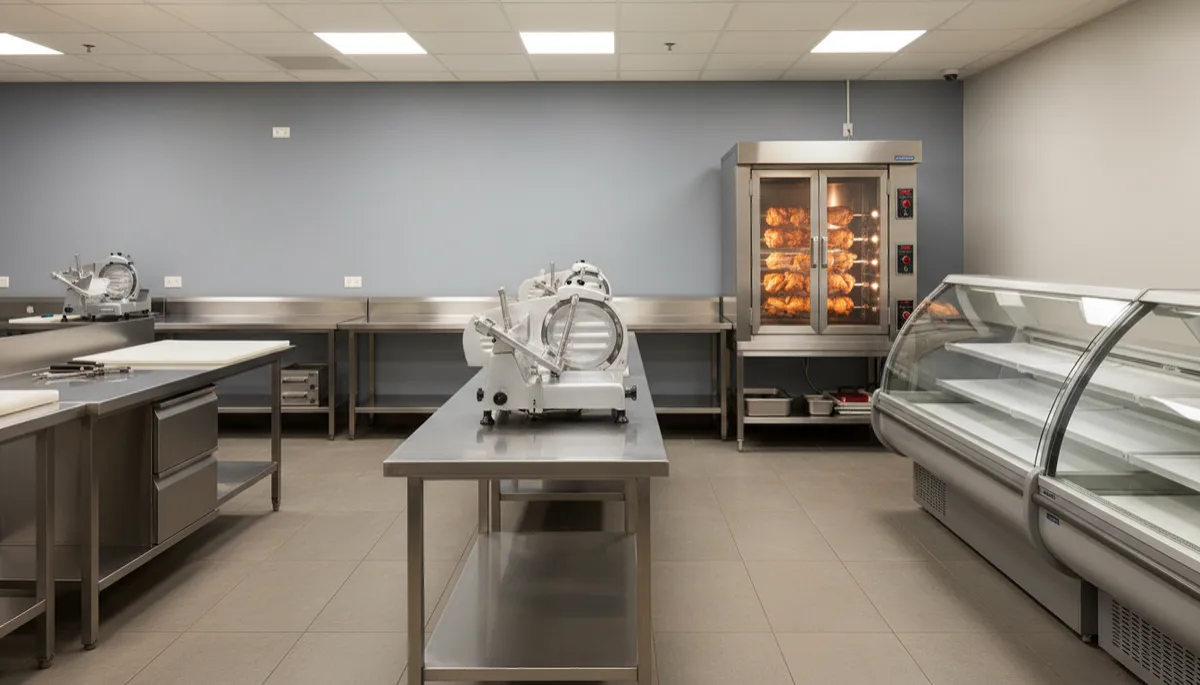
Why “Fix It When It Breaks” Destroys Food Service Operations
In high-volume deli and kitchen operations, reactive maintenance is the most expensive way to run equipment. It feels cheaper because you “save” on scheduled service — until the day your slicer seizes at lunch or your rotisserie shuts down right before the dinner rush. I watched this play out repeatedly before we put disciplined preventive maintenance in place at large retailers.
1. Emergency Repair Premium vs. Scheduled PM Cost
When you call a technician because a critical piece of equipment is down, you’re paying for:
- Priority response and travel on short notice
- Overtime or after-hours rates if it’s evenings or weekends
- Expedited parts shipping because you can’t wait a week
A single emergency call can easily cost what a quarterly commercial appliance PM contract would have run you — and the equipment is still older and more stressed than it needed to be.
2. Product Loss From Unexpected Downtime
When a refrigerated display case or walk-in cooler fails, the meter starts running on product loss immediately. At big-box volume, I’ve seen a single failed case cost more in spoiled meat and cheese than the entire annual PM budget for that store.
Even in smaller North Mississippi operations, one failed cooler can wipe out:
- A full day’s worth of prepared salads and sides
- High-cost meats and cheeses that can’t be safely re-used
- Desserts and bakery items that lose quality quickly
3. Health Inspection Risk From Neglected Equipment
Inspectors in Tupelo, Corinth, Oxford, and the rest of North Mississippi don’t just look at food. They look at equipment condition:
- Build-up inside rotisserie ovens and warmers
- Mold and slime in ice machines and drains
- Gaps in door gaskets and poor sealing on coolers
Neglected equipment is an easy citation. A consistent restaurant equipment service agreement that includes cleaning checks and documentation gives you proof that you’re managing risk — and it shows when inspectors walk the line.
4. Staff Disruption and Lost Labor Hours
When a slicer or mixer goes down mid-shift, your team becomes a fire brigade instead of a production line:
- Staff scrambling to re-plan prep around what’s still working
- Manual workarounds that slow everything down and increase injury risk
- Managers stepping off customer service to handle the crisis
Those hours are invisible on an invoice, but they show up in overtime, missed production, and burned-out staff.
5. Customer-Facing Consequences You Can’t Hide
Customers don’t see “equipment failure.” They see:
- No rotisserie chicken at 5 p.m.
- No sliced deli meat for sandwiches or party trays
- Empty or half-stocked refrigerated cases
In big-box stores I serviced, we could track sales dips to specific outages. In smaller stores and restaurants, you feel it in repeat business. Commercial kitchen equipment preventive maintenance Tupelo MS isn’t just an expense line — it’s customer retention insurance.
What Walmart and Sam’s Club Equipment Schedules Actually Look Like
At Walmart and Sam’s Club deli and bakery departments, equipment doesn’t stay running by accident. There’s a layered schedule that combines daily operator checks with technician-driven preventive maintenance. The same structure scales down perfectly for independent grocers, c-stores, and restaurants in North Mississippi.
Daily Operator Checks — Before the First Customer Walks In
In high-volume programs, operators are the first line of defense. Every morning, before production starts, they run through a quick but disciplined checklist:
- Slicers: Verify blade guard operation, smooth carriage movement, and no abnormal noise when powered on.
- Refrigerated display cases: Confirm temperature is in range, fans are running, and no ice buildup on coils.
- Rotisserie ovens: Check doors seal properly, rotation is smooth, and controls respond correctly.
- Mixers: Listen for grinding or hesitation, verify safety interlocks, inspect attachments.
- Walk-ins and coolers: Log temperatures, check doors for proper closure, listen for unusual compressor noise.
Weekly Technician-Level Inspections
In big-box operations, this is where someone with more mechanical awareness — sometimes an in-house tech, sometimes a lead associate — does a deeper pass:
- Inspect power cords, plugs, and visible wiring for damage or heat marks.
- Check for oil leaks, loose fasteners, or misaligned guards.
- Verify that cleaning is being done correctly — especially slicer blades, rotisserie interiors, and ice machine bins.
In our commercial appliance PM contract work around Tupelo and Oxford, we often train one person on your team to own this weekly pass, and we provide the checklist they follow.
Monthly Maintenance Tasks
Monthly tasks are where you start to get into light mechanical work and deeper cleaning that operators don’t have time for in a normal shift:
- Lubricating slicer carriages and moving parts per manufacturer spec.
- Inspecting mixer gears, belts, and planetary assemblies for play or noise.
- Verifying thermostat calibration on hot and cold equipment.
In larger programs, this is often handled by a contracted service provider — exactly the role S.I. Service Group fills for deli equipment maintenance North Mississippi today.
Quarterly Full Service Visits
Quarterly is where you catch the failures that are 60–90 days away. On big-box schedules, a quarterly visit for deli and bakery would include:
- Pulling and cleaning condensers on all refrigeration equipment.
- Checking amperage draw on compressors and motors to spot stress.
- Inspecting bearings, belts, gears, and seals for wear trends.
This cadence is the backbone of any serious restaurant equipment service agreement. It’s where we turn “we hope it keeps running” into “we know what condition it’s in.”
Annual Comprehensive Overhauls
Once a year, high-volume deli programs schedule heavier work that you can’t do in a quick visit:
- Replacing high-wear components like slicer bearings and seals before they fail.
- Deep descaling and sanitizing of ice machines and steam equipment.
- Full inspection of walk-in panels, doors, and refrigeration systems.
For North Mississippi operations, we typically align these overhauls with slower seasons or planned remodels so you’re not giving up peak production time.
Equipment-by-Equipment Preventive Maintenance Schedule
Every piece of equipment in a deli has its own failure pattern. Here’s the field-tested schedule we recommend — the same structure I used to keep high-volume stores running without downtime.
Deli Slicers
- Daily: Full blade and carriage cleaning, guard inspection, and safe shutdown. Never leave dried protein on a slicer overnight — it’s hard on sanitation and hardware.
- Weekly: Lubricate slide rods and moving joints with food-grade lubricant, inspect power switch and cord, verify sharpener function.
- Monthly: Full mechanical inspection: check motor noise, bearing play, mounting bolts, and safety interlocks. Replace worn feet to keep slicer stable.
Refrigerated Display Cases
- Daily: Log temperatures at open and close, visually confirm airflow is unobstructed, check for water leaks or ice build-up.
- Weekly: Inspect evaporator coil area for ice, clean drain pans and visible drains, verify lights and fans.
- Monthly: Check and clean door seals, verify defrost cycles are working correctly, inspect case ends and glass for gaps.
- Quarterly: Pull and clean condenser coils, check compressor amperage, inspect wiring and contactors.
Rotisserie Ovens
- Daily: Thorough interior clean after cool-down, including drip trays, racks, and glass. Verify rotation is smooth and doors seal correctly.
- Weekly: Check heating elements or burners for uneven performance, inspect door hinges and latches, verify fans and blowers are quiet and consistent.
- Monthly: Calibrate thermostats and cooking programs, inspect wiring and high-heat components for discoloration or cracking.
Commercial Mixers
- After each use: Clean bowl, attachments, and exterior. Never hose down the mixer body — that’s how you kill motors and bearings.
- Monthly: Lubricate moving parts where specified, inspect planetary for wobble, check speed transitions for smooth operation.
- Quarterly: Inspect gears, belts, and motor mounts; check for oil leaks from gear housings.
Walk-In Coolers
- Daily: Log temperatures, verify doors are closing fully, check for ice build-up around doors or evaporators.
- Weekly: Inspect door gaskets and sweeps, verify interior lights and fan operation, look for water on floors.
- Monthly: Clean condenser coils, check drain lines, inspect panel seams for air leaks or damage.
Ice Machines
- Weekly: Run a clean cycle as recommended by the manufacturer, wipe down bin surfaces, check for slime or scale starting to form.
- Monthly: Sanitize the bin and water-contact surfaces, inspect filters, verify water flow and harvest cycles.
- Quarterly: Technician inspection of refrigeration system, deep descaling where needed, and verification of controls and safeties.
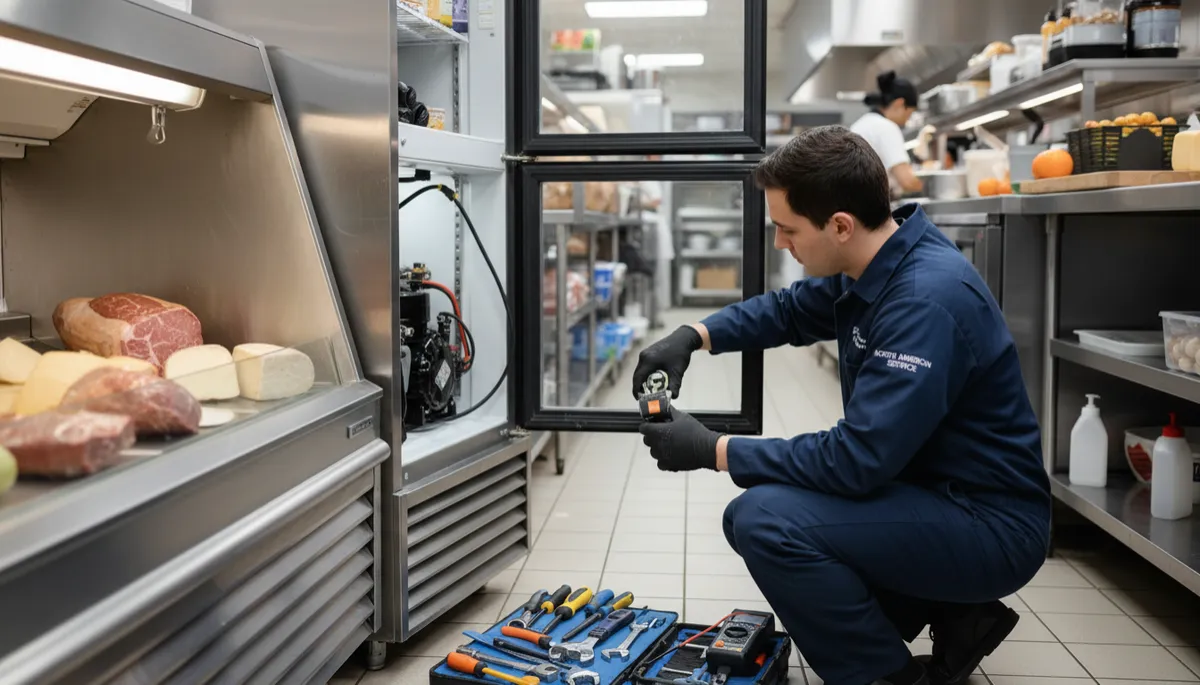
Routine PM visits catch small refrigeration issues months before they become outages.
The Three Phases of Equipment Failure — and Where PM Interrupts Them
Every failure I’ve ever been called to in a deli followed the same three phases. The difference between a smooth operation and a crisis is whether someone intervenes in phase one or two — or ignores it until phase three.
Phase 1: Stress
This is where equipment is overworked or poorly maintained, but still running:
- Condensers clogged with dust and grease, forcing compressors to run hot.
- Slicers running dry because they haven’t been lubricated in months.
- Mixers overloaded with heavy dough beyond their rated duty cycle.
Preventive maintenance interrupts this phase with cleaning, lubrication, and calibration. It resets the clock before damage accumulates.
Phase 2: Warning Signs
Next come the signals your equipment gives you — the ones operators often learn to “live with”:
- A new hum, rattle, or grinding sound.
- Temperatures drifting a few degrees high or low, but still “close enough.”
- Ice machines making smaller or misshapen cubes.
A structured commercial kitchen equipment preventive maintenance Tupelo MS program trains staff to log and report these changes. During PM visits, we investigate every one of those notes instead of just resetting a breaker and hoping for the best.
Phase 3: Failure
If phases one and two are ignored, the failure always arrives — usually at the worst possible time:
- Compressors locking up on a Friday afternoon in July.
- Rotisserie controls failing right before the dinner rush.
- Slicer motors burning out the week before Thanksgiving.
At this point, you’re not choosing between PM and repair. You’re choosing between a controlled, scheduled PM program and expensive downtime, product loss, and customer impact.
How to Build a PM Contract With S.I. Service Group
S.I. Service Group is based in Tupelo and serves deli and food service operations across North Mississippi — Tupelo, Corinth, Oxford, Fulton, Pontotoc, Saltillo, and Amory. We take the same preventive maintenance philosophy I used in high-volume national programs and right-size it for your operation.
What a PM Visit Includes
A typical PM visit under a commercial appliance PM contract includes:
- Visual and mechanical inspection of all covered equipment.
- Cleaning of critical components (condensers, drains, accessible coils).
- Lubrication, adjustments, and minor part replacements where needed.
- Documentation of equipment condition and any recommended corrective repairs.
You get a written report after each visit so you can track trends and budget for replacements instead of being surprised.
Scheduling Options: Monthly, Quarterly, Annual
We tailor the cadence to your volume and risk tolerance:
- Monthly: Ideal for high-volume delis and grocery programs running 12–18 hours a day, or for locations with older equipment.
- Quarterly: A solid baseline for most restaurants, c-stores, and smaller groceries in North Mississippi.
- Annual: Best as a supplement to strong in-house daily/weekly routines, or as an entry point if you’re new to structured PM.
Priority Service Guarantee for Contracted Clients
When you’re under a restaurant equipment service agreement with S.I. Service Group, you move to the front of the line for break-fix calls. We already know your equipment, your layout, and your PM history — which means we can diagnose faster and get you back online quicker when something does go wrong.
Cost Comparison: PM Contract vs. One Emergency Repair
To put numbers around it, here’s a simple way to think about the cost difference. As a Senior Software Developer might script it, the logic is straightforward:
def annual_pm_cost(visits_per_year: int, cost_per_visit: float) -> float:
    return visits_per_year * cost_per_visit


def emergency_breakdown_cost(service_call: float,
                             parts: float,
                             product_loss: float,
                             lost_sales: float) -> float:
    return service_call + parts + product_loss + lost_sales


# Example numbers (illustrative only)
pm = annual_pm_cost(visits_per_year=4, cost_per_visit=450.0)
emergency = emergency_breakdown_cost(
    service_call=650.0,
    parts=400.0,
    product_loss=800.0,
    lost_sales=600.0,
)

print(f"Annual PM: ${pm:.0f}")
print(f"Single major breakdown: ${emergency:.0f}")
In real North Mississippi operations, it’s common for one major breakdown to cost more than a full year of structured PM — and that’s before you factor in the hit to customer trust.
FAQ: Preventive Maintenance Contracts for North Mississippi Food Service
1. How much does a PM contract cost?
Pricing depends on your equipment list, age of units, and visit frequency. A small restaurant with a few key pieces will be on the low end; a full grocery deli and bakery in Tupelo or Corinth will be higher. What’s consistent is this: structured commercial kitchen equipment preventive maintenance Tupelo MS almost always costs less annually than the combination of emergency calls, product loss, and unplanned downtime it replaces.
2. What’s included in a typical PM visit?
A standard visit includes inspection, cleaning of critical components, lubrication, adjustments, and documentation. We’ll agree in advance on which equipment is covered — slicers, mixers, rotisseries, display cases, walk-ins, ice machines, and more. Any larger repairs or parts beyond minor items are quoted separately so you stay in control of spend.
3. How often should we schedule PM?
For most deli equipment maintenance in North Mississippi, quarterly is a strong starting point. If you’re running very high volume, have older equipment, or have had repeated failures, we may recommend monthly. We’ll review your operation, hours, and history, then propose a schedule that makes sense technically and financially.
4. Do PM contract clients get faster response when something breaks?
Yes. Under a restaurant equipment service agreement with S.I. Service Group, your calls are prioritized. Because we already have your equipment history and PM records, we can often arrive with the right parts and resolve issues in a single visit.
5. What areas do you serve?
We’re based in Tupelo and provide deli equipment maintenance North Mississippi-wide: Tupelo, Corinth, Oxford, Fulton, Pontotoc, Saltillo, Amory, and surrounding communities. If you’re in North Mississippi and rely on commercial kitchen equipment, we can likely support you.
Ready to Stop Running Your Deli on Luck?
High-volume deli and kitchen operations don’t stay reliable by hoping equipment holds together. They stay reliable because someone owns a preventive maintenance plan — daily checks, scheduled PM visits, and a technician who knows the equipment as well as your team does.
That’s exactly what S.I. Service Group brings to commercial kitchen equipment preventive maintenance in Tupelo, Corinth, Oxford, Fulton, Pontotoc, Saltillo, and Amory. You get the same field-tested philosophy I used to keep Walmart and Sam’s Club deli and bakery programs running 18+ hours a day — applied directly to your operation.
If you’re tired of surprise breakdowns, last-minute product loss, and equipment that always seems to fail at the worst time, it’s time to put a structured PM plan in place.
Reach out today to start the conversation — before your next breakdown forces it.