Ice Machine Repair Tips for Tupelo Restaurants
Restaurant Operations, Commercial Ice Machine Repair Tupelo MS
Your Restaurant's Ice Machine Isn't Making Enough Ice — Here's Why
It’s a July afternoon in North Mississippi. The dining room is full, the bar is slammed, the drive-through is wrapped around the building — and your ice bin is already half empty. If your commercial ice machine can’t keep up in this heat, you’re staring at a real problem: slow bar service, lukewarm drinks, and food safety headaches you don’t have time for.
Why Summer Is the Worst Season for Ice Machines in North Mississippi
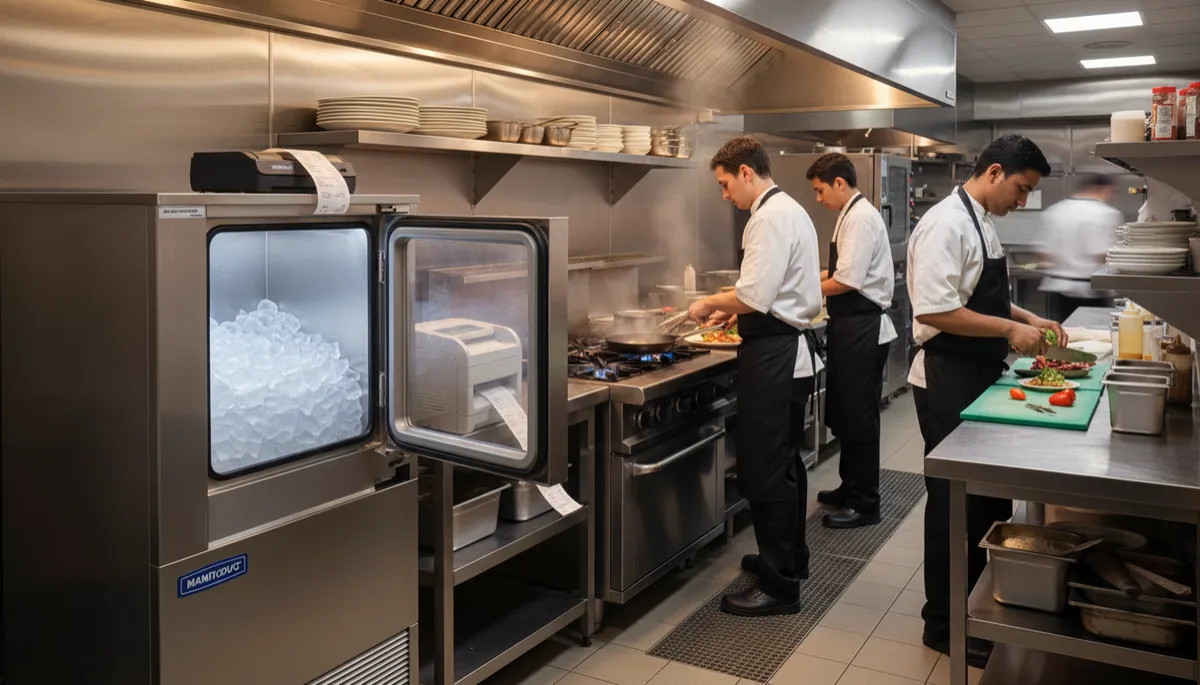
In Tupelo, Corinth, Oxford, and the rest of North Mississippi, summer isn’t just hot — it’s brutal. When the outside temperature is 90–100°F and your kitchen is even hotter, your ice machine is working in conditions it was never designed to love. Most commercial ice machines — Manitowoc, Hoshizaki, Scotsman, Ice-O-Matic, Follett — are rated for maximum production at around 70°F air and 50°F water.
Every degree above that rating cuts your production. Put that same machine in a 90°F dish room with no airflow, and your “500 lb per day” unit might only make 60–70% of its rated capacity — even if nothing is technically “broken.” Now add in dirty coils, clogged filters, or low refrigerant, and suddenly your bar is out of ice by 5 p.m. every single day.
The Real Reasons Your Ice Machine Can’t Keep Up (Most Common to Least)
I’m Dan with S.I. Service Group. I work on commercial ice machines in restaurants, fast food chains, hotels, hospitals, and gas stations across North Mississippi every day. When someone calls me for commercial ice machine repair Tupelo MS, these are the problems I find over and over — listed from most common to least. For each one, I’ll tell you what you notice, what’s actually happening mechanically, and whether you can safely tackle it yourself or need a tech on-site.
1. Dirty Condenser Coils — The #1 Summer Ice Killer
What you notice: The machine runs constantly, but the bin never gets full. By mid-afternoon, you’re already rationing ice at the bar and drive-through. The machine may feel very hot to the touch on the sides or back. You might even hear the fan screaming along at full speed all day.
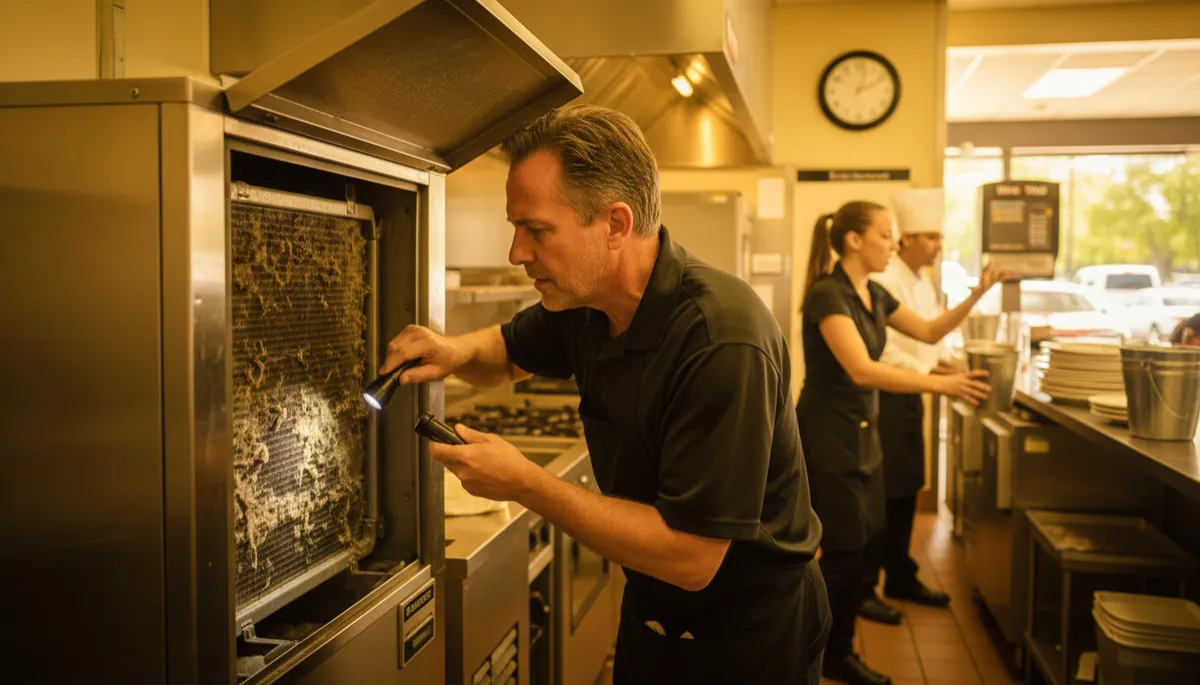
What’s actually happening: The condenser coil is where the machine dumps heat. When it’s covered in grease, dust, flour, and lint — which is exactly what happens in a busy kitchen — the machine can’t get rid of that heat. In a Mississippi summer, that’s a double hit: hot room + dirty coil. The head pressure climbs, the compressor runs hotter, and the machine slows down production to protect itself. On some Manitowoc and Hoshizaki models, the machine may even shut down on a high-pressure or safety fault if it gets bad enough.
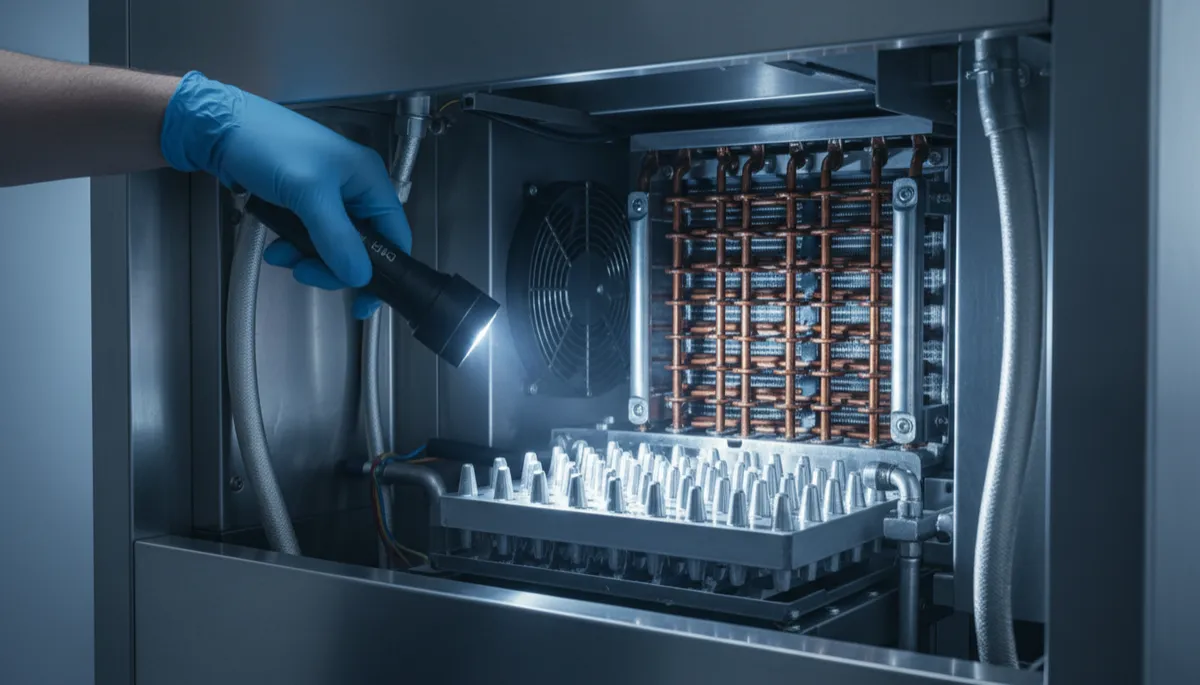
Regular internal inspections catch coil, scale, and pump issues before peak summer rush.
Self-fix or service call? Light coil cleaning is often a safe self-fix if you’re careful:
- Turn off power to the machine at the disconnect or breaker.
- Remove the front or side panel to access the condenser coil (looks like a radiator).
- Use a soft brush and vacuum to remove dust and debris. Don’t bend the fins.
If the coil is caked with grease or you can’t even see the fins, it’s time for a professional cleaning. We use coil-safe cleaners and proper rinsing techniques to avoid damage. If your machine is shutting down or still not making enough ice after cleaning, call for restaurant ice machine repair North Mississippi before the next rush hits.
2. Ambient Temperature Too High — Wrong Room, Wrong Results
What you notice: The ice machine seems to work fine first thing in the morning, but by late afternoon the bin never recovers. The room the machine sits in (dish area, back hallway, small mechanical closet) feels like a sauna. You may also notice warm air blasting out of the machine’s vents into an already hot room.
What’s actually happening: Air-cooled ice machines use the room air to remove heat. If that room is 90–100°F, the machine is starting from behind. Every Manitowoc, Hoshizaki, Scotsman, Ice-O-Matic, and Follett has a performance chart — and you’ll see production drop sharply as ambient air temperature rises. Combine high ambient with dirty condenser coils, and you’ve just cut your capacity in half during your busiest season.
Self-fix or service call? This one is mostly an operations and facility issue:
- Improve ventilation — keep doors open where possible, add a fan to move hot air away from the machine, don’t block the air intake or exhaust.
- Avoid stacking hot equipment (like dishwashers or ovens) right next to the ice machine if you can help it.
If the room itself is unconditioned or poorly ventilated, talk to your HVAC contractor and your equipment tech. We can help you decide whether relocation, extra ventilation, or a different style unit (like a remote condenser) makes sense for your operation in Tupelo, Oxford, Pontotoc, or surrounding areas.
3. Water Filter Clogged or Not Replaced — Starving the Machine
What you notice: The ice cubes look smaller than usual or thin. The machine might take longer between harvests, and you may hear it filling with water more often. Sometimes you’ll see a filter change light on the head or on the filter head itself — and it’s been on for months because “it’s still making ice.”
What’s actually happening: A clogged water filter restricts flow into the machine. Less water means smaller slabs or smaller cubes, longer freeze cycles, and less ice per harvest. On some Hoshizaki and Manitowoc ice machines, low water flow can also trigger error codes or shut the unit down entirely. In North Mississippi, where water can be high in minerals, filters load up faster — especially in high-volume restaurants and fast food locations.
Self-fix or service call? This is usually a simple self-fix:
- Locate your water filter housing (often mounted on the wall above or beside the machine).
- Shut off the water, spin off the old cartridge, and replace it with the correct new one (same brand/model).
- Turn water back on slowly and check for leaks, then reset any filter indicator lights if your system has them.
If you change the filter and still see low production or error codes, that’s when it’s time to call for commercial ice machine service — the restriction may be inside the machine, not just in the filter.
4. Low Refrigerant Charge — Slow, Weak Freeze Cycles
What you notice: The machine runs, but harvest cycles take longer and longer. Ice slabs may be thin or incomplete. The bin never gets full, even overnight when demand is low. You don’t see obvious leaks or water problems, but production is way off from what it used to be, especially once the kitchen heats up in the afternoon.
What’s actually happening: Low refrigerant means the system can’t absorb and remove enough heat from the water. The evaporator doesn’t get cold enough or doesn’t stay cold long enough. Freeze cycles stretch out, slabs don’t form properly, and the machine may struggle to complete a harvest. In summer, when the condenser is already fighting high ambient temperatures, a low charge hits even harder. This is common on older Manitowoc and Scotsman units that have developed small leaks over time.
Self-fix or service call? This is absolutely a service call. Handling refrigerant requires EPA certification, proper tools, and leak detection. When we come out for Manitowoc ice machine repair or any other brand, we:
- Check pressures and temperatures against factory specs.
- Locate and repair leaks when possible (fittings, coils, etc.).
- Evacuate and recharge the system with the correct refrigerant and charge weight.
5. Harvest Cycle Problems — Ice Getting “Stuck” on the Evaporator
What you notice: You hear the machine go into harvest, but the ice doesn’t always drop cleanly into the bin. Sometimes you see slabs hang up, break off in chunks, or only partially release. The machine might stop and restart frequently, or display harvest-related error codes depending on the brand and model.
What’s actually happening: The harvest cycle is when the machine warms the evaporator just enough to release the ice. If the hot gas valve, harvest assist mechanism, or sensors are out of spec, the machine can’t reliably drop the ice. Every failed harvest attempt is lost production time. In peak summer, you can’t afford that lost time — it’s the difference between a full bin and a crisis by dinner rush.
Self-fix or service call? This is usually a service call. You can:
- Make sure the bin is not overfilled and that nothing is blocking the ice from falling freely.
- Check that the curtain or bin switch (on some models) moves freely and isn’t jammed by ice.
Beyond that, a technician needs to test harvest valves, sensors, and control boards. On brands like Hoshizaki and Scotsman, harvest timing and water temperature are critical — we’ll verify that the machine is set up and cycling correctly for your conditions in North Mississippi.
6. Scale and Mineral Buildup on the Evaporator — Insulation Where You Don’t Want It
What you notice: Ice cubes look cloudy, misshapen, or uneven. You might see white or brownish buildup on the metal surfaces where ice forms. The machine may run longer freeze cycles, and production slowly drops over months. If you’ve never had your machine descaled, this one is almost guaranteed in our region.
What’s actually happening: Minerals in the water (calcium, lime, etc.) deposit on the evaporator over time, especially in hot weather when you’re making ice non-stop. That scale acts like insulation between the refrigerant and the water. The machine has to work harder and longer to freeze the same amount of ice, and it may never reach full slab thickness before the control board forces a harvest. In Mississippi heat, that extra strain adds up quickly to lost capacity and more breakdowns.
Self-fix or service call? Light descaling on some units can be operator-performed using manufacturer-approved cleaner and following the manual exactly. However:
- Using the wrong chemical can damage stainless or nickel-plated evaporators.
- Incomplete rinsing can leave chemical residue in your ice — a food safety issue.
For heavy scale, or if you’re not comfortable with the process, schedule a professional cleaning and descaling. At S.I. Service Group, we include descaling as part of our preventive maintenance packages for foodservice operations across Tupelo, Saltillo, Amory, Fulton, Pontotoc, and Corinth.
7. Failing Water Pump — Uneven Flow, Uneven Ice
What you notice: The machine is noisy or sounds different than usual. Ice cubes are uneven — thick in one area, thin or missing in another. Sometimes you hear the pump start and stop, or you see water not flowing evenly over the evaporator plate. The bin never quite seems to fill, especially when the kitchen is slammed and the machine is running non-stop in the Mississippi heat.
What’s actually happening: The water pump circulates water across the evaporator. If the pump is weak, partially clogged, or failing, the water distribution gets patchy. Some parts of the evaporator freeze well, others barely freeze at all. That means smaller harvests, more incomplete slabs, and less ice per cycle. Over time, a struggling pump can also contribute to scale buildup and harvest problems.
Self-fix or service call? This is typically a service call. You can:
- Check and clean the water distribution tubes or spray bars if the manufacturer allows operator cleaning.
- Make sure the water trough is clean and free of debris.
But diagnosing a failing pump versus a control issue requires testing under load. We carry replacement pumps for common Manitowoc, Hoshizaki, Scotsman, and Ice-O-Matic models on our trucks to get you back up fast.
8. Expansion Valve Issues — Wrong Refrigerant Flow, Wrong Freeze Time
What you notice: The machine acts “off” but not obviously broken. Freeze cycles may be too short or too long. Ice thickness is inconsistent from batch to batch. You may notice more issues during the hottest parts of the day when the system is under maximum load. The unit might trip on safety controls intermittently, then run fine for a while.
What’s actually happening: The expansion valve meters refrigerant into the evaporator. If it’s not feeding correctly — stuck, misadjusted, or internally failing — the evaporator may be too starved or too flooded. Either way, the machine can’t freeze water efficiently. In summer, when head pressures are already high due to hot condenser air, a bad expansion valve pushes the system over the edge, slashing production and stressing the compressor.
Self-fix or service call? This is 100% a service call. Expansion valves are refrigeration components that require gauges, temperature probes, and experience to diagnose. Adjusting or replacing them without proper training can make things worse or damage the compressor. If your ice machine not making enough ice is paired with strange cycle behavior, let a tech handle this one.
9. Machine Undersized for Demand — You’re Asking Too Much of It
What you notice: The machine is clean, serviced, and technically working correctly — but you still run out of ice every day during peak hours. This is especially common when a restaurant has grown, added a patio, expanded bar service, or increased drive-through volume since the machine was originally installed. You may be constantly buying bagged ice to get through the night, even after repairs and cleanings.
What’s actually happening: Your machine is simply too small for your real-world load, especially in Mississippi summer conditions. Remember: that “500 lb per day” rating is at 70°F air and 50°F water. In a 90°F kitchen, you might effectively have a 300–350 lb per day machine. If your bar, kitchen, and drive-through combined need 500+ lbs, no amount of repair will fix a capacity problem. This isn’t a repair issue — it’s a sizing and design issue.
Self-fix or service call? You’ll want a site visit and load evaluation. We can:
- Confirm the machine is performing to spec for its size and conditions.
- Estimate your true daily ice usage based on seats, bar volume, and drive-through.
- Recommend whether you need a larger unit, a second machine, or a remote condenser setup to handle North Mississippi summers.
Quick Decision Guide: What You Can Do Now vs. When to Call
- Safe self-fix items (do these today): Clean accessible condenser coils, change the water filter, clear airflow around the machine, check for obvious obstructions in the bin or curtains, and gently clean water distribution tubes if the manual allows it.
- Service call items (don’t DIY): Low refrigerant, expansion valve issues, harvest cycle failures, pump replacement, internal electrical problems, heavy descaling, and any situation where the machine is shutting down or showing error codes repeatedly.
If you’re in the middle of a lunch rush in Tupelo or Oxford and your bin is dropping fast, start with the quick checks above. If you still can’t get ahead — or if the machine is alarming, leaking, or short-cycling — pick up the phone. Every hour you spend without reliable ice in July is lost revenue and unhappy guests.
Underperforming vs. Undersized: Don’t Confuse the Two
An underperforming machine is one that should be able to keep up, but can’t because of a mechanical, airflow, or maintenance problem. Once we fix the issue, production returns to normal and the bin fills like it used to — even in Mississippi summer heat, within the limits of the machine’s rating.
An undersized machine is doing all it can and still not meeting demand. If we connect gauges, check amp draws, verify cycle times, and confirm that your Manitowoc, Hoshizaki, Scotsman, Ice-O-Matic, or Follett is hitting its expected production for the current room and water temperatures — but you’re still running out of ice — the problem is capacity, not repair. In that case, the smart move is to talk about upgrades, adding a second unit, or relocating to a cooler space.
Emergency Commercial Ice Machine Repair in Tupelo, MS and Across North Mississippi
When your ice machine not making enough ice turns into a full-blown shortage in July, you don’t have days to wait. S.I. Service Group provides priority commercial ice machine repair Tupelo MS and throughout North Mississippi, including:
- Tupelo
- Corinth
- Oxford
- Fulton
- Pontotoc
- Saltillo
- Amory and surrounding communities
We work on all major commercial brands — Manitowoc, Hoshizaki, Scotsman, Ice-O-Matic, and Follett — in restaurants, bars, fast food chains, hotels, hospitals, and gas stations. Our goal is simple: get your ice production back up before the next rush hits.
Ice Machine FAQ for North Mississippi Restaurant Managers
1. How long does a typical ice machine repair take?
It depends on the problem. Simple issues — like dirty condenser coils, minor harvest adjustments, or replacing a failed water valve — can often be diagnosed and repaired in a single visit, usually within a couple of hours. More complex issues like refrigerant leaks or major component failures may take longer, especially if parts need to be ordered. When you call, tell us exactly what your machine is doing and what brand/model you have so we can bring likely parts and minimize downtime.
2. Do you service my brand of ice machine?
Yes. We service Manitowoc, Hoshizaki, Scotsman, Ice-O-Matic, and Follett, along with most other major commercial ice machine brands used in restaurants, bars, hotels, hospitals, and c-stores across North Mississippi. If you’re not sure what you have, snap a quick photo of the data tag or front panel and send it when you call — that helps us prep for your specific unit and speeds up the repair.
3. Do you offer emergency or after-hours service?
Ice problems rarely happen at convenient times. We understand that a Friday night in July with no ice is a crisis, not a minor inconvenience. S.I. Service Group offers priority and emergency commercial ice machine service for restaurants and foodservice operations in Tupelo and surrounding North Mississippi cities. Call us, explain the situation, and we’ll work to get a technician to you as quickly as possible based on current call volume and parts availability.
4. What areas do you cover for restaurant ice machine repair?
We provide restaurant ice machine repair North Mississippi-wide, including Tupelo, Corinth, Oxford, Fulton, Pontotoc, Saltillo, Amory, and many smaller surrounding communities. If you’re not sure whether you’re in our service area, just call — if we can’t get to you quickly, we’ll tell you up front instead of leaving you hanging while your bin runs dry.
5. Do you offer preventive maintenance contracts for ice machines?
Yes, and in Mississippi’s climate, PM is the difference between steady ice and constant emergencies. Our preventive maintenance programs typically include coil cleaning, descaling, water filter changes, checking refrigerant pressures, verifying harvest cycles, and inspecting pumps and valves. We can schedule service around your slower times to avoid disrupting lunch or dinner rushes. Regular PM is especially important if you run multiple machines or rely heavily on drive-through and bar volume in the summer.
Ready for Reliable Ice All Summer? Here’s Your Next Step.
If you’re reading this on your phone between tickets and you already know your ice bin won’t make it to dinner, don’t wait for the problem to “work itself out.” In North Mississippi summer heat, it only gets worse. Your bar slows down, your fountain drinks suffer, and you start scrambling for bagged ice just to keep guests from walking out.
S.I. Service Group is here to keep your operation moving. Whether you need commercial ice machine repair Tupelo MS, help sizing a new Manitowoc or Hoshizaki for a growing restaurant, or a preventive maintenance plan that keeps you out of trouble when it’s 100°F outside, we’ve got you covered across North Mississippi.