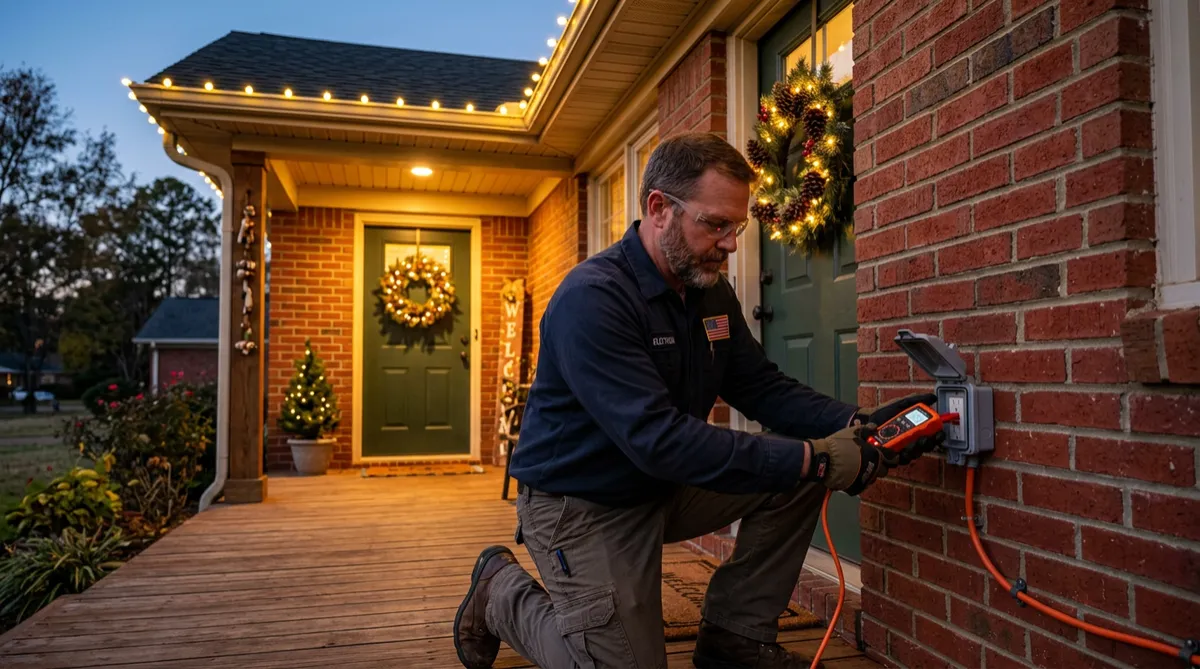

Last November I got a call from a fella over in Verona who sounded half embarrassed and half fed up. He'd spent a whole Saturday stringing lights across the roofline, wrapping the porch posts, setting up a big inflatable snowman in the yard, and plugging in a few light-up reindeer. He flipped the switch at dusk, the whole house glowed, the kids cheered — and ninety seconds later, everything went dark. He reset the breaker. It tripped again. He reset it once more, and this time he heard a little pop from the outlet by the front door.
"Dan, I've only got lights on there," he told me. "How can that be too much?"
That's the question I hear every single year as the weather cools off and folks start decorating: how many Christmas lights can you plug into one outlet? The honest answer is "it depends" — but it depends on a few simple things you can figure out in about five minutes with a calculator. In this post I'm going to walk you through exactly how I size it up on a service call, what trips breakers when the decorations go up, which shortcuts are a genuine fire risk, and when it's time to call a licensed electrician instead of buying one more extension cord.
I know it's still October. But from Halloween displays to Thanksgiving weekend, when half of Tupelo, Saltillo, and New Albany seems to be up on a ladder, the calls start rolling in early. Let's get you ahead of it.
The Short Answer: It's All About Watts and Amps
Most outlets in a North Mississippi home — porch, garage, living room — are on a 15-amp or 20-amp circuit. Here's the math I use every time:
- Volts × Amps = Watts. A standard household circuit runs at 120 volts.
- A 15-amp circuit can technically deliver 1,800 watts (15 × 120).
- For anything that's going to run for hours, like holiday lights, you want to stay at 80 percent of that — about 1,440 watts. That's the real working limit.
- A 20-amp circuit gets you to about 1,920 watts under the same rule.
Now here's the part that surprises people: that limit isn't per outlet. It's per circuit. A circuit might feed three, four, six outlets or more, and in a lot of older homes around Fulton and Amory, it can feed outlets in rooms you wouldn't expect. Plug lights into the porch outlet, an inflatable into the garage outlet, and a space heater into the same circuit out in the workshop, and you've got a pile of load on one breaker without ever realizing it.
LED vs. Incandescent: Why It Matters So Much
This is where the biggest difference shows up. If you're still using those old-school incandescent strings your granddad put up, you can run out of capacity fast. If you've switched to LEDs, you could light up half the neighborhood.
Older incandescent strings
A typical 100-count mini incandescent string pulls around 40 watts. The big old C7 and C9 bulb strings can pull well over 150 watts per string. Stack ten or twelve of those on one circuit and you're pushing the limit — and that's before anything else in the house is running.
Modern LED strings
A 100-count LED mini string often pulls somewhere in the neighborhood of 4 to 7 watts. That means you could connect dozens of them on a single 15-amp circuit and still be well under your working limit. This is why I tell nearly everybody in Saltillo, Plantersville, and Mooreville the same thing: if you're replacing lights anyway, go LED. They run cooler, they cost pennies to operate, and they're a whole lot kinder to your breaker.
Read the tag. Every string has a label near the plug that tells you the wattage and the maximum number of strings you can connect end to end. That manufacturer limit is a hard rule — a lot of incandescent sets say three strings maximum — because the first set's tiny wires carry the current for all the sets behind it. Ignore it and those thin wires heat up.

Why Your Breaker Keeps Tripping When the Decorations Go Up
Back to my friend in Verona. When I got to his place, the lights weren't the problem at all — he'd actually gone LED. What I found was that the front porch outlet, the one by the door, shared a circuit with the garage and an outdoor outlet on the back of the house. His inflatable snowman had a blower motor running full time, the reindeer were on a second cord, and his teenage son had a space heater going in the garage with the door cracked open. Add it all up and that circuit was running way past its limit. The breaker was doing its job. Honestly, that little pop at the outlet was a worn receptacle telling me it had been getting hot for a while.
Here are the usual culprits I run into during the holiday season:
- Too much on one circuit. Lights, inflatables, a space heater, a freezer in the garage, and a vacuum all on the same breaker.
- Moisture getting into connections. Mississippi humidity and fall rain find every gap. A wet plug-to-plug connection can leak current to ground and trip the breaker or GFCI.
- Damaged or old light strings. Cracked insulation, bare spots, or bent plug blades can cause a short.
- Daisy-chained cords and power strips. Every connection point adds resistance and heat.
- A worn breaker or loose connection in the panel. If it only trips with a modest load, the breaker itself may be weak. That's not a decorating problem — that's an electrical problem, and a good reason to have a licensed electrician in Tupelo take a look.
One more thing I need to say plainly: don't swap a tripping 15-amp breaker for a 20-amp one. I've seen it done in homes from Mantachie to Plantersville. The wire in the wall is sized for the breaker. A bigger breaker lets the wire overheat before it ever trips. That's how house fires start, and it's one of the first things I look for when I open a panel.
Outdoor Lights: GFCI Protection Isn't Optional
Outdoor outlets should be protected by a ground-fault circuit interrupter, or GFCI. It's the outlet (or breaker) with the little TEST and RESET buttons. Its job is to shut power off in a fraction of a second if electricity starts going somewhere it shouldn't — like through you, standing on wet grass hanging a string of lights.
A few things I tell every homeowner:
- Press TEST once a month during decorating season. If it doesn't click off, it's not protecting you.
- Use outdoor-rated cords and lights only. The tag says "indoor/outdoor" or "for outdoor use." An indoor cord outside is a shock hazard waiting to happen.
- Use weatherproof "in-use" covers on outdoor outlets so the plug stays protected from rain even when something's plugged in.
- Keep connections off the wet ground. Raise plug-to-plug joints up on a stake or tuck them in a weatherproof cover.
- If the GFCI keeps tripping on a clear day, don't just keep pressing reset. Something is leaking current, and it needs to be found.
I had a call from a lady out near Mooreville whose outdoor GFCI wouldn't hold. She'd been resetting it for two weeks. Turned out water had gotten into the outlet box behind a cracked cover, and the receptacle was corroded. It was an easy fix and a very inexpensive one — but if she'd kept forcing it, we'd have been talking about a much bigger problem.
Extension Cords: The Part Everybody Gets Wrong
Extension cords are the most abused electrical product in America, and the holidays make it worse. Here's how I think about them:
Match the cord to the load
Cords have a gauge number — the lower the number, the thicker the wire. A thin 16-gauge cord is fine for a couple of LED strings. For inflatables, heaters, or a long run, step up to 14-gauge or 12-gauge. A cheap thin cord feeding a high-draw item will get warm to the touch. If a cord is warm, unplug it. That's the wire telling you it's overloaded.
Keep it short and straight
Use the shortest cord that gets the job done, and uncoil it fully. A coiled cord under load holds heat like a toaster element.
Never run cords under rugs or through doors
A cord pinched in a doorway or buried under a carpet can break down inside and arc. And never staple or nail a cord to the house — clips designed for light strings are cheap and made for the job.
No daisy-chaining power strips
A power strip plugged into a power strip plugged into an extension cord is the classic recipe for a call I really don't want to take. The weakest link in the chain sets the limit, and that's usually a tiny connection point getting hot behind the couch.

Inflatables, Space Heaters, and the Hidden Load
Light strings are only part of the picture. Here's what else is quietly pulling power while your display is running:
- Inflatables: A typical blower motor draws roughly 1 to 3 amps and runs the entire time. Two or three of them add up quickly.
- Animated displays and projectors: Motors and transformers draw more than you'd think.
- Space heaters: A standard 1,500-watt space heater draws about 12.5 amps by itself. On a 15-amp circuit, that's nearly all of your working capacity. Plug lights into the same circuit and you're over the limit. If you've had heater trouble already this season, check out my earlier thoughts on a space heater tripping the breaker.
- Garage freezers and shop tools: A chest freezer cycles on without warning and can push a loaded circuit over the edge.
If your home's heating season is already getting off to a rough start, it's worth having your system looked at too. We handle heating and HVAC repair alongside the electrical work, so when a heat pump and a holiday display are fighting over the same breaker, one call sorts out both.
My Five-Minute Holiday Lighting Check
Before you plug in your display, do this. It's the same thing I do when I'm standing in somebody's driveway:
- Find out which outlets share a breaker. Flip the breaker off and see what goes dead. Write it on a sticky note on the panel door.
- Add up the wattage. Check the labels on every string and device. Stay under 1,440 watts on a 15-amp circuit.
- Inspect every string and cord. Throw out anything with cracked insulation, exposed wire, or bent prongs.
- Test your GFCI outlets and make sure the weatherproof covers are in place.
- Use a timer or smart plug. Lights don't need to run all night. A timer cuts the risk and the power bill.
- Do a feel test. After an hour of running, touch the cords, plugs, and outlet covers. Warm is a warning. Hot means unplug immediately.
When It's Time to Call an Electrician
I'm all for DIY decorating. I'm not for DIY panel work. Call a pro when:
- A breaker trips again and again, even with a light load.
- An outlet or plug feels hot, smells like burning, or has scorch marks.
- Lights dim or flicker when something else turns on.
- You don't have enough outdoor outlets and you're running long cords across the yard every year.
- You want a dedicated outdoor circuit for a big display.
- Your outlets are two-prong, loose, or cracked, which is common in older homes around Tupelo and Amory.
Adding a weatherproof GFCI outlet in a smart spot on the front or back of the house is a pretty simple job for a licensed electrician, and it solves the extension cord mess for good. Our residential electrical services cover exactly that — outlets, dedicated circuits, panel upgrades, and finding out why a breaker won't behave.
Frequently Asked Questions
How many Christmas lights can you plug into one outlet?
There's no single number, because the limit is the circuit, not the outlet. On a 15-amp circuit, stay under about 1,440 watts total. That could be around 30 to 35 incandescent mini strings but well over a hundred LED strings. Always follow the manufacturer's end-to-end limit printed on the tag, and remember to count everything else on that circuit.
Why does my breaker trip when I plug in Christmas lights?
Usually the circuit is carrying too much total load, or moisture or a damaged string is causing a short. Unplug everything, reset the breaker, and add items back one at a time. If it trips with only a few lights on, the breaker or wiring needs a professional look.
Is it safe to leave Christmas lights on overnight?
LEDs run cool and are much safer than old incandescent strings, but I still recommend a timer. There's no reason to run lights while everyone is asleep, and fewer hours means less wear on your cords and outlets.
Can I use an indoor extension cord outside?
No. Outdoor cords have insulation made to handle moisture, sun, and temperature swings. Use only cords labeled for outdoor use, and plug them into a GFCI-protected outlet.
How much does it cost to add an outdoor outlet?
It depends on how far the new outlet is from your panel, whether the wall is brick or siding, and whether you want a dedicated circuit. I'd rather look at the job than throw out a number over the phone. Give us a call and we'll quote it straight.
The Bottom Line
Holiday lights should make your house look great, not make your breaker panel nervous. Know your circuit's limit, switch to LEDs when you can, use outdoor-rated cords, keep your GFCI outlets tested, and don't ignore a breaker that keeps tripping. Whether you're in Tupelo, Saltillo, Verona, Plantersville, Mooreville, Mantachie, Fulton, Amory, or New Albany, the same rules apply, and the fix is almost always simpler and cheaper when you catch it before the display goes up rather than after something fails on Christmas Eve.
Ready to Stop Guessing? Call S.I. Service Group.
If your breaker keeps tripping, your outdoor outlets aren't cutting it, or you want a licensed set of eyes on your panel before the holidays, we're a phone call away. Call us at 662-523-5514 and we'll get a technician out to your home anywhere in Northeast Mississippi. You can also see everything we do on our electrical services page. Happy decorating, and stay safe out there.
— S.I. Service Group, Shop Talk