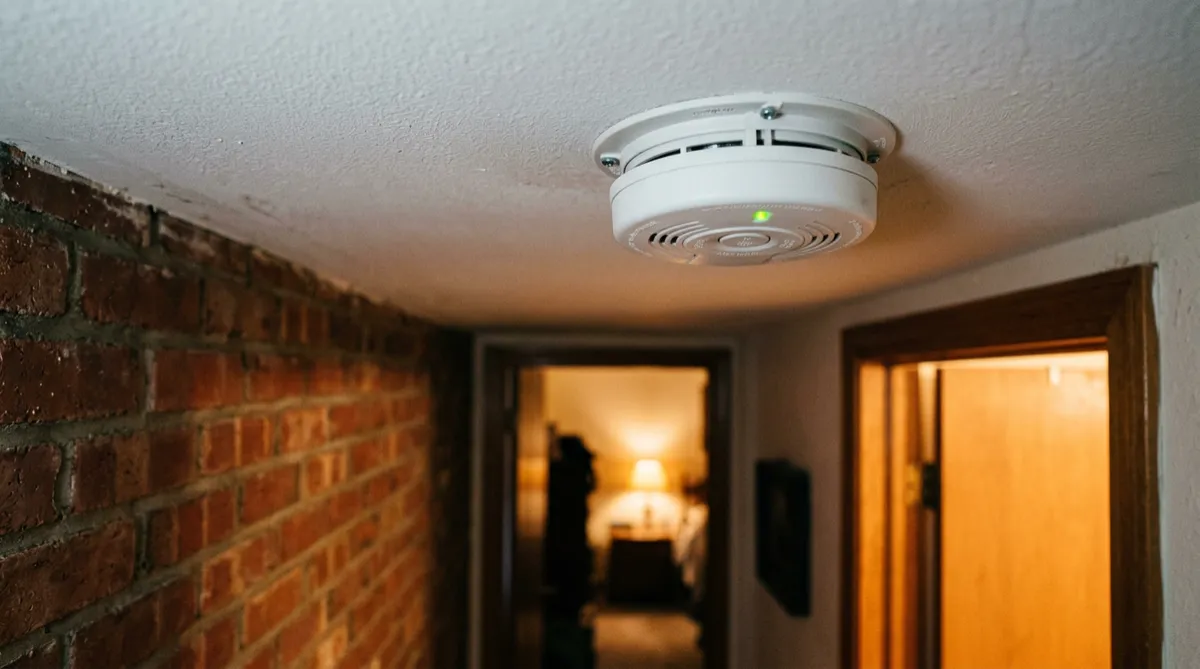
Hardwired Smoke Detector Chirping or Going Off for No Reason? What a Tupelo Electrician Checks First
Hardwired Smoke Detector Chirping or Going Off for No Reason? What a Tupelo Electrician Checks First

Nothing gets a homeowner out of bed faster than a smoke alarm chirping at 3 in the morning. And it's almost always 3 in the morning. The house cools off overnight, a tired backup battery sags just under what the unit wants, and you get one little chirp every minute or so. Then you stand in the hallway with a flashlight, because every alarm in the house sounds exactly alike.
I'm Dan Southwick, owner of S.I. Service Group here in Tupelo. We get a bump in smoke alarm calls every fall, right when the first cold nights show up, the windows get shut and the heat comes on. Here's what I look at when I get one of these calls, what you can safely handle yourself, and where it turns into a job for a licensed electrician.
Hardwired vs. Battery-Only: Know What You've Got
A hardwired smoke alarm runs on your home's 120-volt wiring and has a battery inside as backup for when the power's out. If you twist yours off the ceiling bracket and there's a plug and wires behind it, that's hardwired. If it's just a plastic disc with a battery door and nothing else, it's battery-only.
Most newer homes around Lee County and Itawamba County have hardwired alarms, and they're usually interconnected, meaning when one goes off, they all go off. A lot of older houses in Corinth, Pontotoc and Fulton still have the old battery-only kind in the hallway and not much else. That matters, and I'll come back to it.
Why a Hardwired Smoke Detector Chirps
These are the causes I run into most, roughly in order of how often I see them:
- A weak backup battery. By far the most common. Even on a hardwired unit, the battery still wears out and the alarm lets you know. Check the label on the alarm to see what it takes. Some use a 9-volt, some use AA, and some newer ones have a sealed lithium battery you can't change at all.
- The alarm is simply old. Smoke alarms wear out after about ten years, and the date it was made is printed on the back. When one hits the end of its life it will chirp, and no new battery fixes that. Replace the whole unit.
- Dust, bugs and steam. Mississippi humidity doesn't help. A hallway alarm near a bathroom gets hit with steam every morning, and the kitchen ones get cooking smoke. Dust or a tiny spider in the sensing chamber can set one off or make it act up.
- A power blip. After a thunderstorm or a flicker on the line, alarms sometimes chirp or reset themselves. Usually that clears up, but if it doesn't, something else is going on.
- A loose or mismatched connection. The plug on the back may not be fully seated, or someone mixed alarms from two different makers on the same interconnect wire. They don't always talk to each other the way they should.
Finding the One That's Actually Chirping
On interconnected alarms, the unit that started the problem usually has a light that blinks differently from the others. Check each one. The pattern varies by brand, so read the little chart in the manual if you still have it, or look the model number up online. If nothing stands out, press the test button on each alarm, one at a time, and listen for the one that sounds weak or off.
A Safe Way to Swap the Battery and Reset the Alarm
- Shut off power to the circuit feeding the alarms before you take one down. If you're not sure which circuit that is, don't guess. Call us.
- Use a real ladder, not a kitchen chair. Twist the alarm off its mounting bracket and unplug the wire harness.
- Take the old battery out and hold the test button for 15 to 20 seconds. That drains any charge still in the unit.
- Put in a fresh battery of the type the label calls for, plug the harness back in, and mount the alarm.
- Turn the power back on and press the test button. You should hear a loud alarm from every interconnected unit in the house.
If the chirp comes back after a fresh battery and a reset, the unit is bad. Replace it with the same brand and model family as the others on that circuit so they work together.
What Not to Do
- Don't pull the battery and walk away. An alarm with no power is no alarm at all, and I've walked into houses where it was left that way for months.
- Don't tape, bag or paint over an alarm to quiet it.
- Don't stick a mix of old and new alarms on the same system and call it good.
- Don't ignore one that keeps going off with no explanation. A nuisance alarm is still telling you something.
When It's an Electrician's Job
Plenty of this you can handle yourself. Here's where I'd pick up the phone instead:
- Alarms keep going off across the house with no smoke and no steam, even after new batteries.
- The wire connector on the back looks brown, melted or brittle, or you smell anything like burning plastic. Stop and call.
- The alarms are more than ten years old, or nobody knows how old they are.
- You've got battery-only alarms and you'd like hardwired, interconnected ones. In an older home that means running new cable through an attic or crawlspace, and that's licensed electrical work.
- You've added a room, finished a bonus room or enclosed a porch, and nobody ever added an alarm there.
For placement, the National Fire Protection Association guidance is simple: an alarm inside every bedroom, one outside each sleeping area, and at least one on every level of the home. A lot of houses I walk into come up short on that.
Heating Season, Propane and Carbon Monoxide
Fall is when furnaces fire up for the first time, space heaters come out of the closet and a lot of folks lean on gas logs or propane. A smoke alarm doesn't detect carbon monoxide. That takes a separate CO alarm, or a combination unit that does both. This matters even more out in the county, where plenty of homes run propane furnaces and gas water heaters, and after a storm when somebody's got a generator running too close to the house.
If a CO alarm goes off, get everybody outside, call 911 and don't go back in. Call us after the fire department says it's safe.
Clocks Go Back This Sunday
Daylight saving time ends Sunday, November 1. It's a good reminder to do a quick run through the house: press every test button, check the date on the back of each alarm, and swap batteries where you need to. Ten minutes, and you're set for the winter.
Smoke Alarm and Electrical Help Across North Mississippi
S.I. Service Group is a veteran-owned, licensed and insured contractor (Mississippi contractor license #20095) based in Tupelo. We handle residential electrical work in Lee, Itawamba, Monroe, Prentiss, Tishomingo, Alcorn, Lafayette, Union, Marshall and Pontotoc counties, from Tupelo, Saltillo and Mantachie to Corinth, Amory, New Albany, Oxford and Holly Springs.
If you've got an alarm that won't quit, or you'd rather have us replace or add hardwired alarms, call 662-523-5514 or reach out through siservicegroup.com. Tell us what the alarm is doing and what you've already tried, and we'll get you taken care of.