Do I Need a Whole-House Surge Protector? A North Mississippi Electrician Explains
I got a call last week from a homeowner over in Saltillo. She came home from work to find her refrigerator dead. So was her big-screen TV, the thermostat, and the garage door opener. Her husband walked out to the garage and found the panel smelled like burnt plastic.
The power company had done a switching operation on the line — routine maintenance — and the voltage spike that came down that line hit every piece of electronics in the house. In about half a second, they lost somewhere around $4,000 worth of appliances and electronics. No fire. Nobody got hurt. But that family sat in 98-degree July heat with no AC while we assessed the damage.
That's a scene I've been walking into more and more across North Mississippi — Tupelo, Mooreville, Verona, Amory, New Albany. And every time, the homeowner asks the same question: "Is there something I could have done to prevent this?"
The answer is yes. And it costs a whole lot less than replacing a refrigerator, HVAC unit, and TV all at once.
What Is a Power Surge — and Why Should You Care in Mississippi?
A power surge is any sudden spike in voltage that goes above the standard 120 volts — or 240V for larger appliances — your home normally runs on. These spikes can last anywhere from a fraction of a millisecond to a few seconds. That's all it takes to fry sensitive electronics.
Here's what causes surges at the residential level:
- Lightning strikes — Direct or nearby strikes can send tens of thousands of volts down your utility line. Mississippi is one of the highest lightning-density states in the country. This isn't a hypothetical — it happens constantly from May through September, and homeowners from Plantersville to Mantachie feel it every storm season.
- Utility switching — Power companies regularly switch loads on the grid, especially during high-demand summer days. That switching creates a voltage spike that travels right down the line into your home. I've seen meters in Verona and Mooreville where the utility was switching loads multiple times a day during a heat event.
- Downed power lines — When lines come down in a storm and reconnect, the irregular voltage can surge into your service entrance.
- Internal surges from large appliances — This one surprises people. Your AC compressor, refrigerator compressor, and well pump all draw a large amount of current when they start up. That inrush current creates small but repeated voltage spikes inside your home's wiring. Over time, these micro-surges degrade electronics and reduce their lifespan — even when the sky outside is perfectly clear.
Modern electronics are far more sensitive to voltage fluctuations than the appliances of 20 or 30 years ago. Your grandmother's old window unit probably survived a power surge that would destroy a modern inverter-driven mini-split. Smart TVs, variable-speed HVAC systems, LED lighting with electronic drivers, smart home devices — the more technology you have in your home, the more you have to lose.
What Does a Whole-House Surge Protector Actually Do?
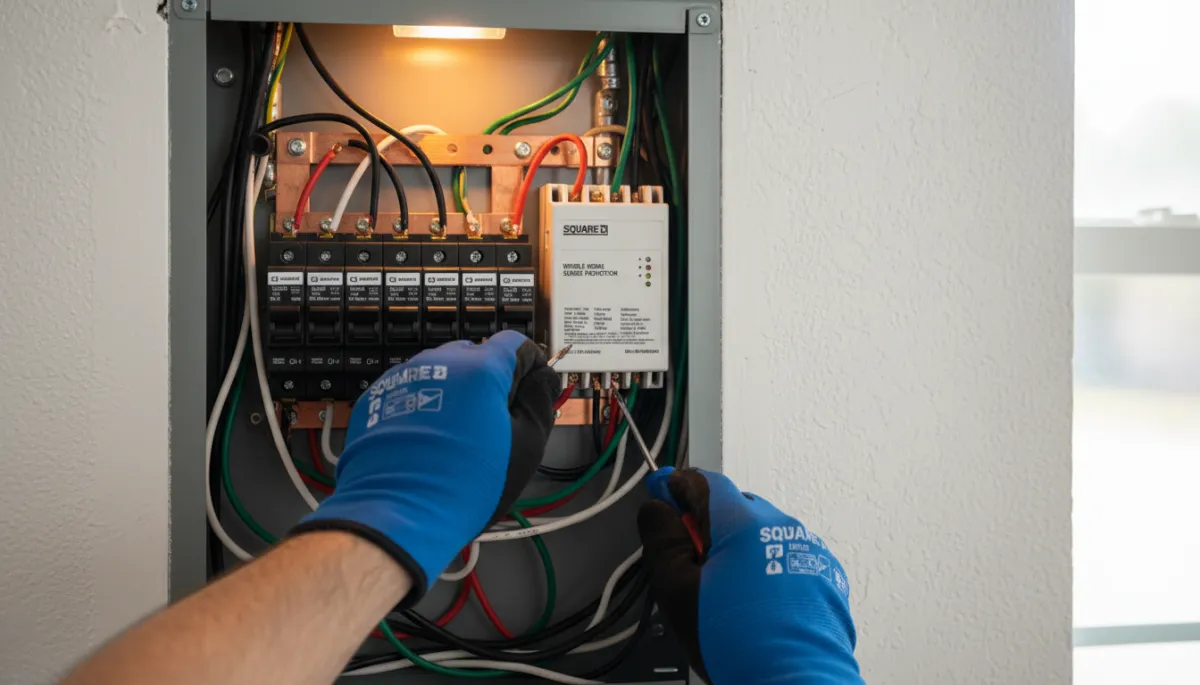
A whole-house surge protector — technically called a Surge Protective Device, or SPD — is installed directly at your main electrical panel or at the meter base. When a voltage spike hits your home's incoming power, the SPD intercepts it and diverts the excess energy to ground before it can travel through your wiring and reach your devices.
There are two main types:
Type 1 SPD — Meter Base Installation
A Type 1 device installs at the meter socket, between the utility line and your main panel. It's designed to handle the largest surges — the kind that come off the utility line from switching events or nearby lightning. These are the heavy hitters. If your utility company allows it (most do in North Mississippi), this is your best first line of defense.
Type 2 SPD — Main Panel Installation
A Type 2 device mounts inside or directly adjacent to your main breaker panel. It handles surges that make it past the utility entrance, as well as internal surges generated by your own appliances. This is the most common residential installation, and it's what I put in the vast majority of homes I work in across Tupelo and surrounding communities.
When you're comparing SPDs, two specs matter most:
- Joule rating — Think of joules as the SPD's capacity to absorb energy before it fails. Higher is better. For a whole-house device, I recommend nothing under 2,000 joules — and I prefer 3,000+ for homes with newer HVAC equipment or a lot of smart home electronics.
- Clamping voltage — This is the voltage level at which the SPD activates and diverts the surge. Lower clamping voltage means better protection. A device rated at 330V lets less damaging voltage through than one rated at 400V. Aim for 330V or lower for maximum protection on a standard 120V circuit.
The best whole-house protection uses both a Type 1 and Type 2 device in combination — what the industry calls a "layered" approach. Think of it like wearing a seatbelt and having airbags. One layer is good. Two layers is real protection.
What a Whole-House Surge Protector Will NOT Do
I'll be straight with you here, because some contractors oversell these devices — and that's not how I run my business.
A whole-house SPD will not fully protect you from a direct lightning strike on or immediately adjacent to your home. A direct strike can carry up to a billion volts. No consumer-grade SPD absorbs that. What it does is significantly reduce the damage that travels through your internal wiring — but if lightning hits your meter base directly, you're going to have some damage regardless.
A whole-house SPD also won't protect electronics plugged into cheap, unrated power strips. The whole-house device handles large surges coming in from outside. But a basic power strip with no surge rating offers nothing at the outlet level. For computers, home theater systems, and gaming equipment, I always recommend quality point-of-use surge protectors rated at 1,000+ joules in addition to the whole-house device.
Finally — and this is important — surge protectors wear out. Every significant surge they absorb depletes some of their protective capacity. Quality whole-house SPDs have an indicator light that shows you when the device needs replacement. After any major storm event with nearby lightning, check that indicator. Don't assume the device is still doing its job without verification.
Is a Whole-House Surge Protector Worth It in North Mississippi?
In my experience — absolutely. Here are three reasons specific to where we live.
1. Mississippi gets hit hard by lightning. We're in one of the highest ground flash density zones in the continental United States. Homes in Plantersville, Mantachie, and Fulton aren't sitting in the same risk environment as homes in Arizona. The atmospheric conditions over North Mississippi in July create significant lightning activity, and power lines are frequent targets.
2. Our grid gets stressed in summer. When it hits 100 degrees in Tupelo and every home and business in Lee County has their AC running full blast, the utility grid is under enormous load. The power company manages that by switching loads between substations and feeders. Every one of those switching events is a potential micro-surge on your line.
3. Modern HVAC systems are expensive and vulnerable. If your home has a newer variable-speed air conditioner or heat pump with an inverter drive and electronic control board, you're looking at $800–$1,500 or more just to replace that control board if it takes a surge hit. I've replaced control boards on systems in Amory and New Albany that were less than three years old, all because of surge damage. A whole-house SPD installed for a few hundred dollars protects a $10,000+ HVAC investment. That math isn't complicated. (Want to know more about protecting your HVAC system? Visit our HVAC services page.)
I've been doing electrical work across Northeast Mississippi long enough to know which houses call me back the most. The ones without surge protection call more often. And the repairs are always more expensive than what protection would have cost.
How Much Does Whole-House Surge Protection Cost in North Mississippi?
Here's a realistic breakdown for homeowners in our area:
A quality Type 2 panel-mount SPD from Siemens, Square D (QO or Homeline series), or Eaton runs $50–$150 in hardware depending on joule rating and features. Installation adds labor time, and the total installed cost for a straightforward residential panel addition typically lands between $200–$400.
If you add a Type 1 meter-base device for that first-layer protection, factor in another $100–$200 for hardware and additional labor. Full layered protection — Type 1 plus Type 2 — typically runs $350–$600 total installed for most homes in the Tupelo area. For a home with new HVAC equipment, smart home devices, a home office setup, or a home theater, that's an easy investment to justify.
For commercial properties, the math is even clearer. We recently repaired surge damage at a medical office in Tupelo where a single storm event damaged a cubicle power distribution system and multiple pieces of equipment. The repair cost was significant. The whole-building surge protection we installed afterward cost a fraction of what the damage did. Our team handles commercial electrical work of all sizes — learn more on our electrical services page.
Frequently Asked Questions About Whole-House Surge Protectors
Will a whole-house surge protector protect my TV and computer?
It significantly reduces the risk. A whole-house SPD handles surges coming in from the utility line — the big external events. For maximum protection on sensitive electronics like TVs and computers, pair it with a quality point-of-use surge strip (1,000+ joules) at the outlet. That two-layer approach is what I recommend for any home with expensive electronics.
How long does a whole-house surge protector last?
Most quality devices are rated for 5–10 years under normal conditions. But they deplete each time they absorb a significant surge. After any major electrical event — a nearby lightning strike, a storm that knocked out power in your neighborhood — check the indicator light on the device. If it's showing a fault or warning, the unit needs replacement even if it's only a year old.
Does homeowners insurance cover power surge damage?
It depends on your policy. Many standard homeowners policies cover sudden, direct damage from lightning with documentation. Surge damage from utility switching or internal surges may or may not be covered depending on your carrier. Call your agent and ask specifically about surge-related appliance and electronics coverage. Then install a surge protector regardless — because filing claims has consequences for your rates.
Can a surge protector stop a direct lightning strike?
Not fully. A direct strike delivers energy that exceeds what any consumer SPD can absorb. What a whole-house surge protector does is limit the damage that travels through your internal wiring during and after a strike. It's not a zero-damage guarantee — it's a very significant damage reduction. For true lightning protection, a separate system with lightning rods and proper grounding is a different category of product entirely.
Do I still need surge protector power strips if I have a whole-house device?
Yes, for sensitive electronics. The whole-house device handles external surge events. Internal surges — generated by your own AC compressor or refrigerator cycling on — can still reach your devices. Quality surge-rated power strips at the outlet level give you that second layer of protection for computers, TVs, and audio equipment. Think of it as wearing a helmet and full pads, not just a helmet.
Is a whole-house surge protector hard to install? Can I DIY it?
I won't say it's impossible, but working in a main electrical panel with live bus bars is genuinely dangerous. Even with the main breaker off, the service entrance conductors coming in from the meter are still live. Contact with those terminals is a lethal hazard. A licensed electrician is the right call here. It's also true that improper installation can leave you with a device that appears to work but isn't properly grounded — which means it won't actually function during a surge. The install takes us less than an hour. This isn't an all-day project.
My house already has surge strips on some outlets. Is that enough?
For those specific outlets, maybe — as long as they're actual surge-rated strips and not just cheap multi-outlet adapters. But a power strip does nothing to protect appliances that are hard-wired or plugged directly into other outlets: your refrigerator, dishwasher, washer, dryer, HVAC system, water heater with electronic controls. A whole-house device protects everything — every outlet, every hard-wired appliance, every circuit in your panel.
Don't Wait Until After the Storm
I've seen what a bad surge does to a house. I've walked through homes in Tupelo, Saltillo, and Amory after storm events and tallied damage that ran well into the thousands. I've replaced HVAC control boards taken out by a grid switching event on a calm, clear afternoon when the weather looked fine. I've talked to homeowners who had no idea what hit them — because power surges don't announce themselves.
A whole-house surge protector isn't a luxury. In North Mississippi — where we get hammered by summer thunderstorms, where the grid works hard to keep up with July's heat demand, and where modern HVAC systems and smart home electronics are in more and more houses — it's basic protection. It costs less than one appliance repair call, and it gives your family real peace of mind when the thunder starts rolling in from the west.
If you want to know whether your panel is set up for a surge protector, or if you want to get one installed before the next storm rolls through, give us a call or text. We serve Tupelo, Saltillo, Verona, Plantersville, Mooreville, Mantachie, Fulton, Amory, New Albany, and all of Northeast Mississippi.
S.I. Service Group — Licensed Electrical, HVAC & Commercial Services
📞 Call or text: 662-523-5514
🌐 www.siservicegroup.com
View our electrical services →