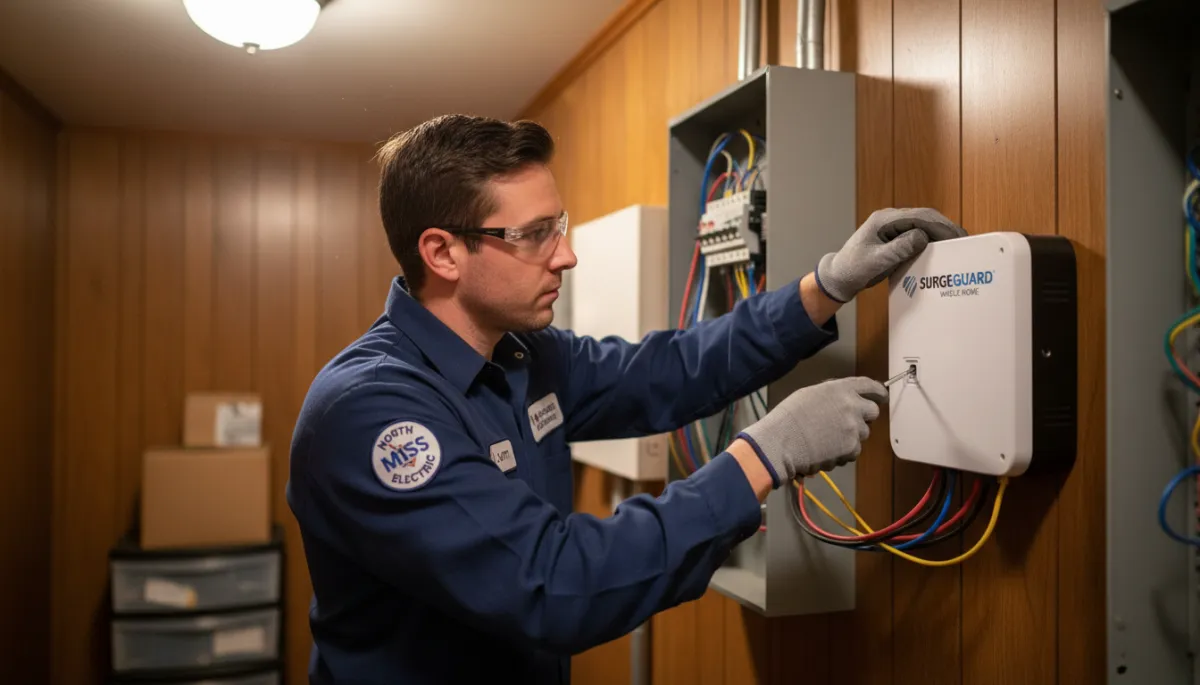
Do I Need a Whole-Home Surge Protector? A North Mississippi Electrician Explains
A $400 Device That Could Have Saved One Mooreville Family $8,000
I got the call on a Tuesday morning last summer, right in the middle of the kind of storm we get here in North Mississippi in August — the kind where the sky turns green and the thunder sounds like it's right on top of you. A homeowner in Mooreville called me about forty minutes after the storm passed. "Everything's dead," he said. "The AC won't come on. The refrigerator's making a noise it's never made. My TV won't turn on."
I pulled up to the house, walked through with him, and by the time we were done assessing the damage, the list looked like this: one 4-ton condenser unit — fried. One refrigerator — compressor and control board shot. One 65-inch smart TV — done. Desktop computer — dead. Washing machine — the control panel was gone. The total damage came in right around $8,200 in replacement costs, not counting labor.
And here's the part that still sticks with me: a whole-home surge protector — installed and permitted — would have cost him about $400. That's it. Four hundred dollars. I've been a licensed electrician in North Mississippi for years, and I'll tell you honestly — surge damage is some of the most heartbreaking, most preventable loss I see on this job. If you don't have a whole-home surge protector on your panel right now, this post is for you.
What Is a Whole-Home Surge Protector, Really?
Let's start with what it is and what it isn't. When most people hear "surge protector," they picture that power strip sitting behind the TV or under the desk — the $25 one from the hardware store. That's a point-of-use surge protector, and while it provides some protection for the devices plugged directly into it, it does absolutely nothing for the rest of your home. Your HVAC system, your refrigerator, your washer and dryer — none of that is plugged into a power strip.
A whole-home surge protector (also called a whole-house surge protector or a service entrance surge protector) is a device that's installed directly at your main electrical panel. It monitors every volt coming into your home and, when it detects a voltage spike above a safe threshold, it clamps that surge and diverts the excess energy into the ground before it can travel through your wiring and reach your appliances and electronics.
There are two main types recognized by the electrical industry:
- Type 1 SPDs (Surge Protective Devices) — installed before the main disconnect, on the utility side. These require coordination with your utility company and are less common in standard residential settings.
- Type 2 SPDs — installed after the main disconnect, on the load side of your panel. This is what most homes get, and it's what I install for homeowners all across Lee, Union, Itawamba, and Prentiss counties.
The bottom line: a whole-home surge protector is a first line of defense that protects every circuit in your house, not just the ones with a power strip plugged into them. If you want to talk about the broader health of your electrical system, our electrical services page covers everything we do from panels to wiring to code compliance.
What Can a Single Power Surge Destroy?
This is the part of the conversation where people's eyes get wide. A power surge doesn't have to be a lightning strike to cause damage — in fact, most surges are small, repeated events that degrade your electronics slowly over time. But a big one? A big one can wipe out everything with a circuit board in your home in a fraction of a second.
Here's what's at risk — and what replacement costs look like right now:
- HVAC system — The compressor, control board, and variable-speed motors are all surge-sensitive. Replacement cost: $5,000–$15,000 for a full system. Even a control board alone runs $500–$900. (For everything related to keeping your system running right, visit our HVAC services page.)
- Refrigerator — Surge damage typically kills the compressor or electronic control board. Replacement cost: $800–$3,000 depending on the unit.
- Smart TVs — Modern televisions are packed with circuit boards. One surge and they're done. Replacement cost: $400–$2,500.
- Computers and laptops — Even plugged into a point-of-use surge protector, a large enough surge can overwhelm it. Replacement cost: $600–$2,500, not counting data loss.
- Washing machines and dryers — Modern units have complex electronic control panels. Replacement cost: $500–$1,800.
- Electric water heaters with digital controls — Yes, even your water heater can get fried. Replacement cost: $800–$2,000.
- Smart thermostats, doorbells, and security cameras — Small individually, but they add up fast at $100–$500 each.
Add it up and you can easily be looking at $10,000–$20,000 in losses from a single bad surge. I've seen it. The homeowner in Mooreville had $8,200 in damage — and he got lucky the HVAC compressor survived.
The Mississippi Factor: Why We Need This More Than Most
I want to talk specifically about why whole-home surge protection matters even more here in North Mississippi than it does in other parts of the country.
First: our storms. Anyone who's lived in Lee, Union, Itawamba, or Tishomingo County knows that August afternoons can get violent fast. We sit right in the corridor for afternoon convective storms — the kind that develop quickly, produce frequent cloud-to-ground lightning, and can strike the same general area multiple times. I've driven through storms in Saltillo, Verona, and Plantersville that would make anyone grateful for a surge protector.
Second: it's not just lightning. Most homeowners think surge damage only comes from lightning strikes, but that's not the full picture. A large percentage of surges actually originate inside your own home — when your HVAC system, refrigerator, or water heater cycles on and off, they create small voltage spikes on the line. Repeated over months and years, these micro-surges degrade sensitive electronics quietly. A whole-home surge protector catches these too.
Third: utility grid switching. When your electric utility switches circuits, reroutes power, or restores service after an outage, that switching event sends a voltage spike down the line into your home. In areas like Mantachie, Fulton, and parts of Amory that rely on older grid infrastructure, these events can be more pronounced. It's not the utility company's fault — it's just physics — but it's another real, underappreciated source of surge damage.
Fourth: peak summer demand. When everyone in Tupelo and New Albany cranks their AC on a 98-degree August afternoon, utilities work hard to balance the load. That balancing act — switching, shedding, restoring — creates voltage fluctuations that find their way into your home. Surge protection catches all of it.
How Much Does a Whole-Home Surge Protector Cost?
I want to give you honest, real numbers — not a vague "it depends" non-answer.
The device itself typically runs $50–$200 for a quality unit correctly specced for a Mississippi home. Cheaper units exist, but for whole-home protection, you want something with a legitimate Joule rating and a UL listing (more on that below).
Installation by a licensed electrician adds $200–$400 depending on the complexity of your panel and whether a permit is required — and in most cases in Mississippi, this work does require a permit, which I pull for you as part of the job.
All in, most homeowners are looking at $300–$600 installed and permitted.
Now compare that to the numbers above. Replacing a fried HVAC system alone is $5,000–$15,000. Even a refrigerator and a TV together can push $3,000–$5,000. The math is not complicated. This is one of the best dollars-per-risk-protected investments you can make in your home — and I say that to people in Tupelo, Verona, and Saltillo on a regular basis, usually right after a storm has already done the damage.
Why This Is Not a DIY Job
I'll be plain about this: a whole-home surge protector is installed at the main panel, and the main panel is not a DIY project.
Even with the main breaker turned off, there are still live conductors inside your panel at the service entrance — the wires coming in from the utility side do not lose power when you flip the main breaker. That voltage doesn't care that you watched a video online. I've seen amateur panel work that looked completely fine until it caused a serious problem years later.
Beyond safety, there's the permit side of things. Mississippi requires an electrical permit for this type of work in most jurisdictions. When I pull a permit, the work gets inspected and documented — which matters for your homeowner's insurance coverage and for the resale value of your home. I hold Mississippi Electrical License #20095 for both residential and commercial work. That's what allows me to pull permits and stand behind the installation. To get on the schedule, visit our contact page — we can usually get out within a few days.
What to Look for When Choosing a Unit
If you're having this work done, here's what actually matters when your electrician sources the device:
- Joule rating — This is the amount of surge energy the device can absorb over its lifetime. For whole-home protection in a lightning-prone area, you want a minimum of 40,000 joules. A smaller unit is underspecified for what North Mississippi weather throws at your home.
- UL 1449 listing — This is the standard for surge protective devices. If it doesn't carry UL listing, it doesn't go in your panel.
- Indicator light or alarm — A quality unit has a status indicator that tells you whether the device is still functional. SPDs wear out as they absorb surges, so you need a way to know when yours has reached the end of its service life and needs replacing.
- Hardwired vs. breaker slot connection — There are units that connect to a dedicated circuit breaker slot and units that are hardwired directly to the bus. Either can work; which is right for your home depends on your panel configuration. Let your electrician make that call based on what's actually in front of them.
Frequently Asked Questions
Does homeowners insurance cover surge damage?
It depends on your policy. Many standard homeowners policies cover surge damage caused by lightning, but coverage for internal surges or utility switching events is often excluded or subject to sublimits. Read your policy or call your insurance agent. What I can tell you is that even when insurance covers it, you're still dealing with a deductible, an adjuster, and weeks without your appliances. A surge protector sidesteps all of that.
Will a whole-home surge protector stop a direct lightning strike?
Honest answer: no device will fully absorb a direct strike. The energy in a direct lightning hit is simply too massive for any SPD to handle. What a whole-home surge protector does is protect against nearby strikes — lightning that hits a utility line, a tree in the yard, or a neighbor's house and sends a surge through the grid into your home. That covers the vast majority of real-world lightning-related surge damage. For protection against direct strikes, you'd need a dedicated lightning rod system.
How long do whole-home surge protectors last?
A quality unit in a North Mississippi home typically lasts 5–10 years, depending on how many surges it has absorbed. Every time it takes a hit, it uses up some of its Joule capacity. That's exactly why the indicator light matters — it tells you when the device needs to be replaced. When I install these, I tell homeowners to glance at the indicator light once a year and after any significant storm.
Do I still need individual surge protectors on my electronics?
Yes — and here's why. A whole-home surge protector is your first line of defense, but think of protection in layers. The whole-home unit at the panel handles the big events coming in from outside. Quality point-of-use surge protectors at your TV, computer, and other high-value electronics handle smaller residual surges. Together, they give you the most comprehensive protection available. One without the other leaves gaps.
Can I install a whole-home surge protector myself?
You can buy one at an electrical supply house. But I'd strongly advise against installing it yourself. As I explained above, there is live voltage at the service entrance of your panel even when the main breaker is off. This is not an exaggeration — it's the kind of hazard that seriously injures people who don't know it's there. Beyond the safety issue, unpermitted panel work can create problems with your homeowner's insurance and with the future sale of your home. Hire a licensed electrician, pull the permit, and do it right the first time.
Bottom Line: Don't Wait Until After the Storm
Every summer, I have this same conversation with homeowners after a storm has already done the damage. It's one of the toughest parts of this job — looking someone in the eye and telling them that what they just lost could have been protected for $400. I had that conversation with the family in Mooreville. I've had it with folks in Plantersville after a June storm knocked out their refrigerator, with a homeowner in New Albany after a grid switching event killed their electronics, and with a business owner in Amory who lost more than he wants to count.
Don't be that conversation. August in North Mississippi is prime storm season, and the grid is under maximum stress right now. If your panel doesn't have a whole-home surge protector, you're gambling with every appliance, every piece of electronics, and every HVAC system you own every single time a storm rolls through. This is an investment I'd put in the same category as smoke detectors — not optional, not something to get to someday. Get it done before the next storm does it for you.
Schedule Your Whole-Home Surge Protection Installation
S.I. Service Group is a licensed, bonded, and insured electrical contractor serving homeowners and businesses throughout Northeast Mississippi. We serve Tupelo, Saltillo, Verona, Plantersville, Mooreville, Mantachie, Fulton, Amory, New Albany, and the surrounding communities. If you're ready to protect your home from the next storm, give us a call at 662-523-5514. We'll assess your panel, pull the permit, and install a whole-home surge protector correctly sized for your home — so the next time the sky turns green over Lee County, you don't have to worry about what's plugged in.