Diagnose & Replace Captive Air Hood Motor
Commercial Kitchens, Ventilation, Equipment Repair, North Mississippi
When a Commercial Kitchen Hood Becomes a Fire Hazard: What We Found in Baldwyn, MS (Part 1 of 2)
A real field story from S.I. Service Group about what we found on a service call in Baldwyn, Mississippi, when a captive air hood stopped pulling air the way it should — and how the diagnostic uncovered a failing motor, heavy corrosion, and a breach in the liquidtight conduit that came one step away from starting a fire inside a grease-coated commercial kitchen hood.
Keep Your Kitchen Breathing Safely

This is Part 1 of a two-part series about a real commercial kitchen hood repair call in Baldwyn, Mississippi — this part focuses only on what we found during the diagnostic.
1. The Call: Captive Air Hood Not Pulling Like It Should
In a busy restaurant kitchen, your captive air hood (often called a make-up air hood or make-up air unit ) is every bit as important as your fryers and ranges. Its job sounds simple but is hard to do day in and day out: pull hot, smoke- and grease-laden air off the cook line and replace it with clean, conditioned air so your building stays safe, comfortable, and code-compliant.
In this case, we got a call from a commercial kitchen in Baldwyn, Mississippi. The complaint was straightforward: the hood wasn’t pulling like it should. Cooks were watching steam and smoke roll out from under the hood and back across the cook line. Odors were drifting into the dining area. This is a classic start to a kitchen hood motor failure problem — and if it’s ignored, it can also be the start of a serious fire hazard.
I’m Dan Southwick with S.I. Service Group, a veteran-owned, multi-trade contractor serving restaurants and foodservice facilities across North Mississippi. I hold Mississippi License No. 20095 for HVAC and electrical work, and I spend my time out in the field on rooftops and inside make-up air units handling captive air hood repair and commercial kitchen exhaust fan repair.
📌 Key Takeaway: When a hood stops pulling like it used to, it’s not just a comfort issue — it’s an early warning that something in the exhaust system is failing.
2. Inside the Belt-Drive Section: Corrosion, Grime, and a Tired Belt
After confirming the breakers were set and the hood controls were working, I headed up to the exhaust unit. This particular system was a belt-drive design — the motor turns a pulley, the pulley turns a belt, and the belt turns another pulley on the exhaust fan shaft.

As soon as I opened the access panel, the first thing that jumped out was the corroded housing and pulleys covered in a thick layer of dirt and grease. The belt itself was dry, cracked, and worn. You don’t get a setup that rough overnight — this was years of operation with almost no real maintenance.
When you see this level of wear and buildup, you know what you’re looking at is just the surface. But even with all that, the belt and pulleys weren’t the root cause of the poor exhaust. To find that, I had to get to the heart of the system: the motor.
3. Failed Motor (MFG No. C13C): Vibration Was the Real Culprit
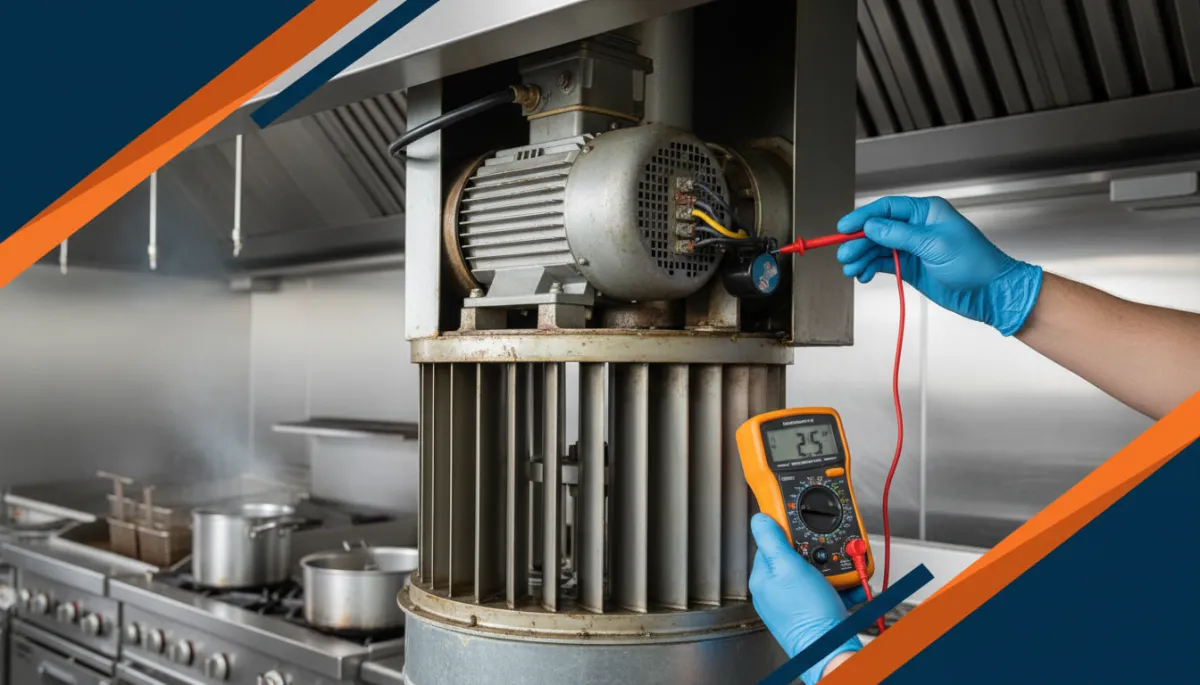
With power safely locked out, I started inspecting the motor assembly. The original motor carried MFG No. C13C. Just putting a hand on the mounting and looking at the surrounding metal, it was obvious this motor had been vibrating hard for a long time — you could see where it had walked and rubbed on its mounts and nearby components.

This motor wasn’t just old. It had been shaking hard enough, long enough, that it started causing problems with everything it touched. In the world of captive air hood repair and commercial kitchen exhaust fan repair, a motor that’s vibrating outside normal limits is a big red flag — it means damage is already happening somewhere in the system.
💡 Pro Tip: If you can hear or feel a hood motor “thumping” or rattling, don’t ignore it. Excess vibration is more than noise — it’s wearing out bearings, belts, mounts, and, as we’ll see, even electrical conduit.
4. Corroded Pillow Block Bearing: Rust and Moisture from Long-Term Neglect
Next, I checked the pillow block bearing that supports the fan shaft. That bearing is supposed to let the shaft spin smoothly with very little resistance. Instead, what I found was obvious rust and signs of long-term moisture exposure.

A worn pillow block bearing doesn’t just fail to support the shaft — it also adds even more vibration into the system. Now you’ve got a shaky motor, a rough bearing, and a corroded, grease-coated housing all working together. That’s a recipe for mechanical failure — and sometimes, a safety problem.
5. BlueStars CD60B Capacitor: Pulled for Inspection and Covered in Soot
On motors like this, the start capacitor is a key part of the circuit that gets the motor turning. In this unit, the capacitor was a BlueStars CD60B rated at 233–280 µF, 110–125 VAC. When I pulled it for inspection, it was coated in black buildup and corrosion.

The capacitor was definitely part of the picture, but it still wasn’t the whole story. Yes, it was in bad shape, but the real danger was building somewhere else — where the electrical side and the mechanical side meet inside a hood that’s been collecting grease for years.
6. The Real Discovery: Liquidtight Conduit Worn Through Inside a Grease-Coated Hood
As I followed the wiring from the motor into the hood, I found the most dangerous part of this whole call. The constant vibration from the failing C13C motor hadn’t just beaten up the mounts — it had literally worn its way through the liquidtight conduit that was supposed to protect the wiring.
In the first photo at the top of this article, you can see the result: breached liquidtight conduit with bare wire exposed inside a grease-coated captive air hood. The black material you see in the pictures is kitchen grease buildup, not burn or arc damage — I confirmed that on site.
But having bare wire exposed inside a hood that’s coated in grease means we were one ignition source away from a real problem. One spark, one arc, or one hot spot in the wrong place, and this could have turned into a fire inside the hood or up in the exhaust duct.
💡 Practical Tip: If you notice your kitchen hood getting louder, shaking more than usual, or not pulling smoke like it used to, don’t wait until it quits. Call a professional who handles restaurant equipment repair in North Mississippi before a simple vibration issue turns into an electrical and fire hazard.
7. What This Means for Restaurant Owners in Baldwyn and the Rest of North Mississippi
This call in Baldwyn wasn’t a one-off. We see hood systems that are run until they fail, with very little real maintenance, and then S.I. Service Group gets the call when the hood stops pulling or when the inspectors start asking hard questions.
If you’re running a restaurant or commercial kitchen in Baldwyn, Booneville, Corinth, or Tupelo, your hood is part of your life safety and health package, not just “a fan on the roof.” A kitchen hood motor failure can mean:
Smoke and grease drifting into the dining room and customer complaints.
Notes from health or fire inspectors about poor exhaust performance.
And in the worst cases, like we saw here, bare wiring inside a grease-coated hood — just one step away from a kitchen fire.
If you want a partner who understands both the ventilation side and the electrical side, that’s where we come in. We’re a multi-trade contractor based in Tupelo, Mississippi, and we handle restaurant equipment repair in Tupelo, MS and the surrounding areas every day — from captive air hood systems to commercial refrigeration.
8. What We Covered Here — and What You’ll See in Part 2
This article is Part 1 of 2, and it focuses only on what we found during the service call in Baldwyn, MS:
A captive air hood that wasn’t exhausting the way it should.
An interior belt and pulley mechanism with a corroded housing, grime-coated pulleys, and a worn belt.
A failed motor, MFG No. C13C, vibrating hard enough to damage components around it.
A corroded pillow block bearing with obvious rust and moisture damage.
A BlueStars CD60B capacitor (233–280 µF, 110–125 VAC) pulled for inspection and covered in soot and corrosion.
And most important: liquidtight conduit worn through with exposed wiring inside a grease-coated hood — a very real near-miss kitchen fire.
Is Your Kitchen Hood Safe?
If you’re running a commercial kitchen in Baldwyn, Tupelo, Corinth, Booneville, or anywhere else in North Mississippi, and you’ve noticed your hood isn’t pulling like it used to or is making new noises, now is the time to get it checked — not after it quits or after an inspector writes you up.
S.I. Service Group is a veteran-owned, multi-trade contractor with real experience on hot side equipment, Captive-Aire–style ventilation systems, and complex make-up air setups. With Mississippi License No. 20095 for HVAC and electrical, we can handle both the mechanical and electrical sides of your hood system in a single visit.
To schedule an inspection or an emergency call, reach out to us directly through our contact page. We serve:
Tupelo, Mississippi and the surrounding communities
Baldwyn, Booneville, and Corinth
Restaurants, schools, healthcare, and institutional kitchens across North Mississippi
If you’re seeing any signs of kitchen hood motor failure — heavy vibration, weak exhaust, burning smells, or frequent shutdowns — don’t wait for it to turn into something bigger. Call S.I. Service Group for restaurant equipment repair in North Mississippi before your hood becomes a real fire hazard.
Check back on Monday for Part 2 — we’ll walk through the full repair on this Baldwyn job: a new motor, new liquidtight conduit, and a hood system made safe and reliable again, with “after” photos and step-by-step details on getting this captive air hood back to doing what it was designed to do.