Fix Your Commercial Rotisserie Oven Issues Fast
Commercial Kitchen, Deli Oven Repair, Rotisserie Equipment
Commercial Rotisserie Oven Not Working Right? Here's What's Going Wrong
When your rotisserie oven goes down in the middle of prep, you don’t just lose a piece of equipment — you lose your hot food program, your rotisserie chicken sales, and a big chunk of today’s revenue. If you’re in charge of a deli, restaurant, or food service operation in North Mississippi, this is the last surprise you need during a busy shift. Partnering with a local, experienced team like S.I. Service Group in Tupelo, MS means you’ve got backup when it matters most.
The 7 a.m. Problem: Cold Oven, No Chickens, Clock Ticking
Picture this: you walk into the deli at 7 a.m., coffee in hand, ready to start the first batch of chickens. You load the Henny Penny or BKI, set your program, hit start — and the oven never comes up to temp. Or the spit doesn’t turn. Or worse, it heats up, runs for a while, and then shuts off mid-cycle with a full load inside.
Now you’re staring at a line of tickets, a hot bar that’s going to be empty, and customers who expect rotisserie chickens ready by lunchtime. Every minute that oven isn’t working is money walking out the door — and you know you can’t just “hope it fixes itself” and walk away. When that happens in Tupelo, Corinth, Oxford, or anywhere else in North Mississippi, you need a plan, not panic — and a trusted food service equipment repair partner who understands deli operations.
Why Rotisserie Ovens Fail Under Real-World Deli Loads
I’m Dan with S.I. Service Group in Tupelo, MS. Before I started servicing equipment across North Mississippi, I spent years maintaining commercial deli equipment — including Henny Penny, BKI, Alto-Shaam, and Hobart rotisserie ovens — for Walmart and Sam’s Club. Those stores run some of the highest-volume rotisserie programs in retail, with multiple full loads cycling every day, seven days a week.
Under that kind of load, small issues never stay small. A weak motor, a sticky door seal, or a partially clogged airflow path might limp along in a low-volume restaurant. In a busy grocery deli, it turns into:
Batches running late or not finishing on time
Unevenly cooked product you can’t sell with confidence
Emergency shutdowns in the middle of a rush
Most of the failures I see in grocery stores and restaurants around Tupelo, Corinth, Oxford, Fulton, Pontotoc, Saltillo, and Amory come down to three things:
Heavy use without scheduled maintenance — high heat, grease, and constant cycling wear parts fast.
Minor issues ignored too long — a little smoke, a small temp drop, or a noisy motor that never gets checked.
Improper cleaning — either not enough cleaning, or cleaning the wrong way and damaging components.
💡 Pro Tip: If your rotisserie runs multiple cycles a day, treat it like a critical piece of production equipment, not just another oven. It needs a plan, not just reaction when it breaks. A simple preventive visit from a local commercial appliance repair technician can save you from a ruined weekend.
Common Commercial Rotisserie Oven Problems — Symptoms and Causes
1. Oven Not Heating to Set Temperature or Losing Temp Mid-Cook
What you see: You set the oven for your usual program, but it takes forever to preheat, never quite reaches set temperature, or drops 30–50°F in the middle of the cook. Chickens come out pale, undercooked, or way behind schedule.
Likely causes:
Failing heating elements or burners (electric or gas, depending on model)
Faulty temperature sensor / probe sending bad info to the controls
Door not sealing properly, bleeding heat into the room
Control board issues not driving full heat when needed
On Henny Penny, BKI, Alto-Shaam, and Hobart units, I’ll usually start by verifying actual temperature with a calibrated thermometer and comparing it to what the display shows. If the oven can’t hold temp, you’re burning energy, losing cook time, and risking unsafe product. This is a call-for-service issue, not a “wait and see.”
2. Rotisserie Spit or Basket Not Rotating (Motor or Gearbox Failure)
What you see: You hit start and the oven heats, but the spit or baskets just sit there. Or they start, jerk, and then stall. Sometimes you hear grinding or clicking from the back of the unit. This is one of the most common “rotisserie oven not rotating” calls I get for deli oven repair in North Mississippi.
Worn or seized rotation motor from years of high-volume use
Gearbox failure — stripped gears, low lubricant, internal damage
Bent spit shaft or misaligned drive components putting extra load on the motor
Electrical issues — bad relay, wiring, or control output not sending power to the motor
In a Walmart or Sam’s Club environment, a weak motor that’s ignored will usually take the gearbox with it. Replacing both is a bigger bill than catching the original problem early. If your rotisserie oven is not rotating consistently, shut it down and get it checked before you damage more parts.
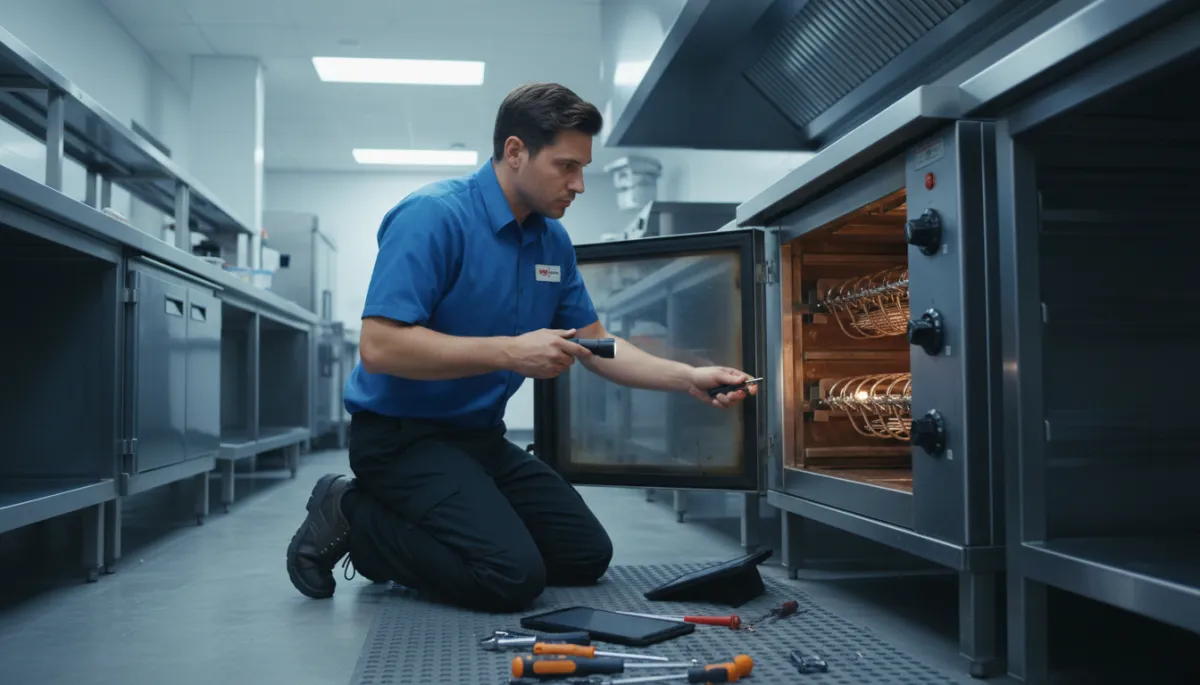
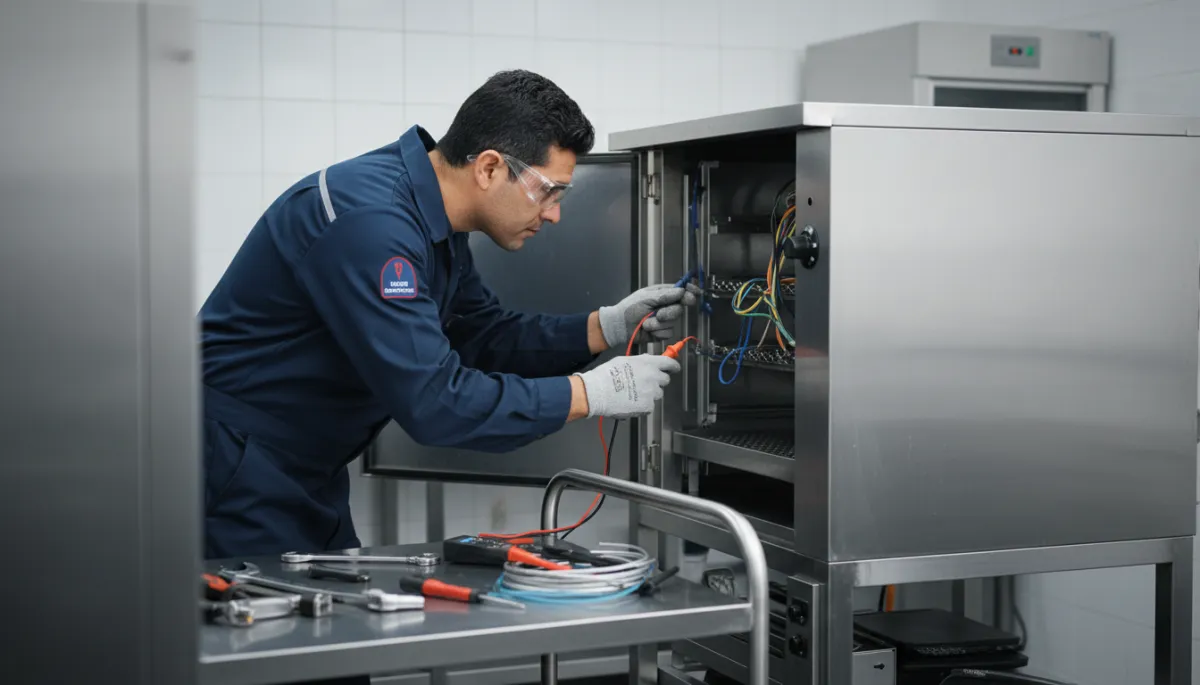
A thorough inspection catches failing motors and wiring before they shut your deli down.
3. Uneven Cooking or Hot Spots (Heating Element or Airflow Issues)
What you see: Front row chickens look perfect, back row is pale. Top baskets are dark and crispy, bottom racks are barely done. You’re throwing away product or spending extra time trying to rotate positions mid-cook just to get an even batch.
One or more heating elements burned out or partially failing
Convection fan not running correctly or running weak, causing poor air circulation
Grease buildup blocking airflow paths, vents, or fan guards
On high-volume units, fans and elements work hard all day. When airflow drops or an element fails, you get hot spots and cold zones. Beyond quality issues, this can turn into a food safety problem if parts of the batch don’t reach safe internal temperature. If you’re consistently seeing uneven cooks, it’s time for a professional to check elements, fans, and airflow, not just adjust cook times and hope for the best. You can also review our related guide on broader equipment issues in 9 warning signs your commercial equipment needs service to catch problems early.
4. Oven Shutting Off Unexpectedly (Thermal Cutout or Electrical Fault)
What you see: The oven starts fine, heats up, then suddenly shuts off mid-cycle. Controls go dark or the heat drops out and won’t come back until it cools. You might have to reset a breaker or wait 15–30 minutes before it will restart — if it restarts at all.
Overheated components tripping a thermal cutout or high-limit safety switch
Failing high-limit thermostat or temperature sensor reading incorrectly and shutting the unit down early
Loose electrical connections, bad contactors, or failing power supplies on the control board
When a rotisserie oven shuts off like this, it’s a serious safety issue. The high-limit is there to prevent a fire. In my Walmart and Sam’s Club days, any unit doing this was immediately taken out of service and inspected. If your oven is shutting down mid-cook, don’t keep resetting it and pushing through — call for commercial rotisserie oven repair in Tupelo, MS or wherever you’re located in North Mississippi.
5. Glass Door Cracking or Sealing Poorly (Heat Loss and Safety Risk)
What you see: Door glass is cracked, crazed, or fogged. The door may not close smoothly, or you can feel heat leaking out around the gasket. Sometimes you see condensation or grease streaking between glass layers.
Heat stress over time, especially if the door is opened constantly during cooking
Damaged or hardened door gaskets that no longer seal correctly
Improper cleaning tools or chemicals scratching or weakening the glass and seals
Besides being a safety concern, a bad door seal means your oven works harder to stay at temp, and often fails. You’ll see longer cook times, uneven results, and higher energy use. On some Henny Penny and BKI models, door and gasket issues are one of the biggest reasons ovens struggle to meet performance specs. If the glass is cracked or the door doesn’t seal tight, it’s time for professional deli oven repair — not duct tape or a towel stuffed in the gap.
6. Excessive Smoke During Operation (Grease Buildup or Element Contact)
What you see: Some smoke is normal in a rotisserie oven. But if you’re filling the deli with smoke, setting off alarms, or customers are complaining about the smell, that’s a problem. You might see grease flaring on the bottom, or heavy smoke when the oven hits higher temperatures.
Grease buildup on the bottom pan, around elements, or in drip trays that aren’t being emptied and cleaned regularly
Heating elements or burners contacting grease or debris directly and burning it off every cycle
Poor ventilation or blocked exhaust, trapping smoke inside the cavity and pushing it into the room
In high-volume programs, grease management is everything. I’ve seen ovens in big-box delis go from “a little smoky” to “we’re calling the fire department” in a few days when cleaning slips. If you’ve stepped up your cleaning and still see heavy smoke, get a tech out to inspect elements, burners, and airflow. Excessive smoke is both a fire and food quality issue. For more on keeping your whole hot and cold line in shape, you can also read our commercial refrigeration guide for North Mississippi operators.
7. Digital Controls or Display Malfunctioning or Reading Incorrectly
What you see: The display flickers, shows error codes, or the buttons don’t always respond. Sometimes the oven says it’s at 350°F, but your product and a separate thermometer say otherwise. Programs may not save correctly or may randomly reset.
Failing control board or power supply from years of heat and grease exposure
Damaged wiring, loose connectors, or moisture intrusion behind the panel
Bad temperature or humidity sensors feeding wrong data to the controls
On modern Henny Penny, BKI, Alto-Shaam, and Hobart rotisserie ovens, the digital controls are the brain of the system. When the brain is confused, you can’t trust temps, times, or food safety. If your display is acting up or readings don’t match reality, it’s time for a professional diagnosis — not guesswork with cook times and temperatures.
8. Timer or Cycle Not Advancing Properly
What you see: You start a standard program, but the timer stalls, jumps, or never reaches zero. The oven might stay in cook mode too long or drop into hold early. You’re constantly babysitting the unit instead of trusting it to run a full cycle on its own.
Control logic problems or failing internal timer circuits on the control board
Faulty door switches or interlocks confusing the control about whether the oven is actually running
Power drops or electrical noise causing the control to reset or glitch
In a high-volume deli, you don’t have time to stand and watch the timer. If cycles aren’t advancing properly, you’ll end up with undercooked or overcooked product and constant rework. This is usually a controls or switch issue that needs a technician with experience in commercial oven repair in North Mississippi, not just a settings change.
9. Unusual Burning Smell That Isn’t from Food
What you see (and smell): Even when there’s no food inside, the oven gives off a sharp, electrical, or plastic burning smell. Or the smell is much stronger than usual and doesn’t match what’s cooking. You might notice it more during preheat or right after startup.
Electrical components overheating — wiring insulation, connectors, or control components starting to burn
Grease or debris trapped where it shouldn’t be, like on top of elements or around fans and motors
New parts burning off protective coatings (normal for the first few cycles after a major repair, but not ongoing)
A strange burning smell is one of those things you never ignore. In my big-box experience, that was often the first warning sign before a part failed completely. If it doesn’t go away quickly, shut the oven down and schedule service. It’s cheaper to find a hot wire or damaged component now than to deal with a full failure — or worse, a fire — during peak hours.
The Real Cost of a Dead Rotisserie Oven
When your rotisserie oven is down, you’re not just losing chickens. You’re losing:
Rotisserie chicken sales — often one of the highest-margin items in the deli case
Side dish and hot bar sales that go with those chickens (potatoes, veggies, rolls, etc.)
Labor wasted loading, unloading, and reworking bad batches that don’t cook right
Customer trust when they come in expecting chickens and leave empty-handed
For many delis, a broken rotisserie oven can mean hundreds of dollars per day in lost product and sales. In a busy grocery store, that number can climb even higher. Over a weekend, a simple motor or sensor issue can quietly turn into thousands of dollars in missed revenue — all because the oven wasn’t maintained or repaired when the first symptoms showed up.
📌 Key Takeaway: A timely service call is almost always cheaper than a full day without rotisserie chickens on the shelf. If you’re already seeing warning signs, call us today to get ahead of a shutdown.
What a Technician Actually Checks During a Rotisserie Service Call
When S.I. Service Group comes out for commercial rotisserie oven repair in Tupelo, MS or anywhere in North Mississippi, we’re not just resetting a breaker and walking away. A proper service call on a Henny Penny, BKI, Alto-Shaam, or Hobart rotisserie typically includes:
Visual inspection: Checking door glass, gaskets, spits, baskets, and drip pans for damage, misalignment, or heavy buildup.
Heating performance test: Verifying preheat time and temperature accuracy with a calibrated thermometer, not just trusting the display.
Rotation system check: Testing the rotation motor, gearbox, drive couplings, and bearings for noise, drag, or slippage.
Electrical and controls: Inspecting wiring, connections, contactors, relays, sensors, and the control board for heat damage or loose contacts.
Safety devices: Confirming high-limits, door switches, and thermal cutouts are working correctly and not bypassed.
Airflow and smoke control: Checking fans, vents, and exhaust paths for obstructions or failing components.
The goal isn’t just to get the oven running today. It’s to keep it running reliably through your busiest periods so you’re not calling again next week with the same problem. That’s the same approach I used supporting big-box delis, and it’s the standard we bring to independent grocers and restaurants across North Mississippi.
Preventive Maintenance: How to Keep Your Rotisserie Out of Trouble
In my Walmart and Sam’s Club days, the stores that rarely had major rotisserie failures all had one thing in common: consistent cleaning and scheduled maintenance. Here’s what that looks like in a typical deli or restaurant setting:
Daily Tasks (Staff)
Empty and clean drip pans and grease trays every shift, not just at the end of the day.
Wipe down interior surfaces with approved cleaners once the oven is cool — no abrasive pads on glass or gaskets.
Check that the door closes smoothly and seals without gaps; report any issues immediately.
Weekly Tasks (Staff with Manager Oversight)
Inspect spits, baskets, and racks for bending, warping, or damage that could stress the motor or cause uneven loading.
Verify basic cook times and product quality — if you’re adjusting programs to “make up” for slow cooking, that’s a red flag.
Quarterly or Semi-Annual Tasks (Professional Service)
Full inspection of electrical components, motors, gearboxes, fans, sensors, and controls by a trained technician.
Testing and calibration of temperature controls and safety devices.
Replacement of worn gaskets, seals, and other wear parts before they fail during a rush.
For high-volume stores running multiple cycles per day, I strongly recommend at least twice-yearly professional maintenance. That’s the schedule that kept big-box rotisserie programs running without constant emergencies — and it works just as well for independent grocers and restaurants across North Mississippi. If you’d like help setting up a preventive schedule, you can schedule service with our team and we’ll build a plan around your volume and hours.
FAQ: Commercial Rotisserie Oven Repair in North Mississippi
1. What brands of rotisserie ovens do you service?
S.I. Service Group services most major commercial rotisserie brands, including Henny Penny, BKI, Alto-Shaam, and Hobart. If you’re not sure about your specific model, call and we’ll let you know what support is available for your equipment. My background includes years working on high-volume deli ovens for Walmart and Sam’s Club, so I’m familiar with how these units behave under real-world loads.
2. Is it better to repair or replace a failing rotisserie oven?
It depends on age, condition, and parts availability. If your oven is relatively modern, parts are available, and the cabinet is in good shape, repair is usually the better value. When units are 10–15 years old, heavily corroded, or need multiple major components (controls, motors, and elements all at once), we’ll give you honest feedback on whether your money is better spent on a replacement. Either way, the goal is to keep your hot food program profitable, not just keep an old box limping along.
3. How often should I schedule professional service for my rotisserie oven?
For high-volume grocery delis and busy restaurants, I recommend every 6 months at minimum. Lower-volume operations can sometimes stretch to once a year, but if you’re running multiple batches a day, a twice-yearly check is cheap insurance against breakdowns. Remember, one weekend of downtime can easily cost more than a full year of preventive maintenance.
4. Do you offer emergency or priority service if my rotisserie is down?
Yes. We understand that when your rotisserie is down, your hot food program is down. S.I. Service Group offers prompt response for critical deli oven repair issues. When you call, let us know your oven is down and you’re losing production — we’ll prioritize getting you back up and running as quickly and safely as possible.
5. What areas of North Mississippi do you serve?
S.I. Service Group provides commercial oven repair in North Mississippi, including Tupelo, Corinth, Oxford, Fulton, Pontotoc, Saltillo, and Amory, as well as surrounding communities. If you’re within driving distance of Tupelo and need commercial rotisserie oven repair, reach out and we’ll let you know how quickly we can get to you.
6. What should my staff do if the oven fails during a rush?
First, don’t keep resetting or forcing the unit to run if it’s shutting down, smoking heavily, or showing error codes — that can turn a repair into a safety incident. Pull any questionable product, switch your team to alternative menu items, and document what the oven was doing when it failed (error messages, smells, noises). Then call us today so we can walk you through safe next steps and dispatch a technician to your location in North Mississippi.
7. Can you help with other hot side and refrigeration equipment too?
Yes. In addition to rotisserie ovens, we handle a wide range of commercial appliance repair and food service equipment repair — fryers, combi ovens, holding cabinets, walk-in coolers, reach-ins, and more. Most North Mississippi delis and restaurants don’t just have one piece of equipment at risk; they have a whole line. We can often address multiple issues in a single visit to minimize downtime and service costs.
8. Are there warning signs I can watch for before the oven fails completely?
Absolutely. Slower preheat times, small but consistent temperature drops, unusual noises from the motor or fan, heavier smoke than usual, or having to “tweak” programs just to get the same results are all early warning signs. If you’re seeing those in your Tupelo, Corinth, or Oxford location, it’s time to schedule a service call. For a broader checklist that covers your whole kitchen, take a look at our related article on 9 warning signs your commercial equipment needs attention.
Ready to Get Your Rotisserie Back on Line?
If your rotisserie oven isn’t heating right, not rotating, shutting off, smoking, or just acting “off,” don’t wait for a full breakdown in the middle of a rush. The issues I saw every day in Walmart and Sam’s Club delis are the same ones I see now in independent groceries and restaurants across North Mississippi — and they almost always start with small warning signs.
S.I. Service Group offers experienced, practical commercial rotisserie oven repair in Tupelo, MS and the surrounding area. We understand the pressure you’re under to keep your hot food program stocked, your customers happy, and your team moving. Whether you’re running a Henny Penny, BKI, Alto-Shaam, Hobart, or another commercial brand, we can diagnose the problem, explain your options clearly, and get you back in business.
If you’re a deli manager, restaurant operator, or food service manager in Tupelo, Corinth, Oxford, Fulton, Pontotoc, Saltillo, or Amory and your rotisserie oven isn’t working right, now is the time to act. Don’t let another day’s revenue disappear because your equipment isn’t doing its job.
👉 Next Step: Contact S.I. Service Group today to schedule service for your rotisserie oven or set up a preventive maintenance plan that keeps your deli running smoothly all year long.