Commercial Mixer Repair Tips for North Mississippi
Food Service Equipment, Commercial Mixer Repair, Hobart Mixer Repair North Mississippi
Commercial Mixer Not Working? Here's What a Food Service Tech Checks First
If you walked into your bakery, pizza line, or deli this morning and your Hobart or Globe mixer was dead, grinding, or slowing to a crawl, you don’t need theory — you need to know what’s wrong, how bad it is, and whether you can save today’s production. That’s exactly what we’ll cover here, from a working tech’s point of view in North Mississippi.
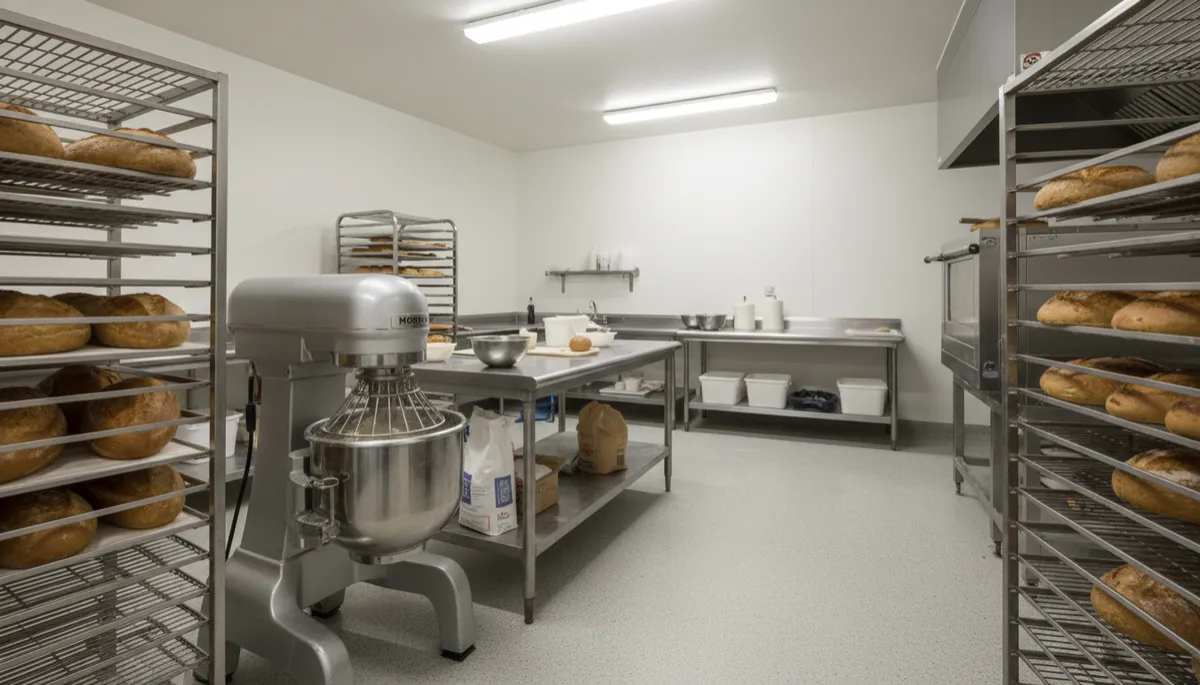
When a Dead Mixer Feels Like a Trading Halt on Your Kitchen Line
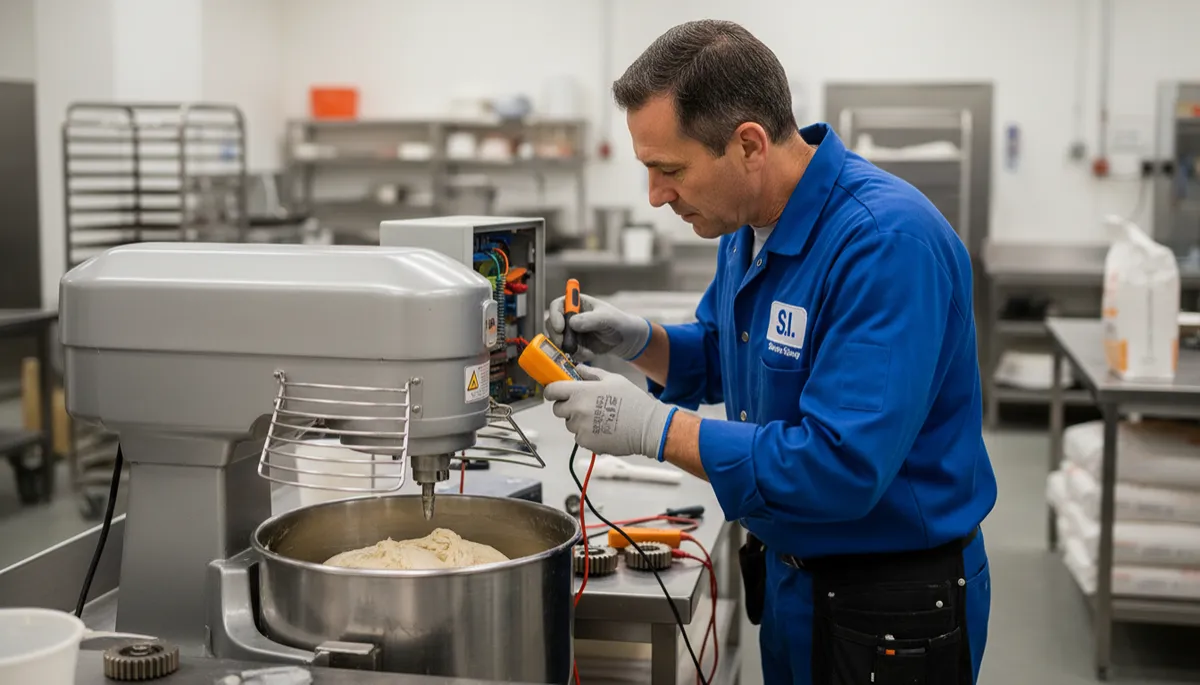
I’m Dan, a commercial equipment technician with S.I. Service Group in Tupelo, MS. Before I was fixing mixers across North Mississippi, I was keeping Hobart units alive in Walmart and Sam’s Club bakeries and delis — N50s, A200s, HL200/HL300s, plus Globe, Univex, and Berkel machines that ran all day on bread dough, batters, and coatings. When one of those mixers went down in the middle of a production cycle, it felt a lot like a trading desk when the main order router fails: everything backs up, and every minute costs money.
For a bakery or pizza shop, a dead mixer can stall your entire “production line.” If you normally run 10–15 dough batches in a morning, and each batch is worth a few hundred dollars in finished product, losing a half-day can easily cost $1,000–$3,000 in lost sales — not counting overtime, waste, and unhappy customers. From a financial analyst’s perspective, mixer downtime is a direct hit to your daily P&L, not a minor inconvenience.
| Operation Type | Batches Lost in 4 Hours | Estimated Revenue Impact |
|---|---|---|
| Small bakery (10–20 loaves/batch) | 6–8 batches | $600–$1,200 |
| Pizza shop (dough for lunch/dinner rush) | 4–6 batches | $800–$2,000 |
| Grocery deli/bakery combo | 8–12 batches | $1,500–$3,000 |
That’s why when someone calls S.I. Service Group for commercial mixer repair Tupelo MS, I treat it the same way a trader treats a major system outage: triage fast, stabilize, then fix the root cause so it doesn’t happen again.
Why Commercial Mixers Fail: The Big Picture
In high-volume bakeries and delis, Hobart, Globe, Univex, and Berkel mixers are built like tanks — but nothing survives endless heavy dough, no cleaning, and no lubrication schedule. In Walmart and Sam’s Club environments, I watched the same patterns repeat:
- Overloading and wrong speed: Running heavy dough on too high a speed or stuffing the bowl past what the chart allows beats up gears, motors, and shafts fast.
- No preventive maintenance: Old grease, worn seals, and loose hardware turn minor wear into full gear failures and leaks.
- Heat and duty cycle abuse: Running back-to-back batches with no cool-down overheats motors and trips thermal overloads, especially on smaller N50 and 20-quart units.
- Operators fighting the machine: Forcing gears while the mixer is running, slamming bowls into place, or ignoring strange noises accelerates failures.
Problem-by-Problem: What Your Symptoms Really Mean
1. Mixer Won’t Turn On at All
Symptom: You flip the switch, nothing happens. No hum, no click, dead panel. On Hobart and Globe units, I start with three buckets: power supply, safety circuit, or control board/overload.
- Power issue: I verify the outlet, breaker, and cord. In older kitchens, outlets get loose or breakers trip when too much equipment shares a circuit. I’ll meter voltage at the plug and inside the mixer at the contactor or main terminal block.
- Thermal overload: Many mixers have an internal overload that trips when the motor overheats. After cooling, some reset automatically, others need a manual reset button inside the base or control area. If I see this repeatedly, I treat it as a motor or ventilation problem, not “just a trip.”
- Control board or safety switches: On newer Hobart HL series, the control board monitors bowl guard, bowl lift, and start/stop. A failed guard switch or bad board can keep the mixer from energizing. I test each safety switch and look for power in/out of the board before calling a board “bad.”
2. Motor Running but Bowl Not Spinning
Symptom: You hear the motor, but the planetary or agitator doesn’t move, or it moves sporadically. This points straight to transmission or gear failure.
- On Hobart A200 and similar, I look for stripped gears, broken keys, or a failed pinion that lets the motor spin but doesn’t transfer torque to the planetary shaft.
- On Globe and Univex, I check linkages between the motor and gear train and inspect for sheared keys or cracked gears — often caused by running heavy dough in too high a speed.
In financial terms, this is like having power to your trading system but no orders reaching the market — the “transmission” between intent and execution is broken. This usually requires disassembly, parts, and downtime, so catching early noises before full failure is critical.
3. Mixer Slowing Down or Losing Power Under Load
Symptom: The mixer runs fine empty, but once you add dough, it bogs down, stalls, or takes forever to mix. Here I’m thinking motor, capacitor, or power supply.
- Weak motor windings: Overheated or aging motors lose torque. I check amp draw under load and compare to the nameplate. High amps with low torque usually means the motor is on its way out.
- Bad start/run capacitor (on single-phase units): A failing capacitor can let the motor start but not develop full power. Swapping a known-good capacitor is a quick diagnostic step on some models.
- Voltage drop: Long runs of undersized wire or overloaded circuits can starve the motor. I meter voltage at the mixer under load to confirm it’s within spec.
4. Unusual Grinding or Rattling Noise During Operation
Symptom: The mixer still runs, but you hear grinding, rattling, or clunking — especially when changing speeds or mixing heavy dough. This is almost always gear wear, broken components, or loose hardware inside the head or transmission.
- I open the gear case and inspect for chipped or missing teeth, worn bushings, or metal shavings mixed into the grease. On Hobarts, I see this a lot when the speed selector is shifted while the mixer is running.
- Loose planetary assemblies or bent shafts can also rattle. I check for play by trying to move the planetary side to side with the mixer off.
5. Mixer Overheating and Shutting Off
Symptom: The mixer runs for a while, gets very hot, then shuts down and only restarts after cooling. That points to thermal overload, poor ventilation, or overuse.
- I check the motor cooling fan and air paths. Flour dust and grease can pack vents and reduce airflow, especially in bakery environments where mixers live near ovens and fryers.
- I review how the mixer is being used. Back-to-back heavy dough batches on a 20-quart Hobart or Globe with no rest will overheat even a healthy motor. Each model has a duty cycle; ignoring it is like running your account at 10x the risk you planned.
6. Bowl Not Locking Properly
Symptom: The bowl rocks, won’t seat fully, or pops out of the lock during mixing. That’s usually locking mechanism wear or misalignment.
- I inspect the bowl clamps, pins, and yokes for wear, bending, or broken welds. Operators sometimes “slam” bowls into place, which slowly deforms components.
- I verify the bowl is the correct size and style for the mixer. Mixing and matching bowls between units can cause poor locking and unsafe operation.
7. Attachment Hub Not Engaging
Symptom: You mount a slicer, grinder, or shredder on the front hub, but it doesn’t spin or slips under load. That points to a worn hub, drive gear, or attachment.
- I inspect the hub drive shaft and internal gear. Wear or rounding of the drive dogs can let the shaft spin without fully engaging the attachment.
- I also check the attachment itself. A worn or off-brand attachment may not seat properly, especially on Hobart hubs that expect a specific fit.
8. Leaking Grease from the Head
Symptom: You see grease dripping down the planetary or into the bowl. That’s almost always seal or gasket failure, or old, separated grease.
- I open the gear case, clean out the old grease, replace seals, and repack with food-grade grease to the correct level. Overfilling can cause leaks just as much as worn seals can.
- Long intervals with no preventive maintenance (PM) in hot bakeries accelerate grease breakdown. In Walmart/Sam’s-style duty cycles, gearboxes that should last years can start leaking in under two if never serviced.
9. Speed Control Not Responding or Stuck
Symptom: The mixer is stuck in one speed, jumps speeds, or doesn’t respond when you move the lever or press the speed buttons. This is usually a control switch, selector, or linkage problem.
- On gear-driven Hobart A200s, I check the mechanical linkage and detents. Forcing the lever while running can bend parts or round gear edges, leading to “in between” speeds and noise.
- On electronic HL series and some Globe models, I test the speed selector switch and control board outputs. A failed switch or board can lock you into one speed or prevent any speed from engaging.
10. Timer or Auto-Shutoff Not Functioning
Symptom: The timer doesn’t start, never shuts off, or the mixer only runs in “manual.” That’s a timer mechanism or control board issue, depending on the model.
- On older Hobarts with mechanical timers, I test the contacts and internal clock mechanism. If it’s physically worn or arcing, replacement is usually the fix.
- On digital timers, I verify the timer input and output at the control board. If the timer counts down but doesn’t send a stop signal, the board or relay is suspect.
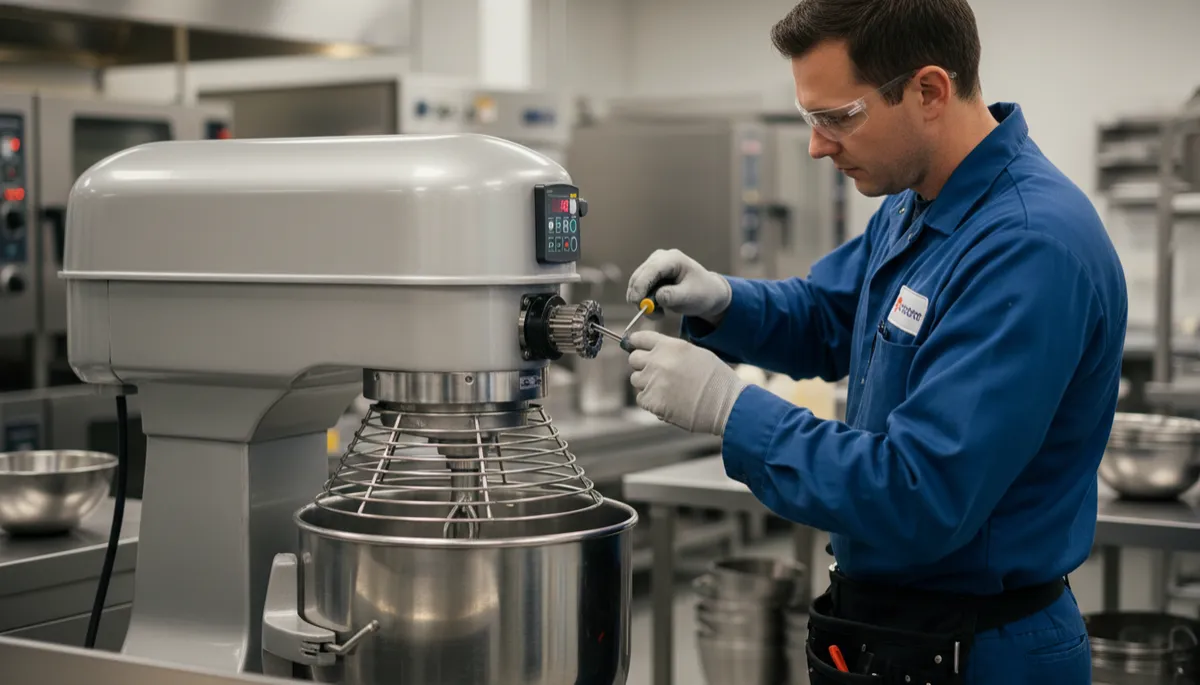
A thorough inspection catches small mixer issues before they shut down production.
What I Check First on a Service Call: A Step-by-Step Approach
When you call S.I. Service Group for food service mixer repair in Tupelo, Corinth, Oxford, or anywhere in North Mississippi, I don’t start by guessing. I use a simple, repeatable checklist — the same way a trader follows a playbook instead of trading on gut feel.
- Confirm the complaint: I have your team show me exactly what the mixer is (or isn’t) doing. Noise, smell, and behavior under load matter.
- Safety and power checks: I verify correct voltage at the outlet and inside the mixer, check the cord, plug, and any visible damage, and make sure guards and bowl lifts are in place and functioning.
- Basic operation test: I run the mixer empty through all speeds, watching for hesitation, noise, or overheating. Then I test under a light load if possible to see how it behaves under real conditions.
- Mechanical inspection: I check the planetary for play, inspect the bowl locks, attachment hub, and look for grease leaks or cracks in the body and mounts.
- Electrical and control diagnostics: Depending on the symptom, I test capacitors, overloads, timers, and control boards with a meter, not just by eye.
- Transmission/gearbox assessment: If I suspect gears, I open the head, inspect gears, bearings, and grease condition, and document what I find so you understand the repair scope and cost before we proceed.
Hobart vs Globe vs Others: Common Failure Patterns
In the field, different brands fail in slightly different ways, especially under Walmart/Sam’s Club–style usage where mixers run multiple cycles daily.
- Hobart (N50, A200, HL series): Very robust gear trains, but I see gear damage when operators shift speeds while running or overload the bowl. HL series add more electronics — timers, boards, and safety circuits — so control issues are more common than on the older A200s. Grease breakdown and seal leaks are frequent in hot bakeries without PM.
- Globe: Solid performers, but I see more issues with attachment hubs and speed selectors when they’re pushed hard in pizzerias. Some models are more sensitive to overloading and can overheat faster than comparable Hobarts if used beyond their ratings.
- Univex & Berkel: Common in delis and grocery operations. Failures are similar — gear wear, motor issues, and timer/control problems — but parts availability and lead times can vary, which affects how quickly I can get you back up.
The point is simple: no brand is bulletproof. Good equipment plus good maintenance beats any logo on the front of the machine.
Preventive Maintenance: The “Risk Management” Side of Mixer Ownership
In trading, risk management keeps you in the game. In your kitchen, preventive maintenance does the same. Here’s what I recommend to bakery managers, restaurant kitchens, and grocery delis across Tupelo, Corinth, Oxford, Fulton, Pontotoc, Saltillo, and Amory.
Basic PM Operators Can Handle
- Daily wipe-down: Clean flour, dough, and grease off the head, vents, and controls. Don’t spray directly into vents or electrical panels — use a damp cloth, not a hose.
- Check bowl locks and guards: Make sure bowls lock smoothly and guards open/close properly. Report any stiffness or looseness early.
- Listen and feel: Train staff to report new noises, vibration, or heat instead of “just finishing the batch.” Early calls are almost always cheaper calls.
Technician PM: Lubrication and Deep Inspection
- Gearbox grease service: For heavy-use operations (multiple cycles daily, seven days a week), I recommend opening and inspecting the gear case roughly every 12–18 months. That includes cleaning old grease, checking gears and bearings, replacing seals as needed, and repacking with the correct food-grade grease.
- Electrical and safety check: Annually, I test overloads, safety switches, and timers, and verify amp draw and voltage under load. This catches weak motors and failing capacitors before they strand you mid-shift.
Quick FAQ for North Mississippi Kitchen Managers
1. What mixer brands do you service?
I work on Hobart, Globe, Univex, and Berkel mixers regularly, including Hobart N50, A200, HL200, HL300 and similar units. If you have another commercial brand, I can usually support it as long as parts are available. When you call, tell me the brand, model, and serial number so I can confirm parts access up front.
2. Should I repair or replace my mixer?
I look at it like an investment decision. If a repair costs more than 40–50% of a comparable replacement and the mixer is already near the end of its expected life, replacement may make more sense. But many Hobart and Globe mixers are worth rebuilding — especially 20- and 60-quart units — because a properly rebuilt machine can run for many more years with regular PM. I’ll lay out the repair cost, expected life, and downtime so you can make a financial decision, not a guess.
3. How fast can you get my mixer back online?
For calls in Tupelo, Saltillo, and nearby towns, I can often respond same day or next business day, especially for critical “mixer down” situations. If the issue is electrical or minor mechanical and parts are on the truck, you may be running again within a few hours. For major gear or motor work that needs parts ordered, I’ll give you a realistic ETA based on current parts availability and shipping times.
4. Do you offer emergency or off-hours service?
Yes, we understand that bakeries and restaurants don’t run on a 9–5 schedule. If your commercial mixer not working threatens a major production run or catering event, let us know when you call. We’ll do our best to prioritize you and discuss any after-hours options that make sense for your operation and budget.
5. What areas of North Mississippi do you cover?
S.I. Service Group provides commercial mixer repair Tupelo MS and across North Mississippi, including Tupelo, Corinth, Oxford, Fulton, Pontotoc, Saltillo, and Amory. If you’re nearby but not sure you’re in our normal radius, call anyway — we’ll let you know what we can do.
If Your Mixer Is Down Right Now, Here’s Your Next Move
When a key mixer fails in the middle of production, it feels like watching a profitable trading strategy suddenly freeze while the market keeps moving without you. Every minute you wait is more lost product and more frustrated customers. But you don’t have to panic — you just need a clear plan and a tech who understands both the equipment and the business impact.
- Tag the mixer out of service if you hear grinding, smell burning, or see grease leaking into food. Don’t “just finish the batch.”
- Shift production to backup equipment or simplify your menu where possible so you can protect at least part of today’s revenue.
- Call S.I. Service Group and be ready with your mixer brand, model, serial, and symptoms. Mention if this is your primary mixer for dough or batters so we understand the urgency.
Whether you’re running a small bakery in Pontotoc, a busy pizza shop in Tupelo, or a high-volume deli in Corinth, my job is simple: get your Hobart, Globe, Univex, or Berkel mixer back in the game as fast as possible, and help you set up a maintenance “risk plan” so you’re not blindsided next time.