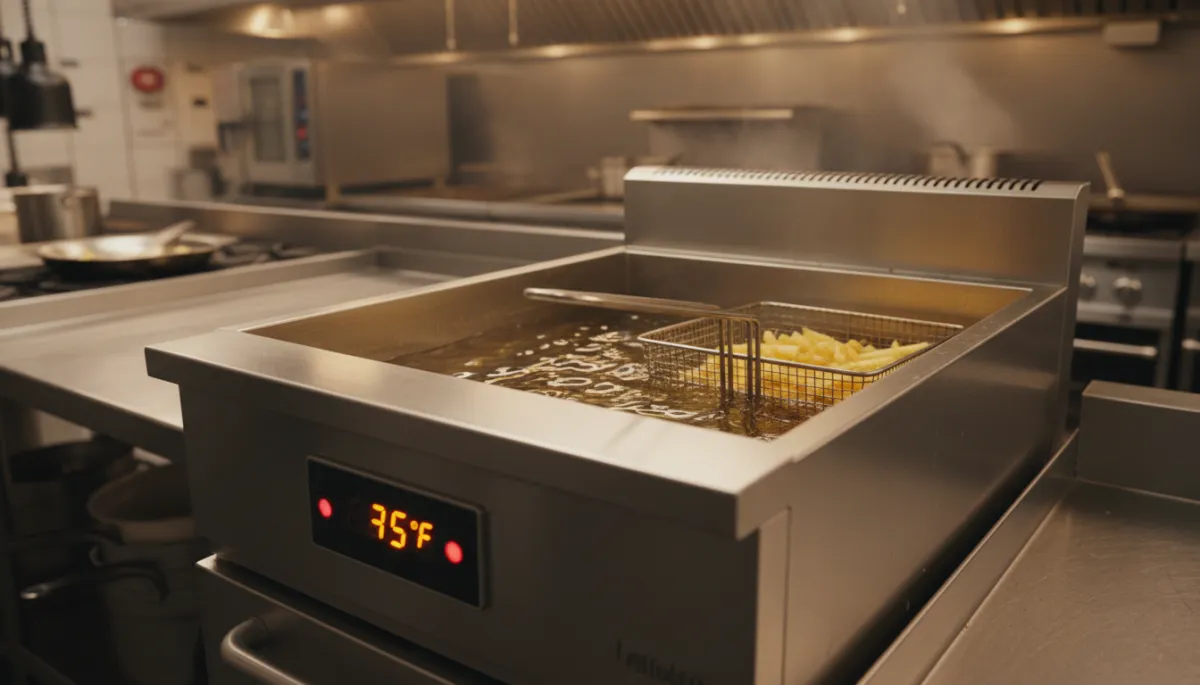
Commercial Fryer Not Reaching Temperature — What We Usually Find in North Mississippi Restaurant Kitchens
Commercial Fryer Not Reaching Temperature — What We Usually Find in North Mississippi Restaurant Kitchens
You're two hours into a Friday lunch rush and your fryer is sitting at 285°F instead of 350°F. Product isn't crisping right, tickets are backing up, and the line is watching the timer. We get these calls all the time from restaurants across Tupelo, Corinth, Booneville, and down into Pontotoc. Nine times out of ten, it's one of the same handful of problems — and most of them aren't as expensive to fix as you'd think.
Here's what our techs look at when a commercial fryer won't reach or hold temperature.
The High-Limit Safety Switch Has Tripped
This is probably the most common thing we find on fryer calls. Every commercial fryer — Pitco SG14, Frymaster MJ45, Henny Penny pressure fryer — has a high-limit switch designed to cut power to the heating system if the oil temp spikes dangerously high. When it trips, the fryer won't heat at all, or will heat slowly and never hit setpoint.
The fix is usually a manual reset button, often located on the back of the unit or behind the front panel. But here's the thing: if your high-limit is tripping regularly, that's a symptom of something else going wrong — thermostat running hot, a failing control board, or an oil volume issue. Don't just keep resetting it. That's how fryer fires start.
Failed or Drifted Thermostat and Temperature Probe
The thermostat probe tells the fryer what temperature the oil is at. If it's reading low — say, 290°F when the oil is actually at 325°F — the control system keeps calling for heat, you run hot, and eventually the high-limit trips. If it's reading high when the oil is actually cool, the fryer cuts off early and you're stuck at 285°F wondering why your breading isn't setting right.
We check it with a calibrated probe. If the thermostat has drifted more than 15–20 degrees from actual oil temp, it's time to replace the probe or the thermostat assembly. On digital fryers like the Henny Penny Evolution Elite, the control board will often throw a fault code that points directly at a sensor issue — which saves some diagnostic time on the bench.
Burned-Out Heating Element (Electric Fryers)
On electric fryers — Vulcan 1ER50 and similar — the heating elements are submerged directly in the oil and work hard every single shift. When one element fails, the fryer still heats, just slowly. It'll run, but it can't recover after you drop a basket during a rush. You'll notice recovery time stretching out — 8 minutes instead of 3 — and product not cooking right by the back half of a busy hour.
We test elements with a multimeter for continuity and proper resistance. A shorted or open element gets replaced. In most cases we can source the part same-day or next-day through our suppliers for the North Mississippi area.
Gas Valve, Pilot, or Igniter Issues (Gas Fryers)
Gas fryers add another layer of failure points. If the pilot won't stay lit or the main burner doesn't ignite reliably, you're not getting consistent heat. It's often a weak thermocouple that isn't signaling the gas valve to stay open. Sometimes it's a partially blocked burner orifice — especially on fryers that haven't been serviced in a while and have accumulated grease and carbon around the burner tubes.
On electronic ignition fryers, a weak spark igniter or a failed solenoid in the gas valve are common. Pitco and Frymaster fryers will often tell you something through pilot light behavior alone: if the pilot lights but the main burner won't kick on when the thermostat calls for heat, that points directly at the gas valve circuit or thermocouple.
Important: If you're smelling gas and can't identify the source, shut the fryer down, turn off the supply valve, and call us before doing anything else. Gas troubleshooting is not a DIY situation.
Sediment and Carbon Buildup in the Fry Pot
This one is almost always a maintenance issue. Breading particles, proteins, and carbonized grease accumulate at the bottom of the fry pot over time — especially in the cold zone below the heating elements on open-pot fryers. That sediment acts as insulation. The heating system works harder, recovery slows, and oil quality drops faster. You're spending more on oil and getting worse food.
Boil-outs should happen at least weekly on high-volume fryers, and the sediment trap needs to be cleaned every shift on busy equipment. If your fryer hasn't been properly boiled out in months, we may find an inch of carbon at the bottom of the pot. That's not just an efficiency problem — it's ruining your oil faster than anything else you're doing wrong.
Degraded Oil Giving You a Bad Reading
Old, heavily degraded oil behaves differently than fresh oil — lower smoke point, different viscosity, and heavy carbon coating on the probe tip that throws off the thermostat reading. We've pulled up on fryer calls where the oil looked like 30-weight motor oil — black, foamy, and way past its useful life — and the owner genuinely couldn't figure out why the food tasted off and the fryer couldn't keep pace.
Change your oil on schedule. Most high-volume operations are looking at daily changes on their busiest fryers, depending on what you're running. Filtering twice a day extends oil life significantly and keeps the fryer running cleaner across the board.
Call S.I. Service Group for Commercial Fryer Repair Across North Mississippi
If your commercial fryer won't reach temperature, is recovering too slowly, or keeps tripping the high-limit, give us a call. S.I. Service Group services commercial kitchen equipment across the 10-county North Mississippi area — Tupelo, Booneville, Corinth, Iuka, New Albany, Pontotoc, and everywhere in between. We work on Pitco, Frymaster, Vulcan, Henny Penny, and most other commercial fryer brands.
We know a fryer problem during the lunch rush isn't something you can wait on. Call us at (662) 594-7734 or visit siservicegroup.com to schedule service.