480V Systems & PLC Repair in North Mississippi
industrial electrician North Mississippi, 480V electrical contractor, Allen-Bradley PLC repair, PLC technician Mississippi, motor control repair Tupelo MS
480V Industrial Systems, Allen-Bradley PLCs, and Motor Controls in North Mississippi: Why S.I. Service Group Is in a Class of Its Own
If you run a plant in North Mississippi, your 480V three-phase distribution, Allen-Bradley PLCs, motor control centers, and VFDs are not “maintenance items” — they are production-critical infrastructure. When they fail, you are not just resetting a breaker; you are making high‑energy decisions that can impact uptime, equipment life, and personnel safety. This is exactly where Dan Southwick and S.I. Service Group operate: at the intersection of power, controls, and real-world industrial reliability.

480V Three‑Phase Systems: High Energy, High Risk, Specialized Licensing
In industrial environments, 480V three‑phase is the backbone of production: large motors, process equipment, compressors, chillers, and MCCs all hang off this bus. Unlike residential 120/240V, a 480V three‑phase system delivers significantly higher fault energy, tighter coordination requirements, and more stringent code constraints. Arc flash incident energy, let‑through current, and coordination with upstream fusing or breakers are not academic; they determine whether a fault is a nuisance trip or a catastrophic event.
This is why 480V work is not for general maintenance staff or residential electricians. Mississippi requires specialized licensing for commercial and industrial work at this level. Dan’s Mississippi License #20095 authorizes commercial electrical work up to $50,000, covering the majority of plant‑scale projects such as MCC additions, panel rebuilds, VFD retrofits, and PLC panel upgrades. More importantly, his field experience on 480V distribution and motor loads means he understands how design decisions translate into production behavior and safety margins on your floor.
Allen‑Bradley PLC Repair and Programming: From Fault Codes to Stable Production
Across North Mississippi, Allen‑Bradley (Rockwell Automation) platforms dominate: SLC 5/03–5/05, MicroLogix, CompactLogix, and ControlLogix are embedded in packaging lines, process skids, and utility systems. When a processor faults, an input card fails, or a network module drops offline, you do not need a generic “controls guy” — you need someone who speaks Rockwell fluently and can move from fault code to root cause without trial‑and‑error downtime.
Dan approaches Allen‑Bradley PLC repair the way a senior software engineer approaches a production outage: gather diagnostics, reproduce the condition, isolate the failing layer, then implement a minimal, testable fix. Using tools like Studio 5000, RSLogix 500, and RSLinx, he traces faults from the controller status to rung‑level logic, then down to field devices and wiring. For example, a common pattern is a VFD “ready” bit dropping intermittently. Instead of simply forcing outputs, Dan will:
- Check controller fault and I/O status bits in the PLC tags or data files.
- Inspect the ladder logic controlling the motor start/stop sequence and interlocks.
- Verify field wiring, control power, and VFD status words over discrete I/O or Ethernet/IP.
A typical diagnostic rung for an Allen‑Bradley motor start can be expressed in structured text, conceptually similar to how a software engineer would write guard conditions:
// Pseudocode / structured text representation of a motor start sequence
IF Start_PB AND NOT Stop_PB THEN
    Start_Request := TRUE;
END_IF;

IF Start_Request
   AND MCC_Bucket_Closed
   AND OL_Trip = FALSE
   AND VFD_Healthy
   AND EStop_OK THEN

    Motor_Run_Cmd := TRUE;
ELSE
    Motor_Run_Cmd := FALSE;
END_IF;

// Capture fault condition for diagnostics
IF OL_Trip OR NOT VFD_Healthy THEN
    Motor_Fault := TRUE;
END_IF;
In ladder logic, the same idea becomes a series of permissive contacts and coils. Dan’s strength is that he treats this logic like production code: clear, commented, and designed for maintainability, so your in‑house technicians can support it after he leaves. That is what “Allen‑Bradley PLC repair” should mean in practice for a PLC technician in Mississippi, not just clearing faults and hoping they do not come back.

Clean PLC cabinets and documented logic reduce mean time to repair during unplanned outages.
Motor Control Centers (MCCs): The Physical Layer Behind Your Logic
MCCs are where 480V distribution meets individual motors. Buckets, starters, overloads, and breakers form the physical execution layer for the PLC’s commands. From a software engineer’s perspective, the PLC is your application code; the MCC is the hardware abstraction layer that actually switches current to your loads. If the MCC is mis‑configured or poorly maintained, even perfect PLC logic will not save you from nuisance trips, locked‑out buckets, or overheating conductors.
Dan’s background as Lead Plant Electrician in Mississippi on 480V systems means he has lived inside MCC rooms: verifying starter sizing, checking overload settings against motor FLA, confirming short‑circuit ratings, and documenting control wiring back to Allen‑Bradley I/O. When he performs motor control repair in Tupelo MS or elsewhere in North Mississippi, he does not just swap parts. He validates the entire chain: utility feed → main distribution → MCC → VFD or starter → motor → feedback into the PLC.
VFD Troubleshooting: Marrying Power Electronics with Control Logic
Variable Frequency Drives are now standard on pumps, fans, and conveyors for energy savings and process control. But they also introduce a new failure surface: DC bus faults, overcurrent, ground faults, communication losses, and parameter corruption. Many plants have VFDs configured once by an OEM and never fully documented, leaving local teams blind when a drive trips under load or refuses to start on a PLC command.
Effective VFD troubleshooting requires a layered approach:
- Power layer: Verify line voltage, grounding, and motor connections. Check for harmonics or supply imbalance affecting multiple drives.
- Drive configuration layer: Confirm motor nameplate data, accel/decel ramps, current limits, and fault response parameters.
- Control layer: Validate digital inputs, analog references, and communication mappings to the PLC (e.g., Ethernet/IP, Modbus).
On the PLC side, Dan often implements explicit fault capture logic so your team can see exactly why a drive stopped. Conceptually, this resembles structured logging in software:
// Pseudocode for mapping VFD status word into discrete diagnostics
IF VFD_StatusWord AND 16#0001 THEN
    VFD_Ready := TRUE;
END_IF;

IF VFD_StatusWord AND 16#0002 THEN
    VFD_Running := TRUE;
END_IF;

IF VFD_StatusWord AND 16#0010 THEN
    VFD_Fault_Overcurrent := TRUE;
END_IF;

IF VFD_StatusWord AND 16#0020 THEN
    VFD_Fault_Overvoltage := TRUE;
END_IF;

// Latch fault for operator visibility
IF VFD_Fault_Overcurrent OR VFD_Fault_Overvoltage THEN
    VFD_Fault_Latched := TRUE;
END_IF;
This kind of structured VFD troubleshooting and PLC integration is what separates a generic 480V electrical contractor from a true industrial electrician in North Mississippi who understands both power and control semantics at a deep level.
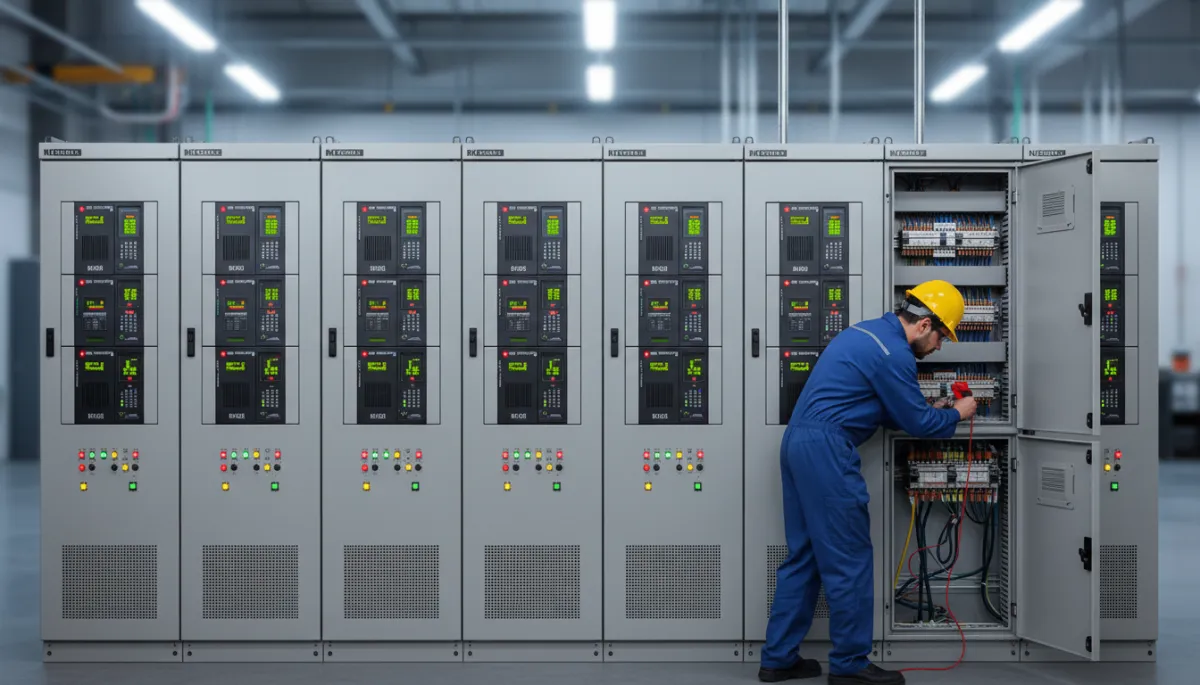
Properly configured VFDs tied into PLC diagnostics prevent repeat trips and unexplained downtime.
Industrial Panel Work: Clean, Documented, and Serviceable
Industrial panels — PLC enclosures, VFD panels, junction boxes, and remote I/O cabinets — are your long‑term “codebase” in copper and steel. Sloppy panel work is the electrical equivalent of unversioned, uncommented legacy code: it may “work” today, but every future change is risky and expensive. Dan’s industrial panel work focuses on:
- Clear segregation of power and control wiring to minimize noise and troubleshooting time.
- Consistent wire labeling tied directly to updated schematics and PLC tag lists.
- Proper component selection and spacing for heat dissipation and code compliance at 480V.
For facility managers and industrial operations directors, this translates directly into lower mean time to repair, easier OEM integration, and a safer electrical environment for in‑house technicians. When you call S.I. Service Group, you are not just getting “a panel wired”; you are getting an engineered, maintainable control asset.
Why Dan Southwick and S.I. Service Group Are Unmatched in North Mississippi
What differentiates S.I. Service Group from other contractors is not just licensing — it is the depth and relevance of Dan’s background to exactly the problems you face in your plant:
- Dual A.A.S. degrees in HVAC and Electrical from Mohawk Valley Community College (Upstate NY), giving him a rare combination of power, controls, and mechanical systems knowledge.
- Trained at the Hood Milk Plant in Oneida, NY during a multi‑million‑dollar expansion, working directly on production‑critical process equipment, controls, and 480V distribution under real schedule and quality pressure.
- Served as Lead Plant Electrician at an industrial facility in Mississippi, owning day‑to‑day reliability for 480V systems, MCCs, Allen‑Bradley PLCs, and VFDs — the same stack most North Mississippi plants run today.
In practical terms, this means S.I. Service Group is operating in an almost completely uncontested niche: there are very few, if any, other industrial electricians in North Mississippi who combine 480V power expertise, Allen‑Bradley PLC programming, VFD troubleshooting, and documented panel craftsmanship under one roof. For facility managers and production leaders, that makes Dan the default escalation path when internal maintenance and generic contractors hit a wall.
FAQ: Industrial Electrical and PLC Support in North Mississippi
Q1: What types of facilities does S.I. Service Group support?
Dan works with food and beverage plants, plastics, packaging, light manufacturing, warehouses with automated systems, and any operation running 480V distribution, MCCs, and Allen‑Bradley PLCs in North Mississippi, including the greater Tupelo area.
Q2: Can you help with legacy Allen‑Bradley platforms?
Yes. S.I. Service Group routinely supports SLC 500, MicroLogix, and older PanelView HMIs, as well as modern CompactLogix and ControlLogix systems. Dan can migrate, clean up, or extend existing logic while maintaining production stability.
Q3: Do you provide documentation and training?
Every project includes updated prints or markups, clear I/O mapping, and, when requested, walk‑throughs with your maintenance team so they can safely support the system after the work is complete.
Q4: Why not just use a general electrical contractor?
General contractors are appropriate for lighting and basic power. For 480V distribution tied to Allen‑Bradley PLCs, MCCs, and VFDs, you need an industrial electrician North Mississippi specialist who understands both the electrical and control layers. That is precisely the gap S.I. Service Group fills.